




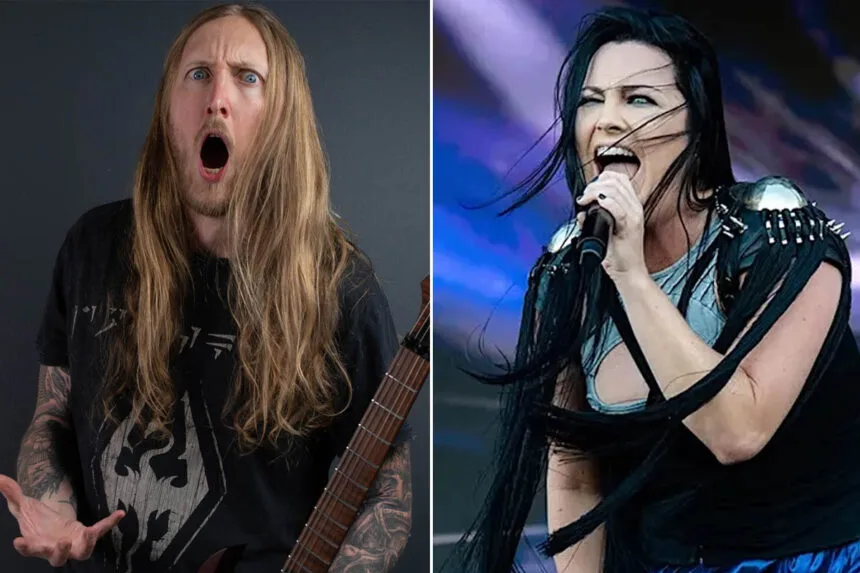
Former Six Feet Under guitarist Ola Englund recently addressed fan claims that Evanescence stole his riff. He responded directly to the accusations in a video shared on his YouTube channel.

Englund responded after fans flooded his inbox with messages alleging that Evanescence’s new single, “Who Will You Follow?”, had lifted the riff from his song “The Sun and the Moon.” He took to YouTube to investigate the claims firsthand and share his verdict.
“All right, this is not going to be an easy video to make, but today I’m investigating one of the biggest riff metal theft in modern metal history,” Englund said. “Not too long ago, the band Evanescence released a new song and single, ‘Who Will You Follow?’ And since the release of that single, my inbox have literally have thousands of messages being sent to me.”
“Actually, it was only four, but you know, it’s a slight detail. There were only four actually. Apparently, Evanescence stole my riff. Sad day. I haven’t listened to the new Evan songs. I’m gonna do that in this video. So, one of the claims said that this is basically the riff in my song, ‘The Sun and the Moon.'”
After comparing the two tracks side by side, Englund acknowledged some similarities but was quick to put them into perspective.
“They’re basically exactly the same tempo,” he said. “Did he actually try to steal my riff? I mean, one thing is that my riff is in a different tuning, but what if I transpose this? Okay, let’s listen now. This is outrageous, you guys. This makes me so incredibly mad. Truth be told, there are some similarities between these two riffs, but I got to say, this riff has been written at least 30 times before by someone else.”
Englund ultimately dismissed the plagiarism claims, wrapping up his response with a lighthearted take on the situation.
“It’s just a repeating f*cking rhythm pattern. And this is not plagiarism,” he continued. “So, no, I don’t think that Evanescence stole my riff, but that’s cute, though. Thank you so much for caring about me. I appreciate that. It’s basically every metal riff right there. Hell yeah. Internet people want blood. I just want to have my coffee.”
The controversy comes at a high-profile moment for Evanescence, as the band is currently in the spotlight ahead of a major new release. This makes the timing of the accusations all the more notable within the metal community.
Amplify Music Magazine reported that “Who Will You Follow?” received its official music video on May 15, 2026. The single serves as a preview of the band’s upcoming album Sanctuary, due out on June 5, 2026 via Sony Music/Columbia. The 12-track record marks a significant return for the GRAMMY Award-winning rock band. The single has been described as a commentary on technology, misinformation, and digital culture. Revolver noted that the music video sees the band bending reality in a visually ambitious production directed by Jensen Noen.
Englund, for his part, is no stranger to the spotlight in metal circles. A Swedish guitarist and prominent content creator, he has built a large following through his YouTube channel, where he regularly posts gear demos, playthrough videos, and commentary on the metal world. His visibility in the community is precisely why fans turned to him first when they believed they had spotted a similarity between the two songs.
Riff plagiarism accusations are far from a new phenomenon in metal and rock music. Disputes over whether a riff has been “stolen” or simply shares genre conventions are a recurring theme across the industry. This is largely because many songs draw from the same foundational elements — palm-muted pedal tones, chromatic movement, and low-register rhythmic figures. In legal and musicological terms, the threshold for plagiarism typically requires substantial similarity in melody, rhythm, and harmonic shape, rather than the mere presence of a few shared notes or patterns.
Englund’s response reflects that broader reality. By pointing out that the rhythmic pattern in question has appeared in countless metal songs before either his or Evanescence’s version, he effectively placed the controversy in its proper context. As he put it, the riff is “basically every metal riff right there” — a sentiment that many musicians and fans in the genre would likely agree with.
Evanescence has not publicly commented on the accusations at this time.