

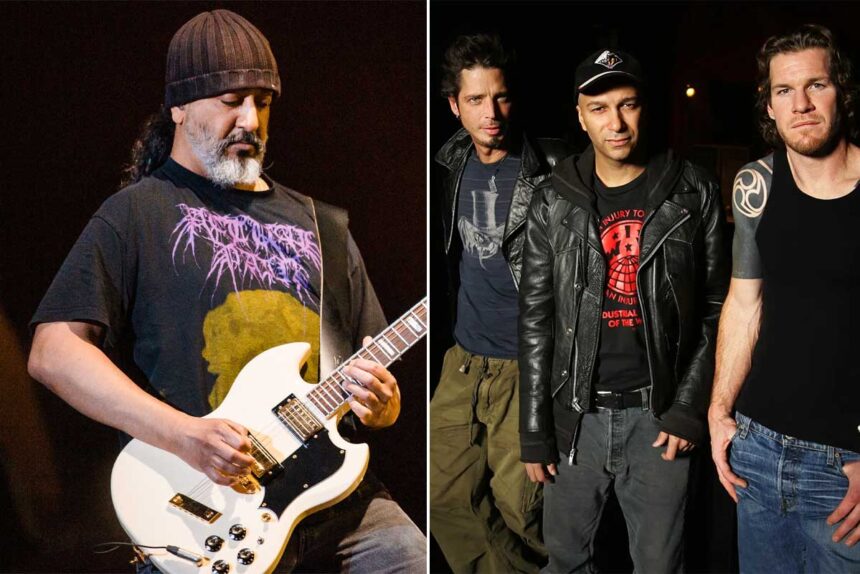
Soundgarden guitarist Kim Thayil recently addressed a notable chapter from his memoir A Screaming Life. He clarified what he meant when he referred to Audioslave as the “Soundgarden Minus,” in an interview shared on Chris Jericho’s YouTube channel.

Thayil was asked directly about the chapter and the phrase, with the interviewer noting: “You mentioned Audioslave earlier and there’s a great chapter in the book where you called them ‘Soundgarden Minus.’ How was that for you when Chris leaves and you guys break up and then suddenly he has this other group like you mentioned a super group which you never really thought was a cool concept to begin?”
In response, Thayil explained that the term was not meant as a slight against Audioslave, but rather a reflection of what he heard — and what was missing — when he listened to the band.
“I mean, I wasn’t really a fan of other super groups,” Thayil said. “I know people refer to Led Zeppelin as basically being a super group, you know, the new Yard Birds, but I didn’t learn of them that way. I was kind of young. They seem to be much bigger than any of those other things.”
“When you know I’ve read that chapter… What I meant by that clearly was that Audioslave didn’t meet what I believe about Soundgarden,” he continued. “It also didn’t meet what I loved and believed about Rage Against the Machine. But that being said, they rocked.”
Thayil then elaborated on the distinct qualities that set Soundgarden apart from a more straightforward hard rock sound.
“There was something about our band that was visceral but limited because it’s AC/DC’s the best at that, right?” he said. “And Audioslave was pretty damn good at that, too. Soundgarden’s kind of weird at that because it’s hard to be physically impactful if your song’s in 5/4. There it can be, but in other ways, we’re kind of cerebral or kind of a little bit psychedelic and emotional.”
“There are a lot of other elements and we’re all weirdos as much as you try to pretend play it cool,” he added. “Even Chris is a weirdo despite how handsome and smooth the guy is. Rage Against the Machine is incredibly visceral and they’re political and whether you agree with the politics or not, it’s impactful. It’s in your face and it’s courageous and when Audioslave came about, there’s a number of factors here.”
Thayil went on to pinpoint exactly what he meant by the word “minus,” acknowledging how the phrase could be misread.
“One, it was a surprise. It’s like Chris’s solo career is one thing. I expect that. But he’s in another band that’s a hard rock band,” he said. “Ultimately what I meant by ‘minus’ was it sounds like Soundgarden take away me, Matt and Ben — you’re hearing Chris, I’m hearing a voice going, that’s Chris, that’s a big part of what Soundgarden is, minus the rest of us. And that’s what I mean by that — Soundgarden minus. And I know when I reread it, it’s like, oh god, that looks like I’m saying that somehow Audioslave’s inadequate.”
“And what I mean is that I’m hearing a hard rock band minus Soundgarden, you know, minus me and Ben, minus those components,” he clarified. “But then if I do have to look at it because it’s been brought up by journalists and friends, I’d say, well, I think Rock World could have benefited from both Soundgarden and Rage Against the Machine going side by side in the world then.”
Thayil’s comments come as part of his broader promotion of A Screaming Life, his memoir reflecting on his career with Soundgarden.
A Screaming Life: Into the Superunknown with Soundgarden and Beyond was published on June 9, 2026, and is co-written with journalist Adem Tepedelen, as Loudwire reported. The book covers Soundgarden’s rise, the quieter years following the band’s 1997 breakup, the 2010 reunion, the band’s final songs, and the aftermath of Chris Cornell’s death in 2017. Loudwire also described it as “an honest, vulnerable account of the pressures of success as a band grows in popularity.”
Salon noted that Thayil does not shy away from difficult subjects in the memoir, including the band’s 1997 breakup and Cornell’s death by suicide in 2017. The publication highlighted how the book addresses Cornell writing songs in the wake of Andy Wood’s death by overdose, tying personal grief to the creative process that defined Soundgarden’s early years. That candor makes the “Soundgarden Minus” chapter all the more significant — it is part of a larger, unflinching look at the band’s legacy and the forces that pulled it apart.
90 The Original described the memoir as “more than a memoir.” The outlet called it “a meditation on creativity, perseverance, and the unpredictable ways in which small decisions can grow into cultural movements.” That framing helps explain why Thayil’s reflection on Audioslave reads less as a critique and more as a reckoning with what Soundgarden was, and what it meant to hear Cornell’s voice in a different context.
The formation of Audioslave itself underscores why Thayil’s phrasing felt so loaded. After Soundgarden disbanded in 1997, Cornell eventually joined forces with Tom Morello, Tim Commerford, and Brad Wilk — the three remaining members of Rage Against the Machine — to form Audioslave. As Salon noted, the band was built around Cornell as a vocalist fronting musicians from another established group. That is precisely what made Thayil’s “Soundgarden Minus” label so pointed: Audioslave was not a continuation of Soundgarden, but a new supergroup in which Cornell’s voice was the most recognizable thread connecting the two worlds. For Thayil, hearing that voice without the rest of Soundgarden around it was, by his own admission, the entire meaning behind the phrase.