



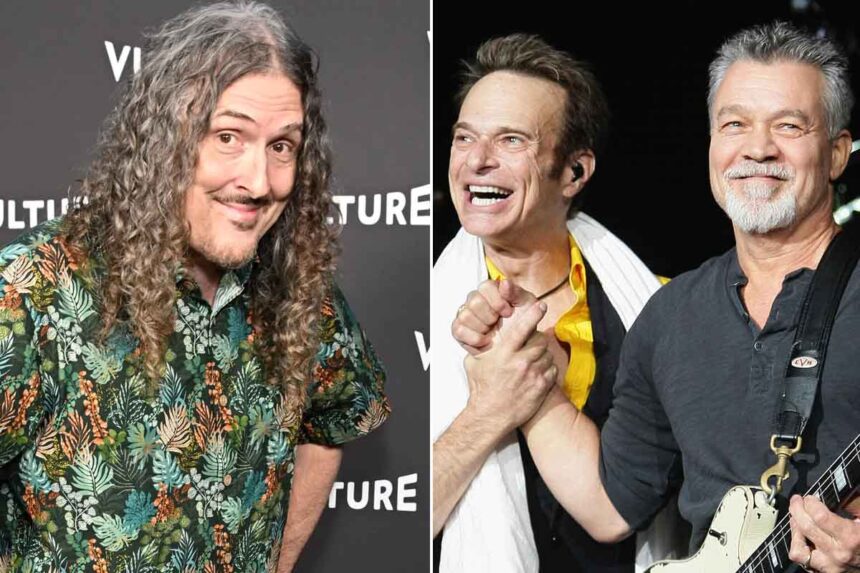
Weird Al Yankovic recently revealed how he adapted Van Halen’s famous “no brown M&M’s” rider rule to build his iconic Hawaiian shirt collection. He shared the story on Rock & Roll High School.

The musician explained how he transformed Van Halen’s safety-focused contract requirement into his own creative merchandise strategy.
“Van Halen had the thing where they had no brown M&M’s in their rider, which they say they did for safety concerns, sort of like the canary in the coal mine thing,” Yankovic said. “Well if you don’t get that right how are you going to get everything else right…”
Yankovic then described how this inspired his own approach to concert riders.
“But I was just thinking, ‘Oh, you can ask for free stuff, great: give me a free tacky Hawaiian shirt for every show that I do,'” he continued. “That year I did 200 shows, so I got 200 shirts. That was a jump start for my collection.”
This revelation provides insight into how the parody artist’s signature wardrobe style began as a practical business decision inspired by rock legends.
The Van Halen M&M clause has become one of the most famous examples of strategic contract design in entertainment history. What many people don’t realize is the sophisticated thinking behind this seemingly trivial demand.
Safety Dimensions reported that the brown M&M clause was buried deep in Van Halen’s technical rider as Article 126. It was hidden among detailed production and safety requirements. This placement was intentional, serving as a quick attention test for venue staff who needed to follow complex setup instructions.
The strategy proved effective in identifying potential safety hazards. Business of Software noted that David Lee Roth explained if the M&M request was ignored, the band would inspect the entire setup more closely. This was because it suggested the venue may have missed other critical safety instructions.
Van Halen’s approach demonstrated how seemingly absurd contract clauses could serve serious operational purposes. The band’s elaborate stage productions required precise technical execution. The M&M test helped ensure venues paid attention to every detail that could affect performer and audience safety.
Yankovic’s adaptation of this concept shows how creative professionals can learn from established industry practices while making them their own. His Hawaiian shirt collection became both a practical wardrobe solution and a defining element of his public persona. This proves that even borrowed ideas can lead to authentic self-expression.