





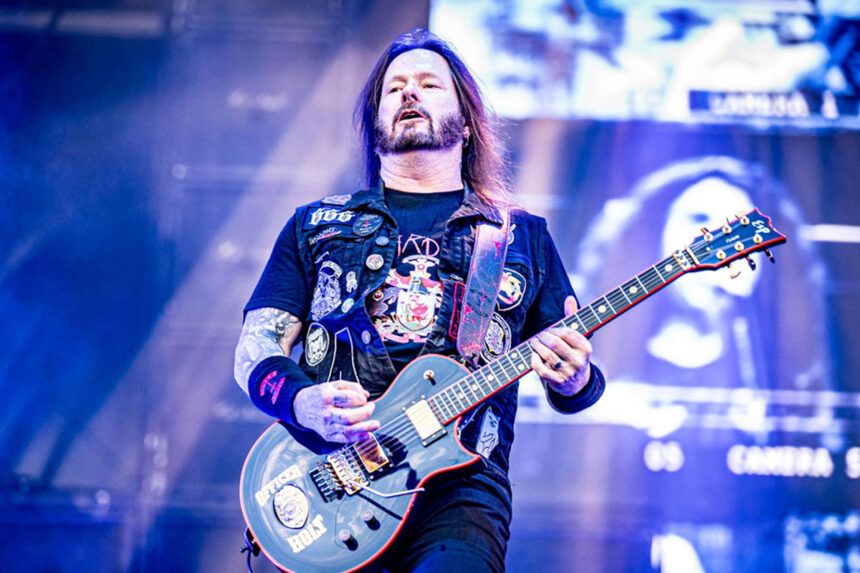
Exodus guitarist Gary Holt recently addressed the band’s exclusion from the Big Four of metal. He explained his perspective on the matter in an interview with Guitar World.

When asked about Exodus potentially being considered among the Big Four studio survivors alongside Metallica, Anthrax, and Testament, given Slayer and Megadeth’s retirement from recording, Holt offered a candid response about his feelings on the topic.
“I’ve never concerned myself with the Big Four,” Holt said. “I always felt like we’re the holders of the torch anyway. People ask, ‘Do you feel upset you were left out?’ And my answer is always the same.”
The guitarist emphasized his confidence in Exodus’s historical significance in the metal scene.
“I know where I was when this was invented,” he continued. “And I know where other people weren’t. That’s enough for me. I don’t need someone else to rewrite history because I was part of it.”
Holt’s comments reflect his stance that Exodus has always been a torchbearer in the thrash metal genre, regardless of official recognition or categorization.
Holt’s confidence in Exodus’s legacy stems from the band’s foundational role in the Bay Area thrash metal movement. Guitar World reported that Exodus formed in Richmond, California in 1979. This placed them among the earliest bands associated with the thrash metal movement alongside Metallica.
The band’s historical significance extends beyond their early formation. Holt has been with Exodus since 1981 and is recognized as the only member to appear on every Exodus studio album. He serves as the band’s key songwriter and guitarist throughout their career. This consistency has helped maintain the band’s creative vision and musical identity across decades.
The Big Four of thrash metal—Metallica, Slayer, Megadeth, and Anthrax—achieved mainstream recognition. However, Exodus are often described as part of the Bay Area’s “Big Six,” which includes Testament, Death Angel, Laaz Rockit, and Forbidden. This broader categorization acknowledges the depth of talent that emerged from the Bay Area scene during thrash metal’s formative years.
Unlike Slayer and Megadeth, who have stepped back from recording new studio albums, Exodus continues to actively create and release new music. Guitar World noted that the band remains focused on writing, recording, and touring as an ongoing creative mission. They refuse to become merely a legacy act. This commitment to new material distinguishes them from some of their contemporaries who have shifted toward retrospective touring.
The band’s recent album “Goliath” exemplifies their continued creative drive. Holt maintains that Exodus has nothing to prove but continues pushing forward with new material. This approach reinforces his earlier statement about carrying the torch. The band demonstrates their commitment to thrash metal’s evolution rather than simply celebrating its past.


