






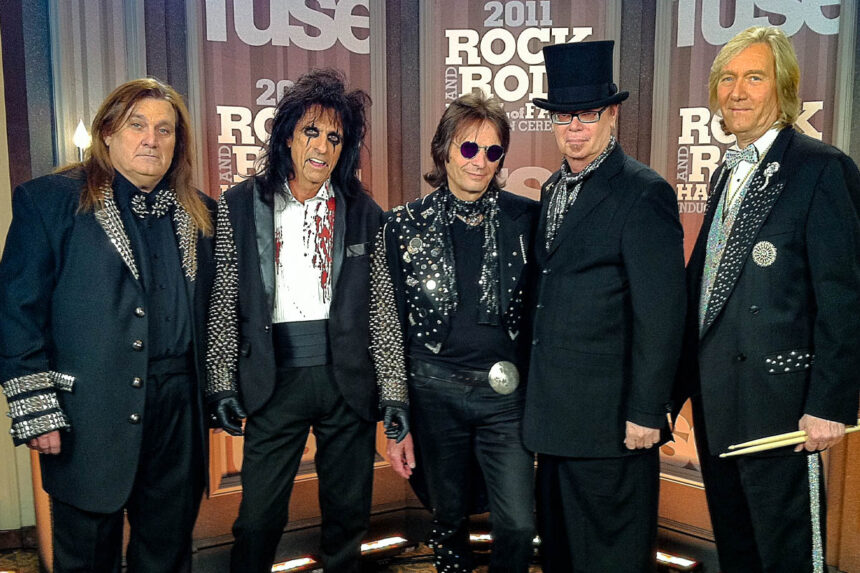
Alice Cooper has opened up about his biggest regret over the 1974 breakup of the original Alice Cooper Group. The rock legend discussed the decision to dissolve the band and the relationships that survived it.

The remarks centered on how the group reached a point where it could no longer continue. They also touched on Cooper’s wish that he could have brought some of his bandmates along with him. When asked about the band and the differing opinions about what happened, Cooper gave his side of the story.
“And you know and it believe we went to high school together. We ran track and cross country together. We did everything together. It got to a point where we hit a wall, and nobody wanted to say it. But we couldn’t go further,” Cooper said.
He went on to describe his motivation for keeping the Alice Cooper name alive. He also addressed a claim made in a former bandmate’s book.
“And to me, it was like, I don’t want Alice to die, so I’m going to keep Alice going. That’s all there was to it. I think in Dennis’s book he said something about well Alice was chasing the money. I had no honest in all money never even was in my thoughts. It was the fact that I did not want Alice to die and Alice was dying a slow death in the business,” he said.
Cooper added that he would have preferred to keep some of his bandmates with him as the act moved forward.
“And I felt if I could have taken Dennis and Neil with me I would have done that. I just you just couldn’t. There was there was other things going on in the band. One, you know, there was just it needed a whole new life. Alice needed another life,” he continued.
Reflecting on the split, he emphasized that the band members never became enemies.
“And to this day, I mean, you know, we never were enemies. There were no lawsuits. There was no bad blood. It just we didn’t really divorce as much. We separated,” Cooper said.
Cooper has said he regrets not being able to take bassist Dennis Dunaway and drummer Neal Smith with him into the next stage of his career. He has repeatedly described the split as a separation rather than a divorce, and he maintains that the band left behind no lawsuits and no lasting feud. The comments add to a long-running debate over why one of rock’s most theatrical acts ended at the height of its fame.
By 1974, the group had reached a creative and personal standstill. Cooper has described the band as dysfunctional and no longer on the same page by the time the Muscle of Love album was finished. That record did not match the chart success of its predecessor, and the members stepped away from one another soon afterward. Cooper then continued under the Alice Cooper name as a solo act.
The history of the group stretches back to Phoenix, where Dunaway and a young Vince Furnier, who would later change his name to Alice Cooper, formed a band as teenagers. The group played prisons, cowboy bars and teen clubs before it became a major force in rock. Dunaway later told that story in his memoir Snakes! Guillotines! Electric Chairs!, which also covers how the breakup was long misunderstood.
Dunaway has written about how the split felt from the other side of the stage.
“After ten long, hard years, it appeared that Alice Cooper had ceased to be ours. Everything that we had created for that name had slipped through our fingers,” he wrote.


