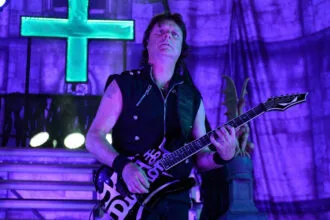






SIXX:A.M. vocalist James Michael revealed a story about industry pressure and songwriting credits in a recent video on his YouTube channel.

He described an incident involving a song written for an ‘American Idol’ contestant’s debut album. A prominent producer attempted to pressure him into sharing writing credits without making any creative contribution.
“I remember one time I had written a song for one of the ‘American Idol’ contestants who had done very well in that show and was getting ready to release their first album,” Michael said. “And I don’t wanna mention names, but a very well-known artist.”
The situation took an unexpected turn when the producer’s team contacted him.
“And I’d written a great song for them. And the record label and the management company loved it and were very excited about it. Now, there was a big-name producer [who] was producing this album. And one day I got a call from the producer’s assistant saying, ‘Hey, the producer wants a writing credit on this song,'” he continued. “And I said, ‘Oh. Well, okay, what did they change?’ And the person that I was talking to kind of sat there for a second and they were, like, ‘Uh, I’m not sure. I’ll get back to you.’ So they got back to me a couple hours later and said, ‘No. They didn’t really change anything. They like the song the way that it is, but since they’re producing it, they want a writing credit on this song.'”
Michael firmly defended his position on the matter.
“And I was just floored by that. I thought, ‘Well, how do you justify asking for a writing credit if you didn’t write something on the song?’ If you’re the producer, you’re getting paid to produce the song,” he stated. “If you have an idea for the song, then by all means, I’m open to you adding your idea to the song, if it makes it better, and then, of course I would share writing credit with you, but that was not the case in this particular situation. This was just a big-name producer wanting a writing credit because he knew that’s where the money was. And I just said no.”
Michael stood his ground and kept his full writing credit. “And you know what happened? The song went on the album, I got the writing credit and everything turned out okay. But the point is this producer was trying to bully me into giving him a credit. He knew that I needed that songwriting cut more than he did, and so he used his power to try to persuade me to cave, to basically give in to him. And I didn’t,” he concluded.
The incident exemplifies a broader issue within the music industry regarding songwriting credits and creative recognition.
Records from Country Music News International showed Michael’s extensive work with American Idol contestants from 2003 to 2007. He established himself as a key contributor to the show’s musical output during its peak years.
Producers seeking writing credits without creative input remains an ongoing challenge in the music industry. The situation highlights the complex relationship between production work and songwriting contributions. Industry standards now emphasize that writing credits must reflect actual creative input to the song’s composition.
Writing credit disputes have grown more frequent as publishing rights increase in value. The industry continues to develop clearer guidelines for protecting songwriters and ensuring fair attribution of creative work.
Michael’s stand against industry pressure demonstrates the importance of protecting creative rights. His experience serves as an example for songwriters who must safeguard their work and ensure proper compensation.