






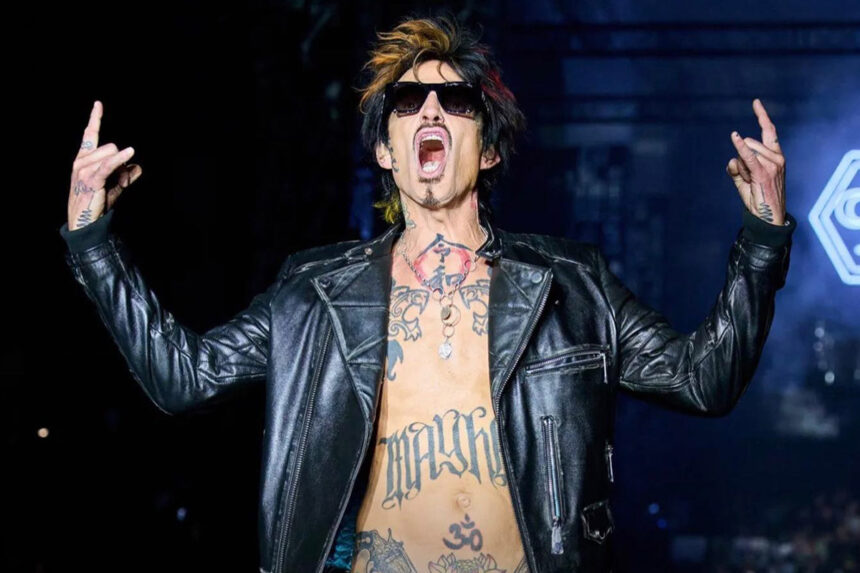
Mötley Crüe drummer Tommy Lee recently opened up about his secret ballet dancing career and the backlash he faced from schoolmates when it was unexpectedly exposed, in an interview shared on the Zac Sang Show.

Lee explained how his journey into dance began unexpectedly and eventually led him to take both tap and ballet lessons — all while keeping it hidden from his peers.
“My sister was taking ballet lessons and I went with my mom and her one day just to check it out,” he said. “And in the next room over, there were tap dancers. Immediately, I was like, ‘Whoa. This is cool. They’re basically playing beats with their feet.’ I was like, ‘What?! I think I might have some fun with this. This is cool.’ And I eventually started taking tap dancing.”
Lee then described how his curiosity led him to add ballet to his routine, partly inspired by professional athletes who had done the same.
“Then, I realized, cause the ballet classes looked cool and all the girls were super cute and I was like, ‘Why don’t I try it?'” he continued. “And at that time, I’d heard like some professional athletes had done it, some running backs had taken ballet for agility and timing and all that stuff and I was like, ‘Why not?'”
Despite his enthusiasm, Lee was careful to keep his dancing a secret — until a local newspaper blew his cover.
“I never told anybody in school cause I’m gonna get fucking railed by my boys,” he said. “And it happened. I kept it super low key and then it came out one day in the town paper. There was a dance recital performance and it was a picture of me in fucking white tights and a girl in one of these finished poses for the show that was coming up. And that day I went to school and I got such shit.”
Lee recalled the taunting he received from classmates and how he fired back with a sharp response.
“They were like, ‘Oh, dude, you doing ballet, bro? What are you gay?'” he said. “Like, you can just imagine. And I’m like, ‘No, dude. As a matter of fact, you f*cking spanking guys asses out on the football field and snapping dudes in the shower while I’m dancing with girls. Your shit’s gay, bro.'”
“So, I shut it down pretty quickly,” Lee added. “But it’s funny like, I guess you could call it bullying but it was just at that time, it was like — if you’re doing ballet dancing you’re gay.”
The candid remarks offer a rare glimpse into Lee’s early life before his rise to fame as one of rock’s most iconic drummers.
What makes the revelation particularly striking is that dance wasn’t just a passing hobby for Lee — it appears to have played a meaningful role in shaping the very skills that would define his career behind the kit.
Loudwire reported that Lee took both tap and ballet classes for a couple of years growing up. While he thoroughly enjoyed the experience, he was equally aware of the social risks it carried at the time. He has since credited those lessons with improving his drumming, saying the training helped his sense of rhythm and timing by “one hundred percent.”
Lee’s early musical instincts were evident long before Mötley Crüe made him a household name. Wikipedia notes that he received his first drumsticks at age four and later played in the marching band at Royal Oak High School — where he also met future bandmate Vince Neil. He eventually dropped out to pursue music full-time with the L.A. club band Suite 19. The dance training, it seems, was just one piece of a broader and unconventional musical education.
Lee’s mention of professional athletes using ballet for agility and timing also reflects a well-documented trend in sports. Running backs and other athletes have long turned to ballet to sharpen their footwork, balance, and body awareness — disciplines that translate just as naturally to the drum kit as they do to the football field.
Screamer Magazine highlighted that Lee found a particular connection between tap dancing and drumming from the very beginning. He was drawn in by the idea that dancers were essentially “playing beats with their feet.” That instinct — to hear rhythm in movement — speaks to the same musical sensibility that would later make him one of the most recognizable drummers in rock history.
The interview ultimately reframes what Lee’s schoolmates once mocked as a source of embarrassment into something far more significant: an early, unconventional foundation for a legendary career.


