





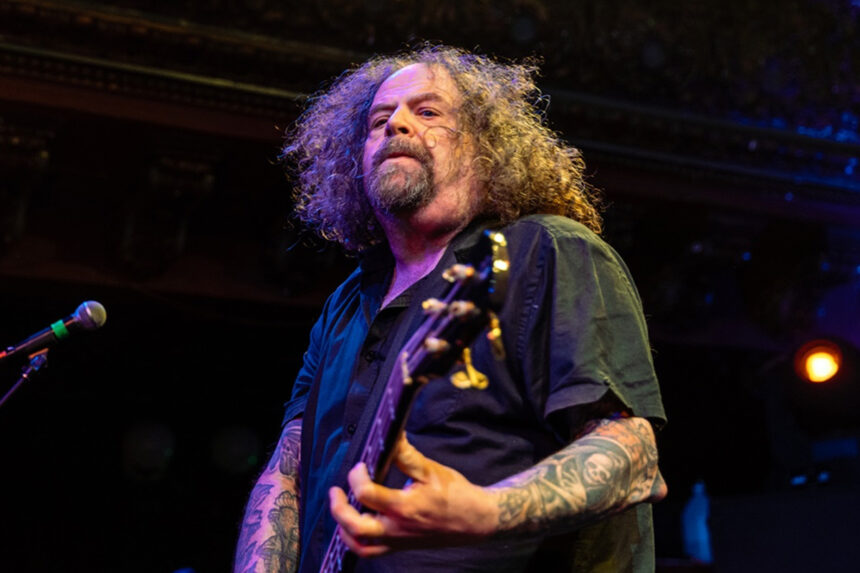
Napalm Death bassist Shane Embury has opened up about the health struggles that led to his absence from some of the band’s recent tours. He shared his story in a candid interview on The False Face show.

Embury spoke at length about his ongoing battle with pancreatitis and alcohol dependency. His account revealed the physical and mental toll that years of heavy touring had taken on him.
“I’ve been on and off probably for a long time. My health’s been generally okay. I’ve been very lucky, really, because I’ve had what they call pancreatitis. I’ve had that, like, three times in my life at various stages, and I’ve been hospitalized three times. And [I’ve been] quite lucky to bounce back as I have done,” he said.
Embury went on to address the root cause of his condition and how it resurfaced in recent years.
“I developed pancreatitis through drinking. You don’t like to think that you’re a, quote-unquote, alcoholic. You go, ‘Ah, no, I’ve got a handle on it.’ You think you have because you go on tour and you come back, and then you switch it off. I hadn’t drank for a long, long time. But the last few years, it kind of crept back in again, and loads of other different issues were going on for me,” he continued.
He then described a particularly difficult moment during the Melvins tour, which ultimately forced him to step away.
“And last year was pretty hardcore on the Melvins tour. I got about three weeks into it and I had to leave. It could have gone really bad. I’m in a much better place now than I was this time last year, that’s for sure — mentally, physically, everything. I bounced back, so to speak, relatively quickly. They do say alcoholics are very sturdious in that respect. And I went to some AA [Alcoholics Anonymous] meetings, which I’d never done before, and I found that kind of interesting from multiple perspectives of listening to them talk and reading The Big Blue Book, as they call it. And [I went], ‘Okay, I recognize myself in these pages.'”
Embury also spoke about the psychological work he has been doing alongside his AA involvement.
“I’m also kind of into my Jungian psychology [psychological theories and practices developed by Swiss psychiatrist Carl Jung], which is an ever-learning experience. You can’t sort of take it, quote-unquote, for you, because every person’s different. But the whole looking at your inner shadow and your persona, and the ego and various things. So together, with the AA, I felt a bit more armed this time towards trying to work it out. And then, of course, the life on the road’s very different to life at home,” he said.
He reflected on the concern shown by his bandmates and the deeper questions he has been asking himself.
“The Napalm boys, they’re very supportive. They were worried about me. They probably didn’t wanna wake up and find me dead in the bunk. No one would like that, of course. [And it was] quite irresponsible, I think, of me as well, really. But then I go, ‘What the hell was driving me to go out [and abuse my body like that]?'” he said. “Because on the surface, you can say, ‘Well, you’re quite a successful character.’ I have my family, I have multiple projects, so why are you pushing yourself to such extremes? So that’s kind of been a bit of a quest, what’s triggering me before all that shit.”
Embury ultimately pointed to the sheer volume of touring commitments as a key factor in his burnout.
“I mean, it’s not so much Napalm Death as the fact that at one point I was touring with four or five bands, just pushing, pushing, pushing, pushing. And I think sometimes you get burned out. And sometimes your body has to tell you — maybe — or your inner spirit or whatever. But if you try to ignore it, it will knock on you and go, ‘Look.’ So that was that, really. So, yeah, I’ve been reassessing what’s going on, really,” he concluded.
Embury’s comments offer a rare and honest look into the personal challenges he has faced. They suggest he is now taking a more measured approach to his health and career going forward.
His willingness to speak openly about addiction and mental health marks a significant moment, particularly within a genre that has historically placed little emphasis on vulnerability. The physical and psychological demands of relentless touring have long been a silent but serious issue for musicians across generations, and Embury’s story is not an isolated one in the world of heavy music.
Shane Embury is one of the founding members of Napalm Death and has been with the band since the mid-1980s. He played a central role in shaping the grindcore genre. His contributions extend well beyond Napalm Death, with involvement in numerous side projects over the decades, reflecting a career built on an extraordinary level of creative output and musical commitment.
Pancreatitis is a serious and potentially life-threatening condition in which the pancreas becomes inflamed, often as a result of prolonged alcohol use. Repeated episodes, as Embury has experienced, can cause lasting damage to the organ and significantly increase the risk of further complications. His recovery is all the more remarkable given the severity of what he has endured.
Alcoholics Anonymous was founded in 1935 and remains one of the most widely recognized peer support programs for alcohol dependency worldwide. Its foundational text, commonly referred to as The Big Book, outlines a twelve-step recovery framework. It has helped millions of people confront and manage addiction over the decades.
Jungian psychology is rooted in the work of Swiss psychiatrist Carl Jung. It places particular emphasis on self-examination, the unconscious mind, and the concept of the “shadow” — the hidden or repressed aspects of one’s personality. Its application in addiction recovery has grown in recent years. Many practitioners now incorporate Jungian principles alongside more traditional therapeutic approaches to help individuals understand the deeper psychological drivers behind destructive behavior.