
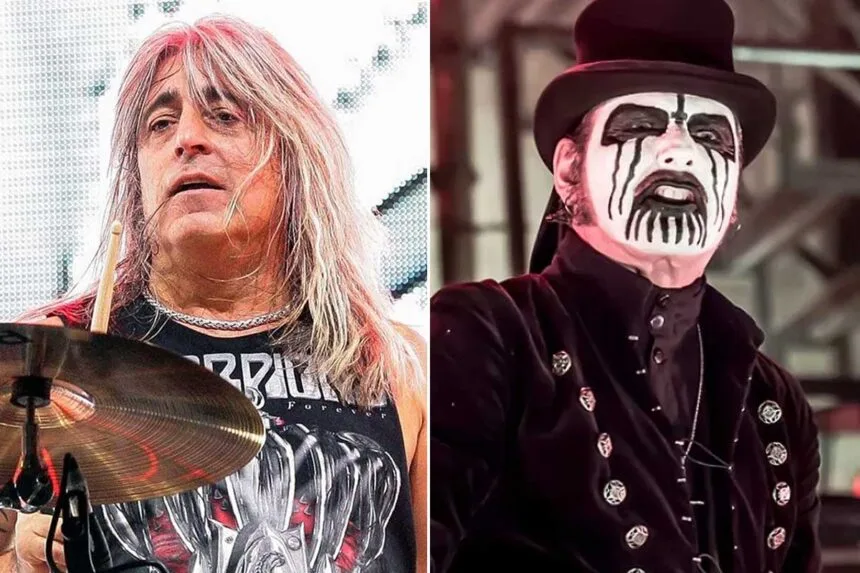
Mikkey Dee has opened up about his departure from King Diamond and his decision to turn down Motörhead’s first invitation to join the band.

The drummer reflected on his time with King Diamond, explaining how the band’s dynamic shifted in the late 1980s and ultimately led him to walk away.
“It was in the King Diamond days – 1984 and forward – that I started to get a decent salary for what we were doing. We had a blast. We were a great band, with great camaraderie, and we all pulled in the same direction,” he said. “King was a really nice man, but by ’88 I thought that things were changing for the worst, which is why I left the band. It seemed to me that King took his own horse and rode away and left us a little bit. We were no longer like a fist, like a bunch of mates, and that pissed me off because it was not a great feeling.”
Dee went on to describe the personal frustration that pushed him toward the exit.
“I started to feel like a background drummer, if you will. So I said, ‘Look, I’m not having that much fun, and I feel very narrow as a drummer, technically, so I’m going to depart’. So I did.”
He also addressed the lesser-known story of Motörhead’s first approach, which came years before he eventually joined the band.
“We were touring together with Motörhead, I believe it was ’86, and I actually got offered to join the band. Phil Taylor was in the band, and he did okay, but I don’t know what the deal was because Lemmy loved Taylor but I think he had a little bit of a problem with his drumming. They actually called me up after that tour and I respectfully turned them down. I didn’t think I was ready for a band like Motörhead. I hadn’t earned my stripes on my shoulders yet. I didn’t have enough fucking spunk, really.”
Despite declining the offer, Dee revealed that his connection with Lemmy Kilmister never faded.
“After I respectfully turned Motörhead down, we maintained contact. In fact, Lemmy would send me postcards from all over the world, which were pretty funny. The postcards were just little notes that said things like, ‘Hey Mickey, we’re in Toronto’, and nothing else. Okay… Three weeks later, ‘Mickey, we just landed in Sydney’. Then, ‘I hope you’re doing great, we’re in Budapest’. So we just kept contact over the years. The tie between us was never severed.”
That enduring bond between Dee and Lemmy would prove to be more than sentimental. It set the stage for one of heavy metal’s most celebrated drummer-band partnerships, one that would define the final and arguably most powerful chapter of Motörhead’s legacy.
Dee joined Motörhead in 1992, replacing Phil “Philthy Animal” Taylor permanently after years of on-and-off contact with the band. He remained with Motörhead until its dissolution in December 2015 following Lemmy’s death. During that time, he played on 13 studio albums and cemented his place as one of the most iconic drummers in the band’s history. His tenure spanned over two decades and is widely regarded as the period in which Motörhead’s live performances reached their most ferocious peak.
Born Micael Kiriakos Delaoglou in Gothenburg, Sweden, Dee had joined King Diamond in 1985 and appeared on three studio albums — Fatal Portrait (1986), Abigail (1987), and Them (1988). His departure after the Them touring cycle was not the result of personal conflict. It stemmed from a growing creative dissatisfaction, as he felt he had been reduced to a supporting role rather than functioning as an equal contributor within the band.
Since 2016, Dee has been the official drummer for Scorpions. He stepped into the role after stepping back from a planned commitment with Thin Lizzy to accommodate his schedule with the German metal legends. Now in his seventh decade of life, he has stated that he feels he plays better than ever. His work with Scorpions has kept him firmly at the forefront of hard rock’s live circuit.
Most recently, Dee reunited with several of his former King Diamond bandmates — including Andy La Rocque, Pete Blakk, and Hal Patino — in a new side project called Lex Legion. The group’s self-titled debut album was released in 2026. The project marks a full-circle moment for a drummer whose career has taken him from the theatric darkness of King Diamond’s world to the stadium-filling power of both Motörhead and Scorpions, without ever losing the drive that made him walk away from comfort in search of something greater.
Source: Kerrang!