




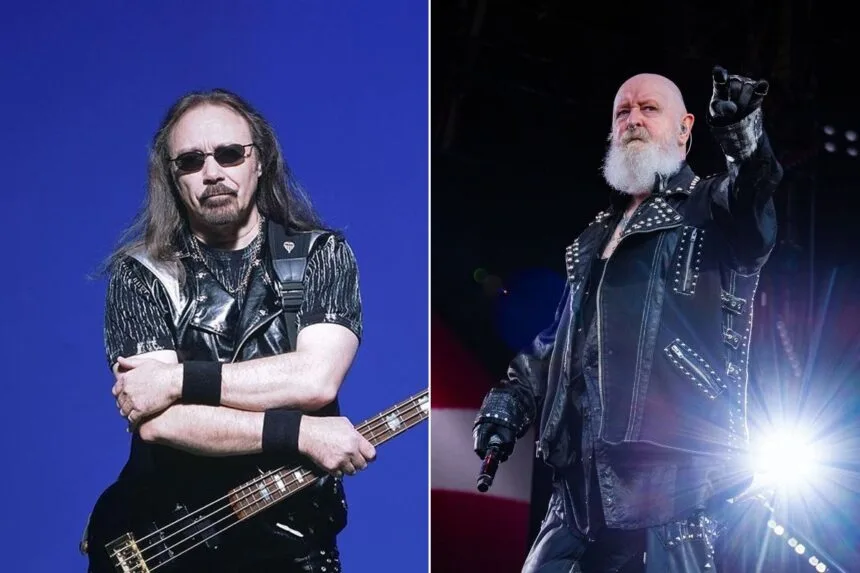
Ian Hill, the longest-serving member of Judas Priest, has explained the health issues that led to his recent decision to retire from the band in an interview with Metal Pilgrim.

Hill talked about the physical problems that made it difficult for him to continue playing. He described how a shoulder injury and arthritis in his thumb have caused him pain over recent tours, and how a specific incident during a heavy touring schedule forced his hand.
“It is funny, because the last couple of tours have been a bit of a struggle, because this trouble is basically my shoulder and my thumb — [I’ve got a] great big lump on my thumb, which is all arthritis,” Hill said. “I’ve been struggling with that for the past couple of tours or so. And it doesn’t go away, unfortunately, and it’s one of those things that just gets worse as time goes by. And I almost retired at the end of the last tour.”
Hill explained how a planned tour with another band turned into a grueling schedule. “It’s funny the way it came about. Iron Maiden said, ‘Do you fancy doing a four-week tour of America this year?’ And I said, ‘Well, yeah, that sounds okay, a four-week tour of America, quick four weeks.’ Then they pulled out. In the meantime, we’d put in Bloodstock in Britain, which is the festival in Britain.”
“So you can’t tool up to do one show. So the next thing, ‘Oh, we’ll do one or two dates in Europe around Bloodstock.’ And nine weeks later… And that’s what did it. We did six shows in eight days. That was running up to Brussels, so that’s when the tendon snapped. Because we were averaging maybe a day on, a day off, day on, day off, so the crew could get to the next gig and what have you. And, of course, it was recovering on the days off.”
The injury worsened during the intense schedule. “Obviously, I wasn’t doing anything, so it recovered. And then, of course, you go on stage and you aggravate it all over again. But then it was sort of, like I say, six shows in eight days, and I’d never had time to recover. And right before the encores on the Brussels show, I just felt a snap and a real sharp, searing pain, and I thought, ‘That’s it. That’s the end of it.’ And for the encores, I had to actually get my elbow and rest it on my stomach and pull the bass back so I could get down to the bottom of the neck.”
Hill described his recovery and the extent of the damage. “And it’s easing off a lot now. I can sort of lift it and do things that I couldn’t do immediately after that. I mean, I couldn’t move it at all. From the elbow down, everything was fine. It worked a treat, but I just could not move my shoulder. And that’s why I had to miss the London show. I physically could not play the bass.”
Hill said his decision to retire was also driven by concerns for those around him. “So I had no choice, really, than to knock it on the head,” he continued. “I couldn’t put the rest of the guys in jeopardy and go out on another tour, and it happen all over again in the middle of a tour. It’s not fair on anybody — the fans, the rest of the guys, the people have put money into us to get us out to these places, and suddenly you’re having to cancel shows and things. It’s not fair. So I decided to call it a day, and I have. I’ve neglected family life. It’s cost me two marriages over the years. So I decided to spend a bit of time with the folks.”
Hill’s comments came as he publicly confirmed his retirement from Judas Priest after decades with the band.
Hill’s decision marks the end of an extraordinary era for Judas Priest. He joined the band in 1970 alongside K.K. Downing, becoming part of the heavy metal pioneers before Rob Halford arrived in 1973 and Glenn Tipton in 1974. Hill and Tipton are the only two members to have appeared on all of the band’s studio albums, from 1974’s Rocka Rolla through 2024’s Invincible Shield, and Hill appeared at nearly 3,000 concerts during his tenure.
Hill became the band’s longest-tenured member after Downing left in 2011. In 2022, he was inducted into the Rock and Roll Hall of Fame alongside his Priest bandmates, cementing his legacy as one of the most important figures in the band’s history. Beyond his work with Judas Priest, Hill has also been credited with bringing Rob Halford into the band, as the two met when Hill was dating Halford’s sister.
The specific incident that ended Hill’s career occurred on September 18, 2026, during a concert in Brussels, Belgium. Hill’s shoulder tendon tore during the Brussels show, forcing him to miss Judas Priest’s concert at Eventim Apollo in London on September 21, 2026, the first show he had missed since joining the band in 1970. The grueling touring schedule leading up to this point—with six shows in eight days—left him without adequate time to recover between performances.
Hill will be succeeded by Davey Rimmer, a bassist who has played with Uriah Heep since 2013 and also performs with Elegant Weapons alongside guitarist Richie Faulkner. Rimmer was prepared to step in after learning the setlist as a precaution and took over for the London concert following Hill’s injury. Despite stepping away from live performances, Hill contributed bass parts to the band’s new album, ensuring continuity for Judas Priest’s recorded music going forward.


