
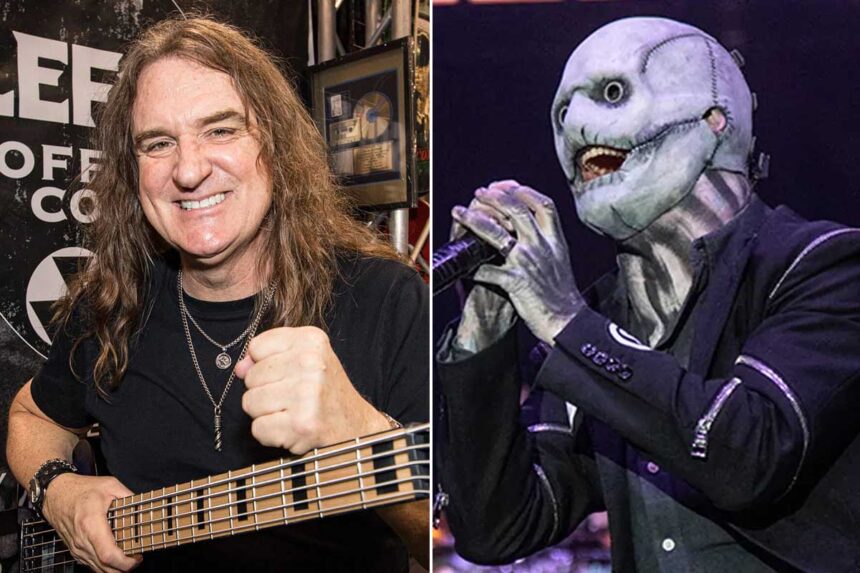
Former Megadeth bassist David Ellefson recently discussed his diverse career activities during his time away from Megadeth. He revealed his behind-the-scenes involvement in helping shape the rise of major bands like Slipknot and Nickelback in their early years, as shared in an interview with Rock Kommander.

Ellefson explained how his work in artist relations at Peavey allowed him to connect with emerging bands that would later become major rock acts.
“For me, I had spent a lot of time concentrated in Megadeth during the ’80s and ’90s. In the 2000s, when the group disbanded, I quickly moved on to some other things. I actually went to college. I got my business degree,” Ellefson said.
“I worked for Peavey, doing artist relations, which was a way to sort of connect to companies’ musical products with the artist community. And at the time, a lot of young groups like Slipknot, Kid Rock, Nickelback were coming up the ranks, and I interfaced with them very early on. And they became tomorrow’s big rock groups. They became the KISS of tomorrow. So I understood it.”
The bassist also detailed how he expanded his musical horizons through various projects and collaborations during this period.
“I also started some other groups. I had a band called F5. I did some guest appearances, like with Max Cavalera on two of his Soulfly records. So that kind of opened and it expanded my musical horizons to be able to do more than just be in one group. So I got to do both then,” he continued.
Ellefson emphasized how these experiences enriched his contributions when he eventually returned to Megadeth.
“So when I went back to Megadeth, now I had this experience as a founding member of Megadeth and as a songwriter and a contributor to that band, but also to have my world wide enough that I knew how to step into situations to record, to perform with them,” he explained.
“I started another all-star group called Metal Allegiance that we put on the Motörhead ‘Motörboat’ cruise. And that kind of started the all-star thing on these cruises where famous rockers get together and they do the all-star jam kind of thing. So, I got to be part of a lot of early ideas, early things that stuck and caught the attention of other people.”
Ellefson’s departure from Megadeth in 2002 marked the beginning of an extensive period of musical exploration. This hiatus would define his career for nearly a decade. This hiatus allowed him to pursue various creative and business ventures that expanded his influence beyond his role as a founding member of one of metal’s most influential bands.
Wikipedia reported that Ellefson was originally in Megadeth from the band’s inception in 1983 to 2002, when the group briefly broke up. During this extended break from Megadeth, he channeled his creative energy into forming new musical projects. He established himself as a versatile artist in the metal community.
One of his most significant projects during this period was F5. For Bass Players Only described this as one of the bands Ellefson led alongside HAIL!. The publication highlighted his abilities as an active songwriter, performer, and record producer. The formation of F5 represented a new chapter in his musical journey. It allowed him to explore different sounds and collaborate with various artists outside the Megadeth framework.
Ultimate Pop Culture Wiki noted that David Warren Ellefson, born November 12, 1964, served as the co-founder and second-longest serving member of Megadeth before his eventual return to the band. His extensive work during the 2000s as a bass guitar clinician and recording artist helped establish him as a respected figure in the metal community beyond his Megadeth legacy.
The bassist’s entrepreneurial spirit during this period extended beyond music performance into education and mentorship. His work as a clinician and his involvement in artist relations positioned him as a bridge between established metal acts and emerging talent. This gave him unique insights into the industry’s evolving landscape and the rising stars who would shape metal’s future.


