




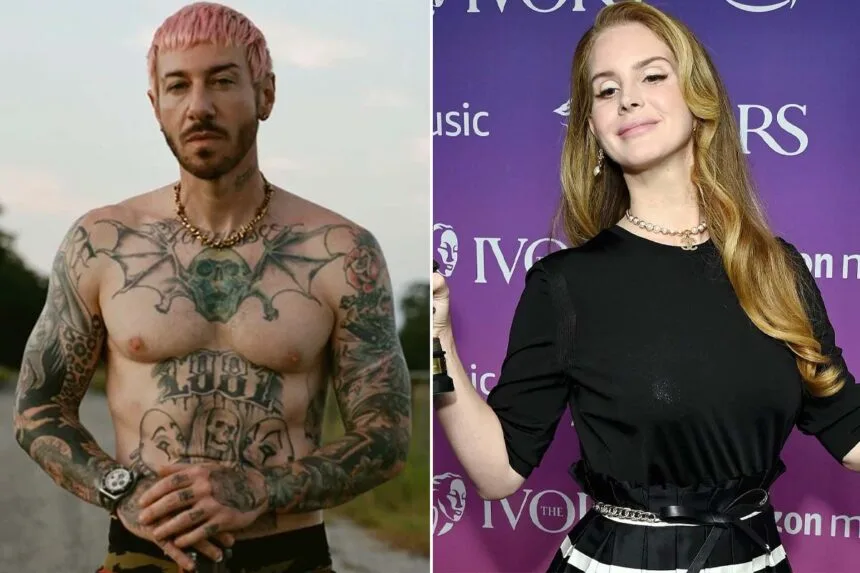
Avenged Sevenfold guitarist Zacky Vengeance has spoken out in defense of Lana Del Rey, recalling how he became a devoted fan after she faced harsh criticism early in her career. His comments were shared in a video published by Revolver, as part of his breakdown of 11 Great Non-Metal Albums.
Vengeance explained how his love for dark, atmospheric music drew him to Lana Del Rey’s Born to Die album — and how a widely mocked Saturday Night Live performance was actually what first caught his attention.
“I love just really depressing, drawn out, over reverberated, slow, sultry songs. They’re just so dark,” he said. “Lana Del Rey came on the scene and just captured that perfectly. I felt like her lyrics were very real and personal and she’s got an incredible voice.”

He went on to describe how the backlash surrounding her SNL appearance pushed him to seek out her music rather than dismiss it.
“What put her on the radar for me at that time was she had done a Saturday Night Live performance that was completely lambasted by critics. Everyone was like, ‘The worst performance we’ve ever seen. Who let her up there?'” Vengeance continued. “And I was like, ‘Okay, I got to go see what all these people are sh*t talking about.’ I went back and watched it and I see this beautiful girl up there with an incredible voice standing there looking like she almost had just slit her own wrists singing these f*cking songs and I was like, this is absolutely incredible. She’s a star.”
Vengeance described how the album quickly became a favorite for the entire band.
“This is going to resonate with people. I went out that day, found the album, saw the cover Born to Die. I was like, this is incredible,” he said. “Went and listened to it. It became one of my entire band’s favorite albums. I listened to it over and over and over and it was just truly art. And then from there she blew up and I was like, that just goes to show if you’re true to yourself, you go there with your vision, you do what you do, people are going to throw stones at you.”
He also drew a parallel between Lana Del Rey’s experience and Avenged Sevenfold’s own history of facing criticism.
“They’re going to, you know — Avenged is no stranger to it. We do what we do. It’s the worst thing we’ve ever heard. We hate this. It’s like, no, you just don’t understand it. It scares you,” Vengeance said. “Maybe you’ll come back around, maybe you won’t. I don’t care. We’re doing it for us.”
He concluded by reflecting on how the best artists often create work that takes time for audiences to fully appreciate.
“The best — my favorite artists create something where I’m completely shocked and surprised and appalled, and later down the road I’m like, ‘Oh, I get it now,'” he said. “And I feel like she had done that completely with that album.”
Vengeance’s remarks highlight a broader conversation about how early critical reception does not always reflect an artist’s long-term impact — a reality that Lana Del Rey’s career illustrates more vividly than most.
The SNL performance Vengeance referenced took place on January 14, 2012, when Del Rey performed “Video Games” and “Blue Jeans” on the show. Gas Lantern Media noted at the time that she “lost the melody multiple times,” “garbled words,” and appeared “almost drugged to the point of disaffection” — a reaction that spread rapidly across media outlets and social platforms in the days that followed.
The backlash extended well beyond her vocal performance. American Songwriter reported that Del Rey was described as “lethargic” during her live performances and “disconnected” on her album, with some critics even accusing her of romanticizing harmful themes. The pile-on was swift and severe, with many in the industry questioning whether she had the stage presence to sustain a mainstream career.
Yet the critical establishment’s initial verdict on Born to Die proved equally harsh — and equally short-sighted. Pitchfork originally awarded the album a 5.5 and called it “the ultimate disappointment.” The publication later revised the score upward to 7.8 in 2021, effectively acknowledging that its initial assessment had missed the mark.
Despite the critical cold shoulder, Born to Die became a clear commercial breakthrough for Del Rey. It helped her build a devoted fanbase and a cult following that only grew stronger over time. The album’s dark, cinematic aesthetic — the very quality that Vengeance described as “truly art” — ultimately resonated with millions of listeners who found something deeply personal in its sound.
The trajectory of Del Rey’s career since that turbulent debut has become something of a case study in artistic perseverance. From a performance that critics called one of the worst in SNL history to a catalog that now commands widespread respect, her story closely mirrors the message Vengeance himself delivered: that staying true to a vision, even under fire, is what separates fleeting trends from lasting art.


