



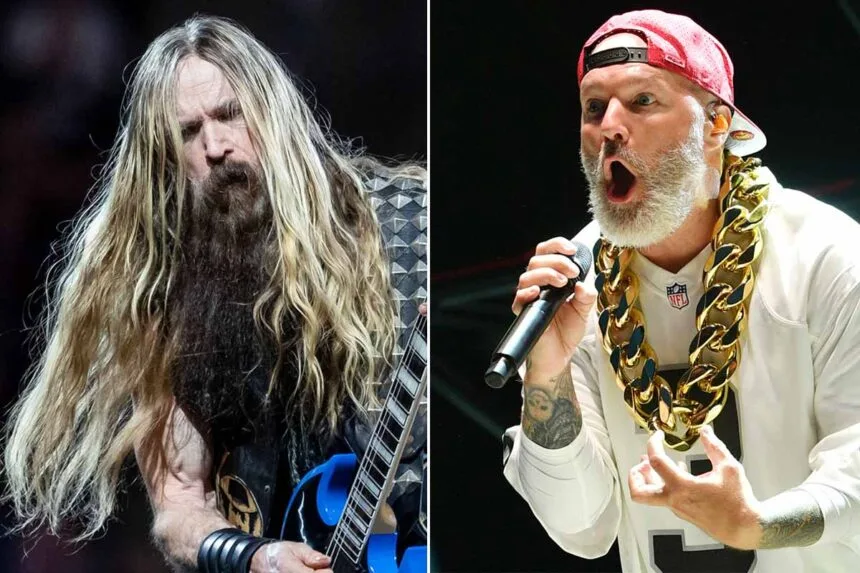
Zakk Wylde recently opened up about his early music career and the industry pressure he faced to follow popular trends, in an interview published on Guitar Player.

The guitarist explained how, throughout different phases of his career, he was repeatedly advised to abandon his own style in favor of whatever sound was commercially dominant at the time — from Bon Jovi-style rock to the rap-rock wave led by Limp Bizkit.
“When I first started with Ozzy, Bon Jovi was the big thing, and I couldn’t stand that kind of music,” Wylde said. “I was into Sabbath and Zeppelin, but we were writing these songs that sounded like Bon Jovi because the producer guys were telling us, ‘You’re never gonna make it if you’re playing that old crap. That stuff is going out of style.'”
He went on to describe a similar situation that arose during the rise of rap-rock in the late 1990s.
“When Limp Bizkit and all them were coming up, I was being told, ‘You should be doing rap shit like that. What are you doing with this whole Viking berserker biker image you’ve got going?'” Wylde continued. “I was like, ‘You gotta be kidding me. You’re saying that if I put on a backwards baseball hat, a pair of shorts, some Vans, and an oversized T-shirt, that’s gonna fix everything? Take your record company and cram it!'”
Wylde concluded by reflecting on the importance of artistic integrity and staying true to one’s own musical identity.
“You just gotta stay true to what you love,” he said. “That’s what all the great bands I love did. The only way to find your own identity is to keep doing what you love. If you think about finding that identity, it’s never gonna happen. Just keep plowing ahead with all the stuff you love.”
Wylde’s comments serve as a reminder of the commercial pressures artists often face, and his career stands as a testament to the value of resisting them.
Wylde’s ability to stay the course despite industry pressure is rooted in a career built entirely on his own terms — one that began not with a calculated image, but with a raw audition that changed everything.
Wylde joined Ozzy Osbourne’s band in 1987, hired to replace Jake E. Lee after a successful audition, as detailed on Wikipedia. He went on to play on some of Ozzy’s most celebrated records, including No Rest for the Wicked (1988), No More Tears (1991), and Ozzmosis (1995), cementing his reputation as one of the defining guitarists of Ozzy’s solo era.
Rather than chasing the commercial highs of his work with Ozzy, Wylde chose to double down on his own vision. After his solo project Book of Shadows saw limited commercial success, he founded Black Label Society in 1998, recording the debut album Sonic Brew with drummer Phil Ondich, as noted on Wikipedia. The band became his primary creative outlet and has since grown into one of heavy metal’s most enduring acts.
His musical roots have always been firmly planted in the heavy and the raw. As Guitar World via YouTube reported, Wylde’s style draws from heavy metal, hard rock, Southern rock, and blues. This blend was shaped by influences ranging from Black Sabbath to Eric Clapton and Rush — a wide but uncompromising foundation that has allowed him to remain relevant across decades without ever bending to trend cycles.
In recent interviews, Wylde has continued to articulate his philosophy on artistic commitment. As covered by Guitar Player via YouTube, he frames music not as a product to be shaped by outside expectations, but as something an artist must dedicate their entire life to. That mindset has guided every decision in his career, from turning down record label demands to launching Zakk Sabbath, his Black Sabbath tribute project, in 2014.
Wylde’s story is ultimately one of consistency over compromise. Decades after being told his style was out of fashion, he remains one of rock’s most recognizable figures — proof, as he himself would put it, that plowing ahead with what you love is the only identity worth finding.