




Alice Cooper recently weighed in on the growing role of artificial intelligence in music, addressing its possibilities and implications in a conversation shared on Trunk Nation With Eddie Trunk.

The legendary rock icon explained how A.I. could be used to fabricate an entirely fictional rock star — complete with a manufactured image, sound, and songwriting. He raised serious questions about creativity, ownership, and the future of the music industry.
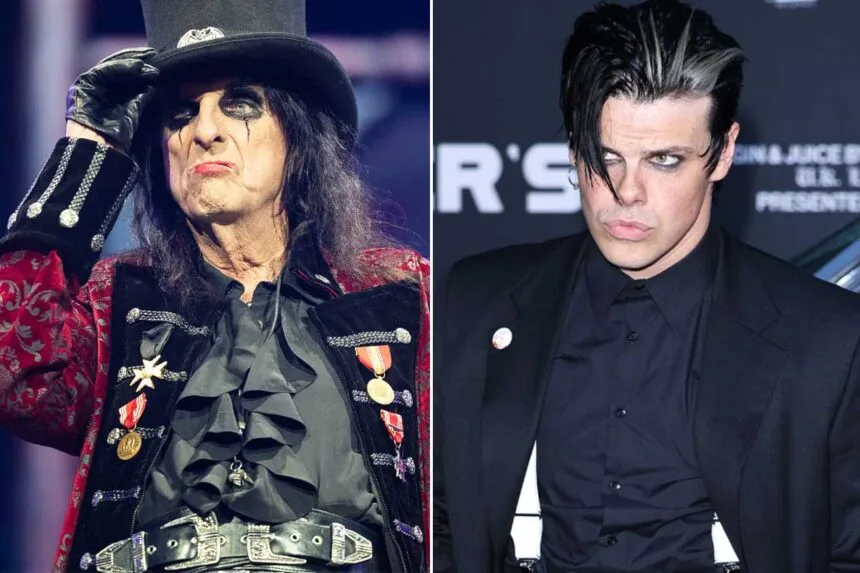
“Well, here’s the deal. I could right now create a rock star,” Cooper said. “I could create a Yungblud, a guy that’s really appealing, rock, tough, cool looking. I could create a guy named — I don’t care — Starboy or whatever, and make him look great. He doesn’t actually exist.”
“I could tell the A.I., ‘I want him to sound like Tom Petty and Freddie Mercury. And here’s what the album’s about. Write the songs,'” he continued. “Okay, now you’ve got a rock star that doesn’t exist, and you’ve got an album that doesn’t exist except in this world. And what happens if it sells? Who gets the money? A.I. wrote the songs. This guy had nothing to do with the creativity of the songs.”
Cooper then turned to the unresolved legal and financial questions that such a scenario would raise.
“So who’s gonna get that money? They have to write the check to the A.I.? That’s gonna happen. You watch that happen, because the guy that just suggested what it should be did not write the songs,” he said.
Despite acknowledging A.I.’s technical capabilities, Cooper pointed to what he sees as its fundamental limitation — the absence of genuine human emotion.
“If I could tell it to write a song about Eddie Trunk joining The Rolling Stones, they would write you a great song — except for one thing,” he said. “The one thing it can’t do — it’s never been in love. It’s never had its heart broken. It’s never been angry. It’s never been happy. It only knows words. And it only knows how to put words together. But it has no emotion. It has no heart, it has no feel, has no soul to it, and that’s where it dies right there.”
“That’s why you could put an album out and you listen to it and go… You know that it doesn’t come from any root inside, any heart, any experience,” Cooper concluded. “When they get that, then I think… I don’t know what’s going to happen to music.”
Cooper’s remarks reflect a broader ongoing debate within the music industry about the role of A.I. in creative processes and the ethical and legal challenges it presents.
Cooper is not alone in his concerns. Veteran artists across the industry have increasingly spoken out about A.I. as a tool that may assist with brainstorming or inspiration. They maintain, however, that it falls fundamentally short of replacing the human spark at the core of rock music. His comments arrive at a moment when the conversation around synthetic artists and AI-generated content has moved from theoretical to urgent.
Record labels, music-rights groups, and publishers have been pushing for clearer rules around consent, licensing, and copyright as AI-generated music continues to proliferate. As noted on Wikipedia, Alice Cooper has built a career spanning over six decades, making him one of the most enduring voices in rock — and one whose perspective on the industry’s future carries significant weight. His concerns about AI echo those of many artists who fear that the commercial machinery around music could outpace the protections afforded to human creators.
The legal landscape surrounding AI-generated music remains deeply unsettled. The main disputes involve copyright ownership, unauthorized training on existing recordings, voice and likeness rights, and whether AI outputs qualify as “derivative works” under existing law. The question of who receives royalties when an AI writes a song — a scenario Cooper described in vivid detail — has yet to be resolved by courts or legislators in any definitive way.
The rise of fully virtual performers and AI vocal clones has further complicated the debate. Synthetic acts capable of releasing music without a human singer have already begun appearing in the market. They often trigger backlash when human likenesses or voices are imitated without permission. These developments have prompted calls for opt-in systems and attribution standards that would give human artists greater control over how their work is used to train AI models.
For Cooper, the core issue is not legal but existential. No matter how sophisticated the technology becomes, he argues, an AI cannot replicate the lived experience that gives music its meaning. Until a machine can feel heartbreak, joy, or anger, he suggests, the music it produces will always ring hollow — technically proficient, perhaps, but missing the one ingredient that makes a song truly resonate.