






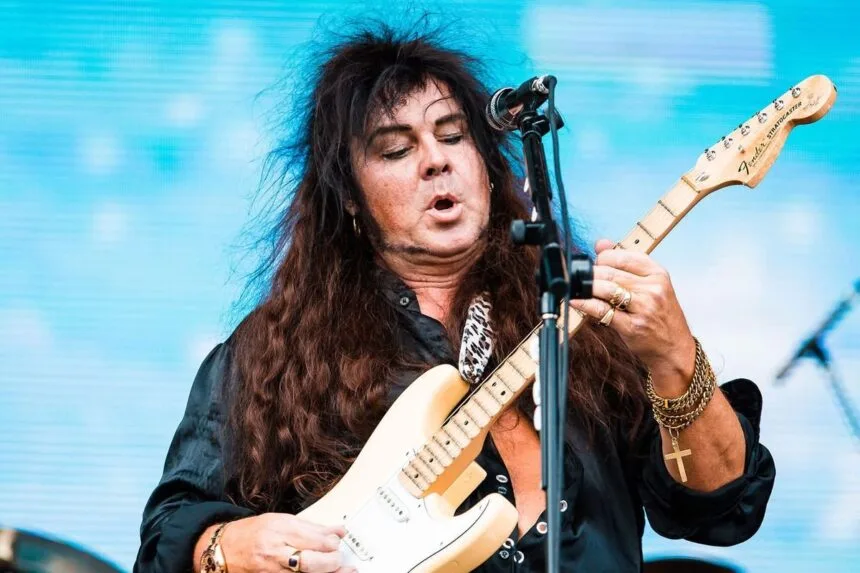
Yngwie Malmsteen has explained why he deliberately avoids listening to other artists or composers while writing music, telling Guitar Interactive Magazine that decades of immersion in classical music have shaped his style so deeply that outside influences are no longer necessary.

The guitarist was asked about modern composers and film composers that might be influencing his work, and whether he still drew inspiration from classical composers of earlier centuries.
Question: “Bringing up classical composers, of course, well documented that you’re very influenced by classical music. But I was wondering if there’s any like modern composers, film composers or just composers in general that are really influencing you now? Or is it more still the older guys from centuries ago?”
“Good question, good question. And here’s the thing. I’m not influenced by anything right now. I deliberately, I deliberately don’t allow myself to be influenced by anything,” Malmsteen said.
He explained that his decades of playing have shaped his artistic output in fundamental ways. “But I play guitar for 56 years or something. Absurd amount of time, yeah. And during the first, I don’t know, 20 years maybe, 30, 50, I can’t remember. I was so immersed in Vivaldi Concerto by Vivaldi, the flute concertos, I was so immersed in this that if you ask me to improvise something now, it will sound like it’s a classical written piece almost because it’s, that’s what’s inside me. It’s already there.”
Malmsteen described how this deep foundation means he no longer seeks outside inspiration when composing. “And it’s so, how should I call it? It’s so settled in that I don’t really have influences. When I write, I don’t want to hear anything. I don’t listen to anything at all, whatsoever, nothing. And I don’t deliberately say, I’m gonna write this now or I’m gonna write that. I have and I can, but that’s to me, that’s not optimal, you know.”
He added that his creative process relies on allowing material to emerge naturally from his accumulated musical knowledge. “And I allow whatever the hell it is that I’m channeling or comes out of me from all these eons of, you know, compressing these tonalities, what it comes out as. Because I don’t want to know. Because I don’t want to, that’s why I say I always want to keep it as spontaneous as possible. But I want it perfect. It’s really stupid almost, you know. But that’s why I try to.”
Malmsteen discussed his creative philosophy in a conversation focused on his musical influences and songwriting approach. Understanding his refusal to listen to contemporary music reveals the unusual balance he strikes between artistic spontaneity and technical perfection.
Malmsteen released his new album, Hell or High Water, on November 13, 2026. He spent eight months writing the album while staying at home, finishing around 80 or 90 tracks before selecting the strongest ones for the final record. The guitarist changed his composing and recording habits during the pandemic, moving away from working while touring toward seclusion and obsessive composition for months at a time.
His approach to songwriting mirrors his philosophy about isolation from other music. Malmsteen describes his music arriving fully formed, without external influences or interruptions during the creative process. He emphasizes that his refusal to listen to music extends to his own previous work, saying he does not revisit his old albums for inspiration because he wants to avoid any inadvertent influence.
The classical masters that shaped Malmsteen’s foundation include Johann Sebastian Bach, Antonio Vivaldi, Nicolai Paganini, Tchaikovsky and Mozart. As a teenager, he watched a video of a violinist performing Paganini’s 24 Caprices, an experience that changed his life and led him to adopt the arpeggios, linear notes and wide vibrato of the violin in his own playing. This early immersion became the bedrock of his artistic identity, emerging naturally in his compositions without the need for contemporary outside input.


