



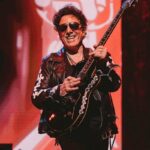



Def Leppard guitarist Vivian Campbell has opened up about his brief tenure with Whitesnake. He suggested that fellow guitarist Adrian Vandenberg may have influenced his dismissal from the band in a recent interview with dopeYeah Talk.

Campbell recounted how he joined Whitesnake. He also described the dynamics that developed between him and Vandenberg during their time as a two-guitar lineup.
“I get a phone call from John Kalodner. I’m in Ireland at my parents’ house and John said, ‘Well, David Coverdale Whitesnake, he’s recorded this album. He’s basically fired the whole band during the process. We’re going to put a band together around this record. It’s going to be huge,'” Campbell said. “I said, ‘Uh, okay. Well, can I hear it?’ He said, ‘Yeah, I’ll send you a copy.’ So, he sends me the album. It’s a Whitesnake 87 album. And I listen to it and I was like, ‘Oh my god, this is going to be huge.'”
Campbell described the initial meeting with Coverdale. He also outlined the band lineup that was being assembled.
“So, we meet with Coverdale and I’d met him briefly in passing before, but I didn’t really know David too well. And Adrian Vandenberg is there. David explains why I wanted to be a two guitar band. And Rudy Sarzo playing bass, Tommy Aldridge on drums. I mean, the pedigree of the band was undeniable,” he continued.
The guitarist revealed that tensions arose immediately over guitar solo assignments. He suggested Vandenberg wasn’t entirely comfortable with the two-guitar arrangement.
“Adrian and I talking, well, you know, what part are you going to play for this and what solo you going to play? So, and Adrian and I immediately start fighting over who’s playing guitar solo. Well, yeah, I want this one. I want that one, you know. So, and I really really like Adrian. He’s a great guy. We got on really really well, but I never got the feeling that Adrian wanted two guitar players in the band, you know. It was nothing personal,” Campbell explained.
Campbell noted that Vandenberg had been involved in the recording process before his arrival. He had played a significant solo on the band’s biggest hit.
“Well, because he was involved first. He came in towards the end of the recording and actually played the solo on ‘Here I Go Again,’ which turned out to be the biggest hit on the record, I think. And at the time, Adrian confided with me that that David hadn’t told him it was going to be a two guitar player band,” he said.
The guitarist acknowledged additional personal conflicts that complicated his time with the band. These included issues between his wife and Tawny Kitaen.
“I mean there were a lot of situations. I mean I just had gotten married in 1987 also and my wife and Tawny Kitaen just did not get along. So there was a bit of that conflict like behind the scenes stuff that was heavy baggage for me to carry. I’m big on principle and like when somebody has a problem with your wife then I got a problem with them,” Campbell revealed.
Campbell expressed respect for Vandenberg. However, he suggested his fellow guitarist may not have supported him when difficulties arose.
“And again going back to the Adrian thing, I really, and I don’t want this to come off the wrong way ‘cuz I love Adrian Vandenberg, but I don’t feel that you know when stuff started to go a little rocky, I’m not so sure that Adrian was saying, ‘Oh, it’s going to be fine.’ I tend to think that maybe Adrian was weighing the skills of justice a little bit, you know, putting his thumb on it. Like, ‘Well, maybe, you know, maybe we don’t need this guy,'” he concluded.
Campbell’s revelations shed new light on the internal dynamics that shaped one of rock’s most successful albums. They provide context for the complex relationships that existed within the band during this pivotal period.
The tensions Campbell described were rooted in Vandenberg’s own complicated history with Whitesnake. Dinosaur Rock Guitar reported that Adrian Vandenberg had previously turned down an offer to join Whitesnake during the Slide It In era. This decision might have changed the course of the band’s musical direction if he had accepted. This earlier rejection may have influenced his perspective on sharing guitar duties when he finally did join the group.
Vandenberg’s reluctance to embrace a two-guitar setup becomes more understandable when considering his background as a bandleader. Wikipedia documented that Vandenberg founded his own band in 1981. He released three albums throughout the 1980s including Vandenberg, Heading for a Storm, and Alibi. The band achieved success with hits like “Burning Heart” and “Friday Night.” This established Vandenberg as a prominent figure in the Dutch rock scene.
This experience leading his own successful group likely shaped Vandenberg’s approach to collaboration within Whitesnake. He had been the primary creative force and lead guitarist in his own band. The prospect of sharing guitar responsibilities and competing for solos may have felt restrictive to someone accustomed to having complete creative control.
The musical chemistry and creative tensions between the two guitarists reflected broader industry dynamics of the era. Mascot Label Group noted that Vandenberg’s musical style was deeply rooted in classic rock traditions. This both complemented and competed with Campbell’s more diverse background that included his work with Dio and later Def Leppard.
Campbell’s dismissal from Whitesnake ultimately led him to join Def Leppard. He has remained a core member there for over three decades.


