

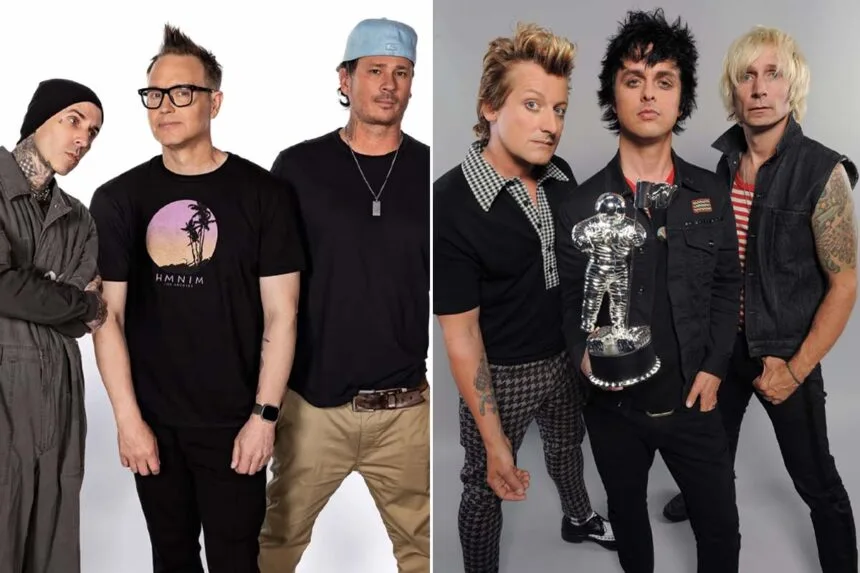
Blink-182 drummer Travis Barker addressed long-standing rumors of tension between his band and Green Day during the 2002 Pop Disaster Tour. He offered his own account of the co-headlining run in a conversation on the Broken Record Podcast.
The discussion centered on conflicting stories about the tour. Fans have long debated differing versions of events from both bands, including claims made by Mark Hoppus in his book that Green Day seemed cold and possibly intent on overshadowing Blink-182 on stage.
Barker was asked directly about the story behind the Pop Disaster Tour and the perception that Green Day secretly wanted to “blow Blink-182 off the stage.” He offered a different take on what actually happened.
“I think I had a different experience probably,” Barker said. “I mean at the time Blink was big you know and I think Green Day might have been in like hibernation mode or writing or something and then I know internally as a band we had always said be cool if us and Green Day to crazy.”
Barker went on to describe how unprepared Blink-182 actually was for the tour, pushing back on the idea of any rivalry.
“You know, I think the world always tries to pin us against each other,” he continued. “The truth is Blink didn’t even practice for that tour. We would go out on tour and not even practice once. We went out there and we didn’t even have a f*cking banner, okay? And we got out there and Green Day had pyro and like crazy sh*t. That’s how like inexperienced we kind of were as a band, right?”
He explained that the experience was more of a wake-up call for Blink-182 about performing on a larger scale, rather than any sign of friction between the two bands.
“Like we’re just like, ‘Yo, we going to go up and play those songs like we’ve always played like we did at the club,'” Barker said. “I think that tour for me and if I had to speak for our band was like a good like eyeopening experience of like, ‘Oh, you play different when you go out and you play big arenas and you play big amphitheaters. We should have a banner. We should have production.’ I think that was our tour where we had that realization, you know, as far as personalities with the band.”
Barker also spoke positively about his personal interactions with Green Day since the tour, dismissing any notion of lingering animosity.
“I remember one time I was on tour with Yellow Wolf and I ran into the Green Day guys and they’re nothing but nice,” he said. “Like, honestly, they’ve never been anything but cool to me in person. And they’re badass. They’re a great band.”
Barker’s comments offer a firsthand rebuttal to years of speculation surrounding the Pop Disaster Tour, suggesting the perceived rivalry was more myth than reality. Looking back at the tour itself helps put his account into context.
The Pop Disaster Tour kicked off on April 17, 2002, at Centennial Garden in Bakersfield, California, launching what would become a sprawling two-month run across North America. By the time it wrapped, Blink-182 and Green Day had played 46 shows in 45 cities across two countries. This schedule matches Barker’s description of a band learning on the fly rather than one plotting to outshine its co-headliner.
Jimmy Eat World, Saves the Day, and Kut U Up rounded out the bill. Their presence turned the tour into one of the era’s most stacked pop-punk lineups. That depth of talent only added to the pressure both headliners faced each night to deliver a memorable arena and amphitheater show.
The scale of that pressure showed in how the tour was received on the road. A May 3, 2002 stop at the E Center in West Valley City, Utah, featuring Blink-182, Green Day, and Jimmy Eat World, was a raging success. It underscored just how well the pairing resonated with audiences despite the behind-the-scenes growing pains Barker later described.
That reception lines up with Barker’s account of the tour as a turning point for Blink-182’s live show rather than a battle for dominance with Green Day. The band’s admitted lack of production and rehearsal stood in stark contrast to the tour’s overwhelmingly positive audience response. This reinforces his point that any rivalry existed more in outside perception than in reality.