





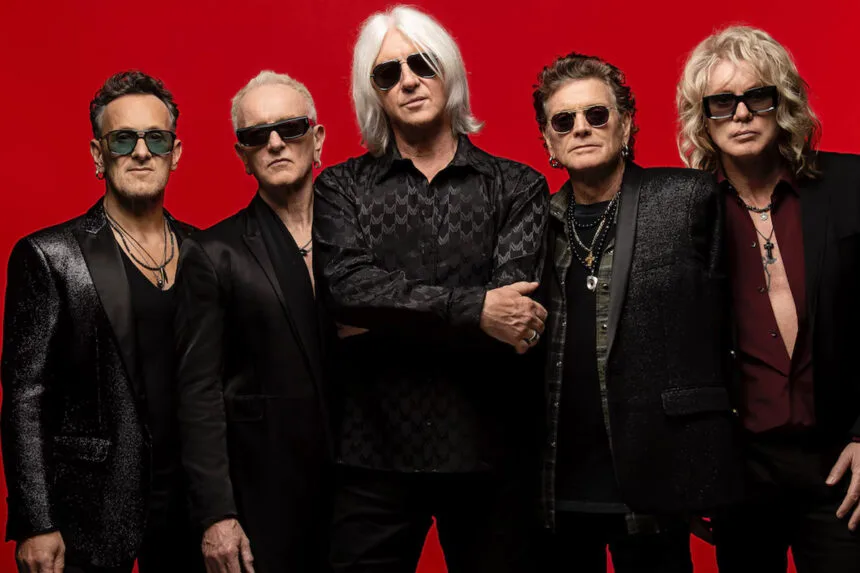
Def Leppard guitarist Phil Collen recently opened up about the band’s longtime collaboration with producer Robert John ‘Mutt’ Lange. He credited Lange as the driving force behind the group’s success.

Collen explained that Lange was not only a producer but also served as a vocal coach, guitar mentor, and co-writer for the band. Lange’s contributions shaped much of their sound from the ground up.
“Probably about 99%. [he taught us] everything,” Collen said. “He taught us how to sing, he taught us how to play guitar. He sings on every song we’ve ever done [with him]. He does backing vocals. He’s got the best singing voice out of all of us put together. And he sings on everything he does.”
Collen went on to point out that Lange’s influence extended far beyond Def Leppard’s own catalog. He noted Lange’s uncredited vocal contributions to several other major acts.
“I mean, I even hear him on, ‘I’m on a highway to hell,'” Collen continued. “His backing vocals are on that, and all the Bryan Adams stuff, Shania Twain stuff. Obviously, all of our stuff. And, yeah, you hear him on Foreigner, I think on The Cars. He’s just got a great voice. It’s just amazing.”
The guitarist also detailed how Lange approached songwriting sessions with the band. He often pushed them to refine their material until it met his standards.
“[Mutt did] everything. He’s the best producer in the world, [and a] songwriter as well,” Collen said. “You’d come to him and you go, ‘I’ve got this chorus.’ He’d go, ‘Okay, well, that’s not strong enough for a chorus. We could use that for a middle eight or a bridge or something like that, but, yeah, we need a stronger chorus.’ And he’d come and he’d write with us as well. So that was a great thing.”
Collen further recalled Lange’s remarkable musical versatility. He described moments when the producer would demonstrate guitar parts or vocal lines himself with apparent ease.
“Mutt does everything. Everything. And he’ll play stuff. He’ll play something on a guitar,” Collen said. “He’ll go, ‘Well, play this.’ And you hand him the guitar and it’s, like, ‘I can’t play that.’ It’d be insane. Or at singing. ‘So sing this.’ He’d be, like, ‘Hey, hey, hey, hey.’ And whatever, and you’re, like, ‘Really?’ And he does it just, like, one take. It’s amazing.”
Lange’s fingerprints on Def Leppard’s catalog run deep. His methods behind the scenes reveal just how far his perfectionism extended into the band’s most celebrated records.
Lange’s relationship with Def Leppard began with 1981’s “High ‘n’ Dry.” On 1983’s “Pyromania,” he truly became a sixth member of the band, earning co-writing credits on all ten tracks and helping reshape their sound into a more polished, radio-ready style. That partnership reached its peak with 1987’s “Hysteria,” Lange’s third and final album with the group. The project was so demanding that sessions stretched from February 1984 to late January 1987, with mixing continuing into the following spring.
Lange’s obsession with detail became legendary among those who worked alongside him. On several tracks, he assembled guitar solos one note at a time, auditioning multiple takes for each individual note before settling on the final arrangement.
“We would just take each song and try to raise it to the standard of a rock classic,” Lange once said of his work with the band on “Hysteria.”
That level of exactitude extended into the band’s writing process as well. Lange pushed the group to rework choruses, bridges, and melodies until every element met his exacting standards. His willingness to demonstrate parts himself, whether picking up a guitar or singing a line in a single take, underscored the hands-on role he played in crafting some of the era’s biggest rock anthems.
Collen’s comments underscore the significant, if often understated, role Lange played in defining Def Leppard’s sound throughout the band’s most successful years.