





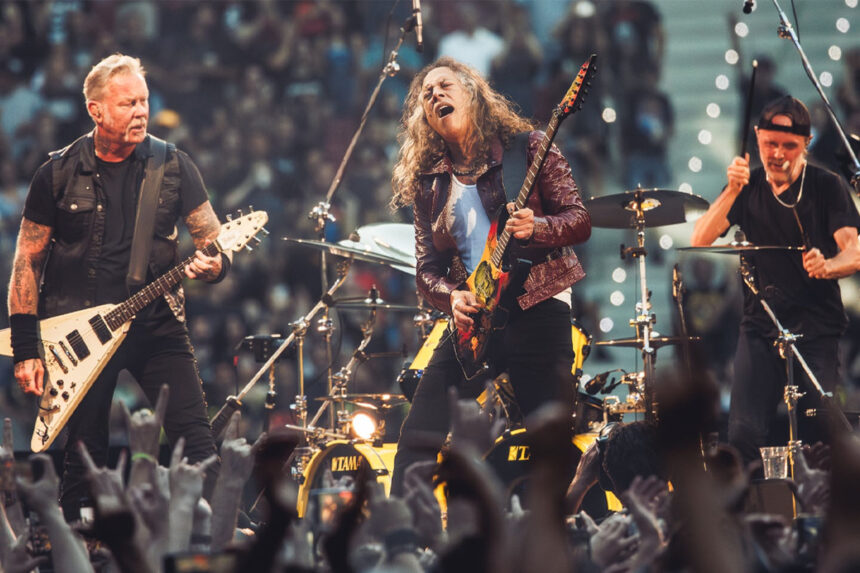
Metallica made headlines after Kirk Hammett and Rob Trujillo defied a ban and performed a portion of the Tom Jones classic Delilah during the band’s appearance in Cardiff, Wales.

The impromptu performance on June 28, 2026, drew an enthusiastic reaction from the crowd. Fans online quickly voiced their support for the band’s decision to play the banned song.
“Metallica: Delilah (Tom Jones cover) at Cardiff, Wales – June 28, 2026,” a Metallica fan wrote in the caption of the video.
Fans were quick to weigh in on the controversy surrounding the ban. One supporter defended the song’s place in music history.
“Yes, go Metallica! Delilah is a murder ballad along with a couple of thousand other songs! Should never have been banned!” the fan commented.
Others expressed curiosity about the potential consequences of the band’s decision.
“The song is not allowed to be played there, lol. I wonder what the fallout will be,” another Metallica fan wrote about the band performing Delilah.
Many fans also questioned the logic of the ban itself, pointing to the crowd’s enthusiastic response as evidence against it.
“If this song is banned, then why is the audience enjoying it? Should’ve not been banned in the first place. Good on Metallica for dusting off this song for the Welsh!” another fan said.
The performance has since sparked a wider conversation about the ban on Delilah at UK stadiums. No official response from venue authorities has been reported at this time.
The controversy surrounding Delilah at Principality Stadium in Cardiff is not new. It has been building for over a decade, rooted in the song’s dark lyrical content and the Welsh Rugby Union’s stance on domestic violence.
Delilah, originally released by Tom Jones in 1968, tells the story of a man who stabs his cheating wife to death. The song’s most controversial line — “She stood there laughing / I felt the knife in my hand and she laughed no more” — became the focal point of growing objections at the stadium. The track had long been a beloved anthem during Welsh rugby internationals. The Welsh Rugby Union first removed the song from its official match-day playlists in 2015, citing the track’s problematic subject matter. A spokesperson for the venue stated that the WRU condemns domestic violence of any kind and acknowledged the song is “problematic and upsetting to some supporters because of its subject matter.”
The ban was tightened further in 2023, when stadium officials explicitly barred guest and public choirs from performing Delilah during pre-match entertainment and throughout games. The decision came during a period of intense public scrutiny of the Welsh Rugby Union, which saw its chief executive resign amid allegations of sexism, misogyny, and racism within the organization. The stricter enforcement reflected the WRU’s effort to align its public image with its stated values. The ban applies only to match-day entertainment organized by the WRU. The resident DJ and choirs are prohibited from playing it, but fans are still free to sing the song spontaneously in the stands.
Tom Jones himself has long pushed back against the restrictions on his signature song. In August 2024, the 86-year-old Welsh music legend stopped his concert at Cardiff Castle to deliver a pointed message to politicians, declaring to a wave of applause: “Do you know when a politician is lying? When his lips move. He can’t stop us singing Delilah can he?” Jones has consistently defended the song’s lyrics, insisting they are not meant to be taken literally.
Despite the official restrictions, Delilah has remained deeply embedded in Welsh sporting culture. Much like Irish fans have adopted The Cranberries’ Zombie as an unofficial anthem, Welsh supporters have long claimed Delilah as their own — a tradition that transcends the song’s controversial storyline. Jones himself performed the track at Principality Stadium as recently as June 2022. Metallica’s decision to revive it on the same stage three years later, to a crowd that enthusiastically sang along, underscored just how far the song’s cultural grip extends — and how contentious the ban remains among fans.


