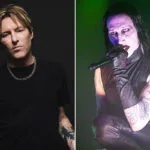


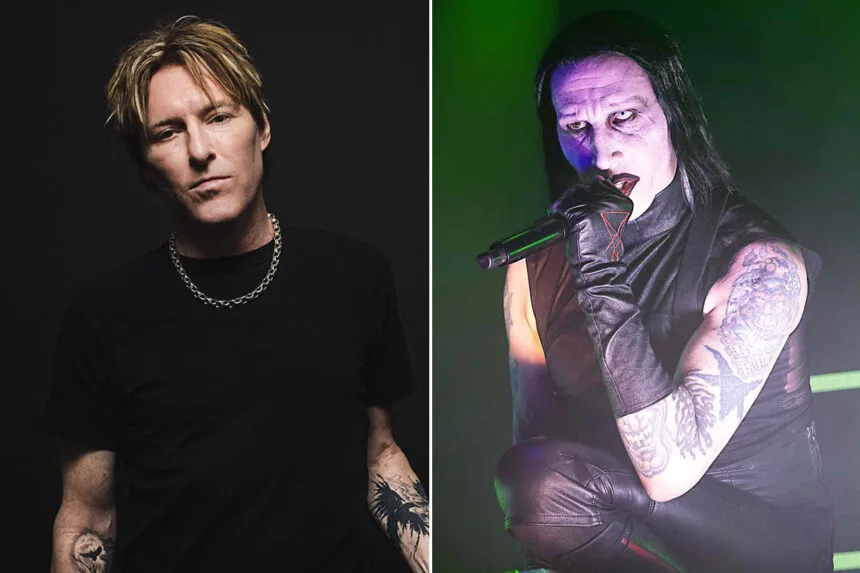
Tyler Bates, producer of Marilyn Manson’s recent albums, has explained why he decided to work with the singer again after his public controversies and recovery from addiction, speaking on Chris Jericho.
Bates described how Manson contacted him after leaving rehab and how the two men reconnected over their shared creative work. He also addressed criticism of his decision to reunite with Manson and outlined the process they used to create the new records.
“So, it’s led to Manson and I having our stresses and times because once we get out there in the studio, we’ve had nothing but incredible experiences,” Bates said. “I don’t know why we have this connection. I was not a particular like Manson fan before we started working together. But when we get outside the studio, the type of challenge that we that I propose or present in creating the music is not necessarily something he’s into.”
Bates explained how Manson’s recovery changed his perspective on their relationship. “So flash forward after a couple dark periods with us, he changed his life and he got sober. And I didn’t think that was really possible with him. But it happened and he contacted me right away when he got out of out of rehab and I just let him know, hey, I’m your friend. I was did not want to work with him again. Said, ‘I’m your friend. If you ever need to talk, call me. I just want to see you prevail in your sobriety.’ Nothing to do with all the other stuff swirling around him.”
When Manson asked to work together, Bates held back at first. “So at some point he came over wanting to show me really the truth in his perspective of what’s going on in his life. Can we work together? I said no man you’re not ready yet. You need to add more context to yourself and your story before we are ready to do something together. I’m not saying no but it’s not ready. So at some point we started working together again and I realized that you know I believe in second chances.”
He went on to defend his decision despite the backlash he faced. “I believe that if somebody does something that is so significant that it cannot go ignored and changing their life for the better that they deserve a second chance even if there are potential repercussions that come with showing that support which all of it is the truth. I did it. I definitely had some repercussions. People around me did but that’s unfortunate that that’s the case.”
“I want to see people become better people,” Bates continued. “We can’t be a world of dead people. People written off with no possibility of contributing. And so, there was nothing to speak of at the time that we got together. Actually I was going on tour with Jerry Cantrell when Manson and I talked. I said, ‘Look, if you’re dead serious, I want you to go study with this vocal coach. She’s amazing. She is going to get you in prime shape and you’re going to be better than you ever have been.’ And that did happen. And that’s reflected in the records, the writing, the melodies. He sang that stuff.”
Bates addressed claims that he had manufactured Manson’s vocal performances. “You know, I’ve been accused of manufacturing his performances. That’s not the case. He did it and I’m proud of him for doing it. And before I left, I said, ‘I’ll write you 10 tracks, and they’re just going to be for the sake of us establishing a dialogue about what we’re going to do.’ I think two of them actually ended up being tracks we developed for chapter 1, but I write the music in front of him. So, he’s on my sofa, you know, reading, writing, doing whatever he does, and we’re talking sometimes, but not a ton. And I’ll just I’ll feel his energy and that’s what I’m writing.”
He described his creative approach with Manson during the songwriting process. “And then I have a sense for what he needs to say. And in this case, he had a lot of very real life personal things he wanted to address and he for himself. Yeah. About himself, for his wife, about their life and the other things that he was contending with. So I wanted to help him get that out. So by the time we completed the first record, there was still no record deal, no agent, no promoter, nothing.”
Bates explained how they continued building on their early work. “So I said, ‘Look, let’s stay the course.’ I think the results of what we are doing right now are special. Let’s just keep going. We’re going to need tracks for a Japanese release, but let’s look about let’s create a demarcation point now and let’s think about what the next story is. And so we began from there and at that, you know, not long after that, then Nuclear Blast came to my studio and those guys seemed to be really knocked out by what we were doing.”
Bates made these remarks in a discussion about his work with Manson on the albums One Assassination Under God – Chapter 1 and Chapter 2. His comments provide insight into how the two men rebuilt their professional relationship after Manson’s recovery.
Bates and Manson’s work together led to significant personal changes for the singer. In January 2024, Manson completed 20 hours of community service, with his certificate of completion submitted to the courts on January 30. The singer worked toward sobriety while recording with Bates at the producer’s Los Angeles studio, The Abattoir, between April 2023 and April 2024.
One Assassination Under God – Chapter 1 was released by Nuclear Blast on November 22, 2024, marking Manson’s twelfth studio album. The first chapter of the project was followed by One Assassination Under God – Chapter 2, which came out on August 14 through the same label. Both records were co-produced by Bates and represented a new chapter for Manson after his separation from his former record label, management and talent agency.
Manson’s return to recording followed years of allegations against him. In February 2021, actress Evan Rachel Wood named Manson as her alleged abuser, and other women came forward with similar accusations. A criminal investigation by the Los Angeles County Sheriff’s Department that ran for four years concluded in 2025 with no charges filed against Manson due to the expiration of the statute of limitations and lack of evidence. One lawsuit brought against Manson was dismissed, while he reached a settlement in January 2023 with another plaintiff.
The collaboration between Bates and Manson began during their work on the TV series Californication. Prior to reuniting for the One Assassination Under God albums, Bates had produced or co-produced three previous records with Manson: The Pale Emperor in 2015, Heaven Upside Down in 2017, and earlier work. When Manson left rehab and reached out to Bates, the producer chose to support him as a friend before agreeing to work together on music, emphasizing the importance of the singer’s recovery over professional considerations.