
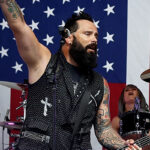





Skillet frontman John Cooper recently opened up about the period in his career when he chose to speak publicly about politics. He explained that it cost the band a portion of its fanbase.

Cooper said he had avoided political topics for most of his career. A shift in 2020 led him to speak out. He also addressed how the decision affected Skillet’s audience and how the band eventually won much of that support back.
“I never wanted to speak about politics,” Cooper said. “And when sometimes people hear that, they’re like, ‘Oh, yeah, right, John.’ And I always tell them, ‘No, I have proof. I have 24 years of my first 24 years of my career.’ I didn’t say peep about anything. I never said who I was voting for. I don’t even know if I said happy July 4th. I just I don’t want to speak about any of that’s not what I do. I’m a musician. I don’t want to speak about this stuff.”
He went on to describe how the events of 2020 changed his approach. “And 2020 just was that sort of like, okay, we’re it this is all hands on deck because if we lose our right to have our individual freedoms and liberties, this is going to be bad,” he said. He added that things have calmed down since 2020 and 2021, and that he is now trying to go back to his “lane,” which is music. “I want to entertain people. And I really hope that I don’t ever have to talk about politics for the rest of my life.”
Cooper then addressed the fallout among the band’s fanbase. “It’s become so polarized and I will say I do think this goes into why Skillet fans are so rabid and maybe it even grew,” he said. “I think in 2020 when I started speaking out about that there was an initial 10% of our fan base that immediately unfollowed, stopped listening. There’s no question and maybe 15%.”
“And I remember thinking like I don’t want that but I just felt I had to do it. I do think that there were some fans that were like, ‘Look I’ve always liked Skillet, now I love Skillet.'”
He said winning fans back took time. “I think it (gaining fans back) took about two years because we did not feel the gaining. It hurt. It hurt for about two years. And that was fine with me. Everybody’s got to do what they got to do. You don’t want to listen. I get it.”
Cooper said standing by his convictions strengthened some fans’ loyalty. “I think that solidified people into I like this guy. And I even saw that with people that were like, ‘Hey, I’m not into the Jesus stuff, but I just appreciate that you put, you know, they they’d say to me, you put your balls out there, man. I like that.'”
The scale of that loss is easier to understand given how long Cooper spent building the band’s audience.
Skillet formed in Memphis, Tennessee, in 1996. Cooper started the band with guitarist Ken Steorts and drummer Trey McClurkin. The group began when Cooper’s pastor suggested he and two members of competing bands join forces for a side project. Within a month, the major Christian label ForeFront Records showed interest. The band released its self-titled debut album in October 1996.
The band’s sound took shape in the early 2000s. Alien Youth in 2001 and Collide in 2003 combined hard rock with electronic elements and anthemic lyrics. Both albums helped Skillet reach a wider market. Collide earned a Grammy nomination, and Comatose later earned another. Comatose went Platinum.
Skillet’s commercial peak came in 2009 with Awake. The album reached No. 2 on the Billboard 200. It was later certified double platinum. It remains the band’s best-selling record to date. It cemented Skillet as one of the leading acts in Christian rock, with strong crossover appeal in mainstream rock.
Cooper’s experience is not unique. Artists whose public views clash with their core audience often face intense reactions from fans. The Dixie Chicks became one of the best-known examples after they criticized then-President George W. Bush. They faced a strong backlash from country fans. The group never regained its earlier level of commercial success. Skillet’s recovery after about two years stands in contrast to that outcome.
Cooper addressed the issue in comments shared with Rock Feed.


