


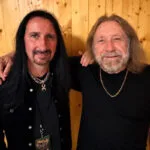



Jeff Scott Soto recently opened up about his time as the frontman for Yngwie Malmsteen’s Rising Force. He discussed why he ultimately felt he had to move on from the project in order to grow as an artist, in an interview shared by Dakota’s Music World.

Soto was asked what it was like to join a project with such a strong, singular creative vision already in place, especially compared to the projects he has led himself later in his career. In response, he reflected on how much he admired Malmsteen’s work before joining. He also explained why the situation ultimately limited his own artistic growth.
Asked, “Looking back to working with Yngwie Malmsteen’s Rising Force, what was it like entering this project that there was already such a clear driving force and kind of vision behind what the music was going to be compared to a lot of your projects you’re doing later, even doing now, where you kind of have more ownership over the direction that the music will take?” Soto responded:
“Well, back then I’ve always had a very wide versatile genre of influence oriented idea of what I wanted as a musician, as an artist, but obviously with Yngwie, especially back then, I was all in,” Soto said. “I loved what he did, his work with Steeler, even though he’s not really a fan of it.”
“You know, that wasn’t really his — that wouldn’t have been his first choice for introduction to Yngwie Malmsteen into the US,” he continued. “But without it, it wouldn’t have led to all the things that eventually, you know, that I did with him. But I was into that. I was into Alcatraz, both the studio and the live album. And so, even just meeting Yngwie for me was a big deal if I didn’t get the gig, but getting the gig, obviously, that was my first foot in the door.”
Soto went on to describe the moment he realized the arrangement wouldn’t help him advance as an artist in the long run.
“And again, I was all in musically. I loved what he was doing musically, what we were doing musically, but it was unfortunate that I learned early on that it wasn’t really going to help me progress as an artist,” he said. “It was always going to be the marquee — was always going to be on Yngwie’s name and focused on him, which is great. You know, that’s what he deserves. That’s what he is all about.”
“But on my personal level as an artist, I knew I needed to move on to be able to grow and to be able to take — in to be taken as an artist, as a serious artist, as a writer, as a producer,” Soto continued. “All of the things that eventually happened for me would not have happened had I stayed on with Yngwie because there was no real course for growth in that situation. And again, it’s not downplaying the situation. I’m extremely proud, happy that he brought me on, that he saw something in me enough to say you’re going to represent my career. You’re going to be the one, you’re going to be the frontman that’s actually the voice of my music, and that was a big deal for me.”
He concluded by emphasizing that leaving was not a calculated career move, but part of a broader search for his own artistic path.
“And to this day, I absolutely praise and treasure that,” Soto said. “But I also had much more to say on my own course, and that’s exactly what I did. It wasn’t an intentional course of ‘I’m going to join 80 bands at the same time and try to just guide my own direction by misdirecting my career.’ It was a work in progress of me trying to find my ground.”
Soto’s comments reflect the reality of his tenure with the guitarist, one that was brief but foundational to both of their careers.
Soto served as the vocalist on Malmsteen’s first two studio albums, 1984’s “Rising Force” and 1985’s “Marching Out,” a period widely regarded as the band’s earliest and most defining era. He landed the gig as an 18-year-old after sending in a demo tape, beating out a pool of hopefuls to become the voice behind Malmsteen’s breakthrough sound. He left the band in 1985. Mark Boals stepped in to take over vocal duties on the follow-up album, “Trilogy,” released in 1986.
Soto has been candid about the dynamic that shaped his exit in other interviews as well. He has previously said that he left Malmsteen’s band because he realized “you don’t really work with Yngwie; you work for Yngwie,” a sentiment that echoes the same frustrations he described about the marquee always belonging to Malmsteen rather than the band as a whole.
Despite the short run, the collaboration left a lasting mark on both artists. Malmsteen later returned the favor by appearing on one of Soto’s own projects, repaying the contributions Soto made during those early years together.
The split proved to be the first of many pivots in Soto’s career. He would eventually front bands including Talisman and even take a turn as Journey’s lead singer in 2006 and 2007, cementing his reputation as one of rock’s most versatile and in-demand vocalists.