






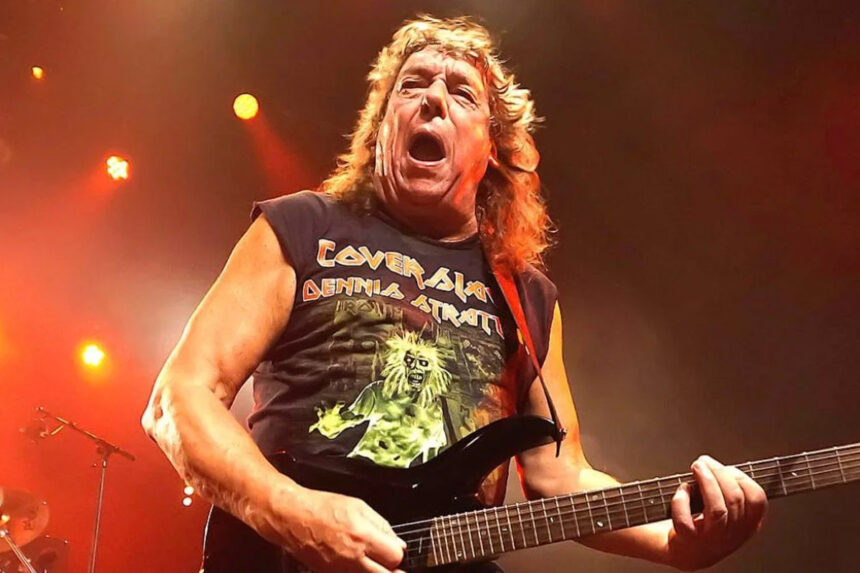
Former Iron Maiden guitarist Dennis Stratton recently shared his thoughts on the band’s new documentary “Iron Maiden: Burning Ambition.” He expressed concerns about how the film portrays the band’s early years. His comments were featured in an interview with Paulieflix.

Stratton discussed his experience watching the documentary. He addressed potential criticism from fans about his perspective on the film.
“When you’re watching it for the first time, it’s a lot to take in,” Stratton said. “But because I had the pleasure of watching it twice, on a Thursday [May 7] as well in Belgrade [Serbia], there was things that I missed on the Tuesday that I picked up on the Thursday.”
The former guitarist emphasized that his critique comes from a place of respect for the band and its fanbase.
“I don’t want the Maiden family or the Maiden fans saying ‘it’s sour grapes’ or ‘he’s got the hump because he’s [not in the band],'” he continued. “I haven’t. It’s a film for the fans.”
Stratton reflected on his contributions to Iron Maiden’s early sound. He discussed his role in shaping their musical direction during his time with the band.
“I’m proud of what I did in Maiden first couple of years, and also what I took into it and working on them early songs,” he said. “Because, yes, in 1979, it’s said many times that the band was very punky and very aggressive, and that’s how we liked it. But you still had to have a bit of class, and that’s when separating them guitars and adding a couple of little vocal harmonies, that’s when you start making the songs a bit more interesting, not so punky, not so raw.”
Despite his overall positive view of the documentary, Stratton expressed disappointment with one particular aspect of the film.
“The film’s fantastic for the fans, but for me, [it’s] just a little bit sad that they rushed through the early days, that’s all,” he concluded.
Stratton’s concerns about the documentary’s treatment of Iron Maiden’s formative period reflect his deep connection to that era of the band’s history. This includes his involvement in their groundbreaking debut album.
Blabbermouth reported that Stratton got his first look at the film at the world premiere on May 5, 2026. He watched it again shortly after. His main criticism centered on the documentary not spending enough time on Iron Maiden’s formative period. This includes his own significant contribution to the band’s first album, “Iron Maiden” (1980), where he played guitar.
The early era that Stratton feels was inadequately covered in “Burning Ambition” represents a crucial period in Iron Maiden’s development. Chaoszine noted that the documentary chronicles the incredible five-decade journey of Iron Maiden. It was produced by Dominic Freeman. However, Stratton’s perspective suggests that the film’s broad scope may have come at the expense of properly documenting the band’s origins.
Stratton has previously spoken about the rapid recording process of the debut album. He noted that it was recorded very quickly with little pre-production. Despite these challenging circumstances, he has expressed feeling honored to have been part of that foundational work. His contributions during the 1979-1980 period helped establish the sound that would eventually make Iron Maiden one of the most influential heavy metal bands in history.
The guitarist’s comments also touched on other aspects of the documentary’s portrayal of different eras in the band’s history. Ultimate Metal indicated that Stratton felt that some later-era material was also portrayed in a somewhat misleading manner. This was particularly around the Blaze Bayley period. This suggests broader concerns about the documentary’s historical accuracy across different phases of the band’s evolution.


