




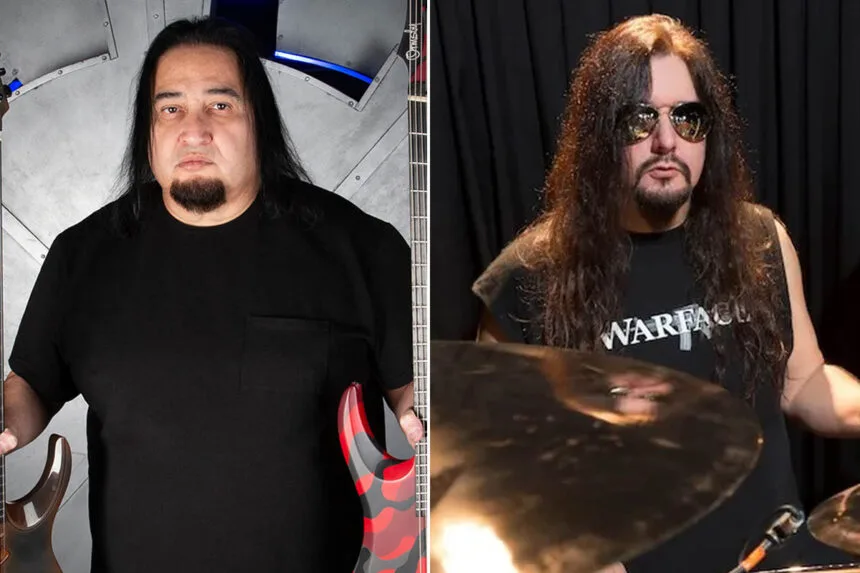
Fear Factory guitarist Dino Cazares has issued a new statement to clarify his previous comments regarding drummer Gene Hoglan’s exit from the band. The statement addresses claims made in a video by Beat Motel Zine Music Podcast titled “Fear Factory’s Betrayal: Drummer Gene Hoglan’s Shocking Exit.” The video alleged that the band failed to inform Hoglan that they were using programmed drums, which led to his departure. Cazares has directly denied these claims.

Cazares took to X (formerly Twitter) to set the record straight on the nature of Hoglan’s involvement with the band and the circumstances surrounding his exit.
“Just to clarify, Gene Hoglan was only contracted for the ‘Mechanize’ album cycle which lasted approximately two years,” Cazares said. “Prior to writing the ‘Industrialist’ album we mutually agreed not to enter into a new contract.”
Cazares also spoke to Hoglan’s reputation and the practical challenges of retaining a drummer of his standing on a full-time basis.
“Gene is an incredible musician and he’s one of the most sought after drummers,” he continued. “He’s always in demand and that’s exactly what makes it difficult to keep someone of his caliber in a full-time band.”
This latest statement follows an earlier response from Cazares, in which he pushed back against those who claimed Hoglan had been replaced without notice. “These dudes have it wrong in their understanding of how things went,” he previously said. “The drummer was no longer a part of the band, which is why we used a drum program for the Industrialist. Therefore, there was no need to inform a drummer who was not present during the time we were using a drum program. No-one got replaced.”
No further official response from Gene Hoglan has been reported at this time.
To fully understand the weight of this dispute, it helps to look back at the history between Hoglan and Fear Factory, and the albums at the center of the controversy.
Gene Hoglan joined Fear Factory as a touring and recording drummer following the band’s reunion in 2009. He stepped in after the departure of original drummer Raymond Herrera. His arrival was a significant moment for the band. Hoglan was already regarded as one of the most technically accomplished drummers in heavy metal, having built his reputation through landmark work with Dark Angel, Death, and Strapping Young Lad, among others.
Mechanize, released in 2010, marked Hoglan’s studio debut with Fear Factory. The album was widely received as a strong return to form for the band. It was praised for its aggressive, industrial-tinged sound and demonstrated a natural chemistry between Hoglan’s powerful drumming and the band’s signature mechanical riffing. It remains one of the more celebrated records in Fear Factory’s post-reunion catalog.
The Industrialist, which followed in 2012, took a notably different approach. Rather than working with a live drummer, the band opted entirely for programmed drum sequences. This creative and logistical decision has since become the focal point of the ongoing controversy. The album’s liner notes did not prominently address the absence of a human drummer, which contributed to the confusion and speculation that has resurfaced years later.
Hoglan’s broader career has continued uninterrupted. He has remained one of the most in-demand drummers in the genre, consistently appearing on projects across the metal spectrum. His reputation as a session and touring musician has only grown since his time with Fear Factory. This lends credibility to Cazares’ characterization of him as someone whose schedule makes long-term band commitments inherently difficult to sustain.
The renewed public attention on this chapter of Fear Factory’s history reflects a broader pattern of the band’s internal disputes finding their way into the open. Fear Factory has navigated a turbulent history marked by breakups, legal battles, and lineup changes. Cazares’ effort to provide a clear, contractual account of Hoglan’s exit stands as a notable attempt to draw a firm line under a long-running point of contention.


