



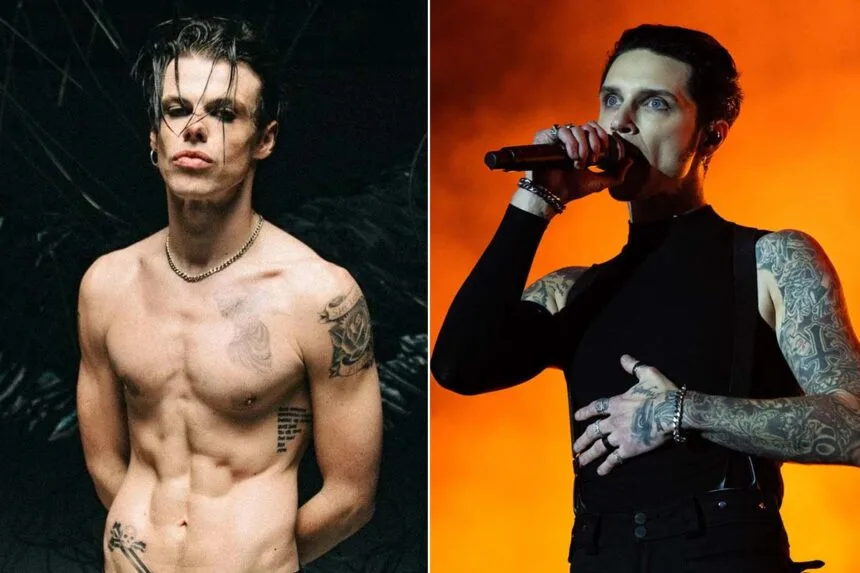
Black Veil Brides frontman Andy Biersack issued a clarifying statement after his comments on Yungblud and the “saviour of rock” narrative went viral. The statement was reported via his post on X (formerly Twitter).

Biersack moved quickly to distance himself from any personal conflict with Yungblud. He redirected the conversation toward what he described as a broader and longstanding misrepresentation of rock music’s health.
“Honestly I don’t care about this at all, I was asked about this a month ago in an interview but I’m not invested in this topic,” Biersack said. “I am however passionate about the false narrative that rock isn’t in a good place.”
He pointed to the success of modern rock festivals as evidence that the genre remains strong without relying on nostalgia.
“DWP fests are bigger than ever and that’s with modern rock and metal bands (MCR, BMTH) headlining this year not exclusively heritage acts or 70’s rock nostalgia acts,” he continued. “We don’t need to bow down to our elders at all times out of some misguided deferential bs. Rock is alive and kicking ass.”
Biersack also made clear that his remarks were never intended as a criticism of Yungblud personally.
“I have nothing against Yungblud. I don’t even know him so it would be ridiculous for me or anyone in my position to take a stance on something like that,” he said. “I’m speaking pretty directly about something I’ve seen for years which is the uninformed mainstream gifting us in the rock scene with who our new savior is because most of them wrongly believe we need saving. Most mainstream music media believe rock died 25 years ago and it’s just patently false.”
This statement followed Biersack’s earlier remarks in which he acknowledged Yungblud’s talent while criticizing the media’s habit of labelling artists as the “saviour of rock.” No further response from Yungblud has been reported at this time.
Biersack’s frustration is not new, and it reflects a tension that has long existed between the rock community and mainstream music media. His comments have reignited a wider debate about how the genre is perceived, covered, and ultimately misrepresented by outlets that rarely engage with it on a consistent basis.
As Louder reported, Biersack’s original remarks were made in a Metal Hammer interview. He praised Yungblud as talented while firmly rejecting the media’s tendency to crown young breakout artists as symbolic rescuers of an entire genre. The coverage of those comments quickly spread online, prompting his follow-up statement on X.
The “saviour of rock” label has a well-documented history in music media. As Louder noted, the framing tends to emerge whenever a younger artist crosses into the mainstream or gains commercial traction at a moment when the genre has been written about as being in decline. Rather than reflecting the actual state of rock, the label often says more about how mainstream outlets engage with the genre — sporadically and through a narrow lens.
Biersack’s own words from the original interview capture the core of his argument plainly: “It’s stupid to label anyone a saviour of a gigantic rock world that still exists.” The quote underscores that his objection is not to Yungblud, but to the reductive framing that implies rock needs saving in the first place. He argues this framing is both inaccurate and damaging to younger artists who get caught in the resulting cycle of hype and backlash.
His reference to Download Festival is particularly pointed. My Chemical Romance and Bring Me The Horizon — two acts that represent the modern face of rock rather than its heritage era — are among the marquee names associated with the festival’s 2026 edition. Louder’s May 2026 coverage reflected that the broader rock conversation has increasingly centered on how the genre is performing in a fragmented music market. Major festivals have continued to serve as one of the clearest indicators of rock’s commercial and cultural resilience.
For Biersack, the evidence is straightforward: rock is not absent from the mainstream, it is simply underreported by outlets that have already decided the story. His statement is less a defense of Yungblud and more a challenge to the media infrastructure that keeps producing the same tired narrative — one that the rock community, by his account, has long since moved past.


