
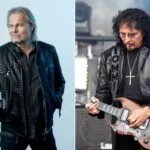

Rage Against the Machine guitarist Tom Morello opened up about growing up as a Black man in a predominantly white town. He also discussed how his racial identity has shaped the way audiences perceive him in an appearance on the Broken Record Podcast.

The musician described how many fans are surprised to learn of his African American heritage. He also reflected on the experiences that shaped his upbringing as the only Black person in his hometown.
“There’s a sizable portion of people in my audience through the decades that are – when I talk about being African American – are stunned and refuse to believe it,” Morello said. “Like, there’s a cognitive dissonance, like, no, no, no, Tom Morello’s not Black.”
“I literally integrated the town, according to the real estate agent,” he continued. “One Black person lives in the town, it’s me. Got a white mom and there’s one kid, and every single day, I was reminded that I was Black.”
Morello went on to describe specific instances that made his race a constant point of attention growing up.
“My hair was different, people wanna touch your hair, they wanna see your palms are a different color,” he said. “There’s a lot of anthropological study of this guy. There’s a noose in my family’s garage at one point. I was Black, and there was no doubt to anyone in town I was Black.”
He then connected those early experiences to the perception he later encountered as a musician.
“Years later, I’m in a band whose music appears on radio stations that don’t traditionally play Black artists, or rock and roll magazines that never feature Black artists,” Morello said. “I think it’s just fascinating. It’s an interesting commentary on race in the United States of how, like, I’m the same shade I was when I was at Libertyville, and yet completely different groups view me in completely different ways.”
Morello’s reflections on race trace back to a childhood defined by a rare cross-cultural household in an overwhelmingly white Midwestern town.
Morello was born in Harlem in 1964. He was raised in Libertyville, Illinois, a suburb of Chicago that was virtually all-white at the time. His father, Ngethe Njoroge, was a Kenyan diplomat who served as one of Kenya’s first ambassadors to the United Nations. His mother, Mary Morello, was an American schoolteacher of Irish and Italian descent who later became known as an activist and founder of the anti-censorship group Parents For Rock And Rap.
Morello’s parents separated. He and his mother later settled in Libertyville, largely because it was one of the few communities willing to accommodate a teacher raising a mixed-race child. Their arrival marked the first time a person of color had lived within the town’s borders, a distinction Morello has referenced repeatedly throughout his career.
The racism he encountered growing up was not limited to subtle discomfort. At age 13, Morello discovered a noose hanging in his family’s garage. He has cited the incident as a stark and formative reminder of how his race set him apart in a town where Democrats did not even run for office.
Despite those experiences, Morello has continued to draw a direct line between his childhood in Libertyville and the way audiences respond to his identity decades later as a member of Rage Against the Machine. He frames his story as a broader commentary on how perceptions of race in America shift depending on context rather than substance.


