




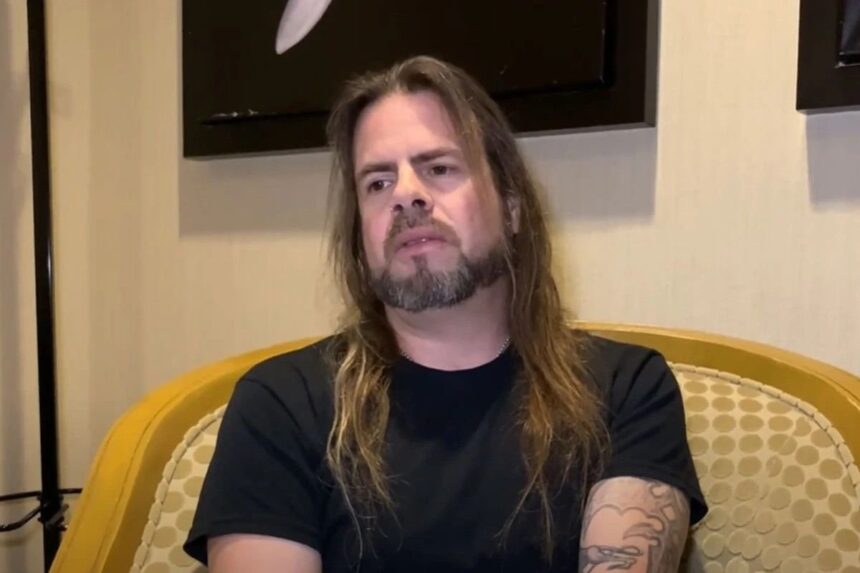
Queensrÿche frontman Todd La Torre has explained the band’s strategy for writing its next album, saying the group will work in smaller sessions rather than all together. He shared the approach in an interview with Trunk Nation With Eddie Trunk.

La Torre said the band has a break in its schedule coming up, with time set aside in December for writing before European dates. He described how guitarist Mike Stone and keyboard player Michael Wilton have already been working on new material with producer Chris Harris at his studio.
Question: “Why is the band splitting up into smaller groups to write the album?”
“We have a show in Washington, then we go home. Then we have three weeks off. And then in December, we’ve got a small run in Europe. And we’re writing the next record. And … I have a ton of songs to write lyrics and melodies to. So a lot of it’s on me right now,” La Torre said. “[The other guys have] done a ton of writing. I need to throw a bunch of vocals down, and then we can do some arrangement changes or whatever. But, dude, we’ve been traveling so much. We’re never home.”
“Stoney [Queensrÿche guitarist Mike Stone] and Michael went to our producer’s, Zeuss [Chris Harris], they went to his place and just did a ton of writing… They did several sessions, and they were just recording all brand-new ideas. And it was, like, way more productive and efficient, and they would just send stuff over and be, like, ‘Hey, check this out.’ And I would listen to it, and we would talk about it.”
La Torre explained that this separated approach had worked well enough that he decided to try a different method for his own contributions to the album.
“And they did that so many times, so the next one I said, ‘Look, I need to just be alone. Let me just do what I do right now.’ And then I wanna get together with Eddie [Jackson, Queensrÿche bassist], ’cause he’s really good at writing — he’s got a real big pop background with what he likes to write… I’ll lean on him first and be, like, ‘Hey, I need help with a chorus idea. Let’s talk about this.'”
He outlined a plan for closer collaboration between smaller pairs of band members during focused writing sessions.
“But I said, ‘Why don’t you come to my house for, like, a week, and let’s just dig in, or maybe the two of us will go to Zeuss’s. Let’s get a bunch of stuff and then show everybody, and then we can kind of do it that way.’ And we’ve done it where we’re all together, working in the same room, but I think just let the two guitar players just do what they do best.”
La Torre described why smaller groups can be more effective than having the entire band involved in every writing decision.
“Sometimes when everybody’s involved and everybody’s part of what they’re doing, it’s nice and it’s fair and it’s great, but it can stump things because everyone has 10 ideas. And that can be counterproductive. And so that’s why Stoney and Eddie went to Zeuss’s, and then Michael and Stoney went to Zeuss’s. They’re all going away for a week at a time doing several writing sessions. And the new stuff sounds like old-school ‘Rage [For Order]’ [Queensrÿche’s second album, released in 1986] and ‘[The] Warning’ [Queensrÿche’s debut album, released in 1984].”
This divided approach to songwriting is how Queensrÿche plans to create its next record.
Chris Harris, known as Zeuss, continues to produce the album after working with Queensrÿche on their previous three releases: Condition Hüman in 2015, The Verdict in 2019, and Digital Noise Alliance in 2022. Harris is a guitarist himself, which helps him understand what the band is trying to achieve. The band began demoing new material in late 2024 while on tour and had hoped to enter the studio to record the follow-up to Digital Noise Alliance in 2025.
By mid-2026, Michael Wilton and La Torre said they were still in the writing and demo recording phase, with the possibility that the album might not arrive before 2027. According to bassist Eddie Jackson, the band was targeting early spring 2027 for studio time, aiming for a release in late fall 2027. La Torre previously clarified that the next album will not be part of the band’s classic Operation: Mindcrime series, though there is a strong connection to the first Queensrÿche album.
The album comes with Mike Stone back in the fold. Stone originally left Queensrÿche in 2008, returned in 2018 as a touring replacement for guitarist Parker Lundgren, and became a full-time member in 2021 when Lundgren departed to pursue other business interests. Stone’s presence helps shape the band’s sound as they move forward with their next record.


