





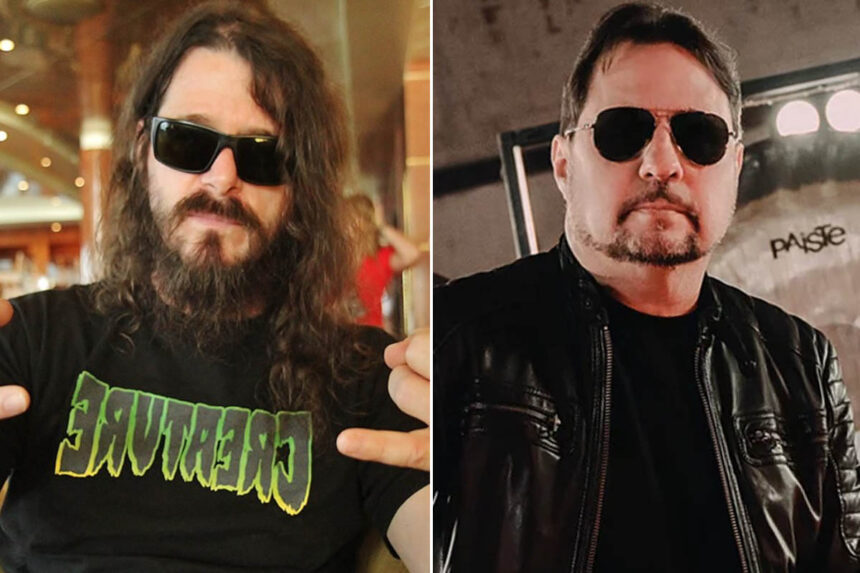
Slayer drummer Paul Bostaph recently discussed his approach when replacing Dave Lombardo in 1992. He explained why he chose not to imitate his predecessor’s style during an interview with Drumtalk.

Bostaph reflected on the pressure he felt when recording his first album with the band, “Divine Intervention.” He discussed his determination to establish his own drumming identity rather than copying Lombardo’s technique.
“That ‘Divine Intervention’ album was the first album that I did as the new drummer of Slayer,” Bostaph said. “So, I put a lot of time into working hard to improve my playing to be the drummer that Slayer needed because the drummer that they had, Dave Lombardo, is a great drummer.”
He emphasized his philosophy of maintaining his own musical identity while respecting his predecessor’s legacy.
“You just don’t come into a band like that. I didn’t want to come into a band like that filling in for a drummer like Dave. Not trying to be him. Nobody will ever be him,” he continued. “You know, he’s his own drummer. He’s a great drummer. But trying to be the best drummer I can be and give the fans what they expect.”
Bostaph drew inspiration from Iron Maiden’s drummer transition. He compared his situation to when Nicko McBrain replaced Clive Burr.
“I was a fan myself, so I kind of already knew. And when so I go back to when Nico McBrain replaced Clive Burr, like I was like, you know, I was big Clive Burr fan, big Iron Maiden fan,” he explained. “But when Nico came in, when you put that needle needle on the record, which there was a record, you know, you put the needle on the record and you’re like, ‘Okay, come on, man. Come on. Just don’t let me down.’ And boom, intro for where equals dare comes on. You’re like, yes.”
The drummer detailed his intensive preparation process for joining one of metal’s most influential bands.
“So that expectation in myself of in that moment made me go, dude, you have to work hard because if you just try to be the drummer you are that they accepted to be in the band, it’s not good enough,” Bostaph said. “So, you know, I wanted to be It took a year for us to work on that record and record it. So, I told myself I had one year to improve.”
He described his commitment to dramatic improvement during that crucial year.
“At the beginning of that year, I was the same drummer, but I wanted to at the end of the year, I wanted if you saw me at the beginning of the year and you heard me at the end of the year, you’d go, ‘Whoa, what happened?'” he explained. “So, I worked really hard to try to achieve that. And, you know, the bottom line is the more you practice, the better you’re going to get. Period.”
Bostaph also shared his practice philosophy and the importance of band chemistry in developing intensity.
“If you practice with the band for 4 hours or however long that is, but if you show up early and you practice for an hour before the band gets there, you put 5 hours in of drumming a day,” he said. “And on top of that, there’s no there’s no like for like thrash metal or for a heavy metal, nothing can replace the intensity of playing with your band. So if you practice by yourself all the time, there’s an intensity level to that. But when you go and you play with the band, that becomes way bigger.”
He concluded with advice about maximizing practice efficiency during band sessions.
“So nobody’s ever going to practice after the band is done. You want to go home. You shouldn’t you shouldn’t be going, well, I can play for two more hours after band practice,” Bostaph noted. “You should probably put all your effort into the music and then it’s time to go home.”
Bostaph’s approach to replacing Lombardo reflects a broader understanding of the challenges faced by musicians stepping into established bands with legendary predecessors.
Yamaha Artists reported that Bostaph joined Slayer in early 1992 and toured and recorded with them for almost a decade. He contributed to several key albums including “Divine Intervention” (1994), “Undisputed Attitude” (1996), “Diabolus in Musica” (1998), and “God Hates Us All” (2001). His tenure with the band was marked by his technical precision and aggressive style. He had developed this approach during his time with the thrash metal band Forbidden from 1986 to 1991.
The circumstances surrounding Lombardo’s departure created significant pressure for any replacement drummer. DRUM! Magazine noted that Lombardo departed Slayer in 1992 amid contract disputes. He left behind a legacy as the band’s “main cowriter” and a defining influence on their sound through his ferocious speed and groove on early albums. This created what many described as a “revolving door” of drummers before Bostaph secured the position.
Bostaph’s musical influences played a crucial role in shaping his unique approach to Slayer’s music. Encyclopaedia Metallum documented that Bostaph originally wanted to play bass but became interested in drumming after being influenced by AC/DC. He later developed his style after listening to Iron Maiden’s “Killers” album. This New Wave of British Heavy Metal influence distinguished his playing from Lombardo’s groove-based approach. It allowed him to bring a more technical and athletic drumming style to Slayer’s music.
The “Divine Intervention” album became a crucial test for both Bostaph and the band. It marked a transitional era in Slayer’s history. Released in 1994, it represented the band’s first major release with Bostaph behind the kit. The album showcased his precise, lightning-fast technique while maintaining the brutal intensity that Slayer fans expected. The album’s success helped establish Bostaph’s credibility within the metal community and proved that Slayer could continue their momentum without compromising their signature sound, even with a different drummer bringing his own interpretation to their music.


