



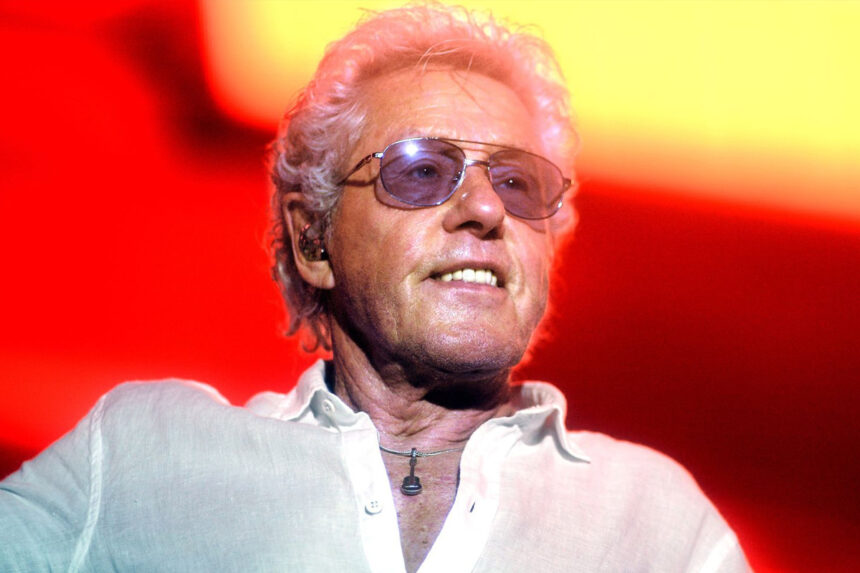
The Who frontman Roger Daltrey has sparked a major debate among music fans by boldly claiming that his band was the very first heavy metal group. He made the statement in an interview published by Rolling Stone. Daltrey argued that The Who “started it all,” predating acts like Black Sabbath and directly influencing the development of the 100-watt Marshall stack as well as the stage-smashing antics later associated with Jimi Hendrix.

Daltrey spoke candidly about The Who’s pioneering role in shaping rock and heavy music, pointing to both their sonic innovations and their influence on other legendary artists.
“We were just different than everybody else. Americans don’t really know the Who from the early ’60s, but as the drummer of Deep Purple [Ian Paice] said recently in a magazine, ‘The Who started it all.’ We were the first heavy metal band,” Daltrey said.
He went on to detail the specific contributions the band made to rock history, from equipment innovation to performance style.
“Jim Marshall invented the 4×12 [speaker cabinet], 100-watt stack for Pete Townshend. All the guitar smashing that Jimi Hendrix became famous for, in his style, was basically copied from Pete Townshend, first of all,” he continued. “And the first rock opera, of course, we elevated rock to be maybe up its own ass in a way, you could say it. We were doing it before anyone, but it’s not important in the long run.”
Daltrey’s comments were echoed by Deep Purple drummer Ian Paice, who had previously spoken about The Who’s foundational impact on the Metal Sticks podcast.
“We helped create what I call ‘the second coming’ of [metal]. Everything else, the band that did it first — The Who did it before everybody. They were the first on the big amp; they were the first to push rock ‘n’ roll beyond pretty little pop songs,” Paice said. “Let’s not forget the importance of The Who. They just changed everything for kids who wanted to do something a little more violently [laughs]. [Pete] Townshend’s notion onstage, [Roger] Daltrey’s aggressive singing and then the control of John Entwistle and the madness of Keith [Moon]. I mean, the whole thing should never have worked. I would say The Who were so important. I mean, people tend to forget them, ’cause they’ve been around for so long. But that was a big spark.”
Daltrey’s remarks have reignited discussions around the origins of heavy metal and The Who’s often-overlooked legacy in shaping the genre. While the debate over who truly invented heavy metal has long centered on bands like Black Sabbath and Led Zeppelin, historical evidence suggests The Who’s contributions run deeper than many fans realize — stretching from amplifier technology to performance culture and even vocal experimentation.
As noted by Wikipedia, the loud volume of The Who’s live show directly influenced the approach of hard rock and heavy metal, cementing their place as one of the genre’s key architectural forces. The band’s relentless pursuit of volume and sonic aggression in the 1960s helped establish a template that countless rock and metal acts would later follow. Their live performances were not merely concerts — they were exercises in controlled chaos that redefined what a rock show could be.
The band’s connection to Marshall amplification is also a matter of historical record. Pete Townshend and bassist John Entwistle’s demand for greater power and projection played a direct role in pushing Jim Marshall toward developing higher-powered amp systems, ultimately leading to the iconic Marshall stack. The relationship is best understood as artist demand driving amplifier innovation — The Who’s hunger for volume quite literally changed the hardware of rock music.
The Who’s influence extended beyond equipment into performance art. Townshend’s accidental guitar break at a 1964 show evolved into a deliberate and defining stage act, helping make instrument destruction a recognizable rock spectacle. As Far Out Magazine reported, the band’s 1966 B-side “Boris the Spider” featured one of the earliest uses of a death growl. This further positions The Who as genuine forefathers of heavy metal, with bassist John Entwistle’s deep, menacing vocal delivery foreshadowing a technique that would become a cornerstone of the genre decades later.
As for Hendrix, the historical picture is nuanced. While Daltrey’s claim that Hendrix “copied” Townshend is a strong one, both artists were operating within a broader 1960s culture of theatrical feedback, destruction, and showmanship. What is clear, however, is that Townshend’s early and very public guitar destruction helped normalize instrument smashing as a rock spectacle. Hendrix, who arrived on the scene shortly after, amplified that spectacle in his own iconic way. TeachRock has established that heavy metal has deep roots in the hard rock of the 1960s — a lineage in which The Who occupy a foundational position that is only now receiving its full due.


