






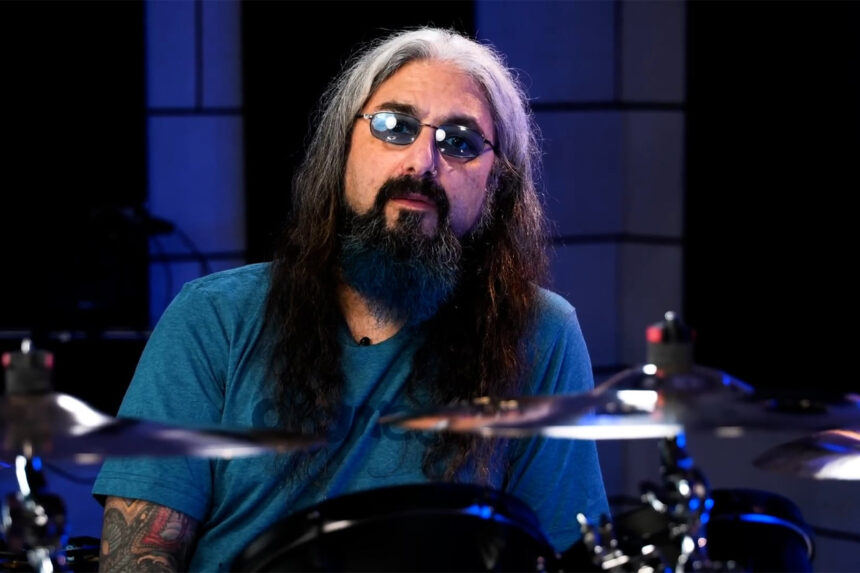
Dream Theater drummer Mike Portnoy recently shared advice for young drummers aspiring to follow in his footsteps. He explained why they should avoid starting with complex progressive metal and focus on fundamentals first. His comments were made during an interview with Overdrive Live.

The discussion arose when Portnoy was asked about guidance for young drummers who want to become the next Mike Portnoy.
“If the question is advice for the young drummer that wants to be Mike Portnoy, don’t,” Portnoy said with a laugh. “I mean, a lot of people a lot of young drummers may hear music by a band like Dream Theater and immediately want to start playing that. But you need to learn to walk before you can run.”
The veteran drummer emphasized the importance of building a solid foundation through classic rock before attempting more complex material.
“You know, when I was a kid, I started off by learning the Beatles and the Rolling Stones and Led Zeppelin and The Who before I started playing Rush and King Crimson and and Yes. and stuff like that,” he continued. “And then later on came all the metal bands that I you know with the fast double bass drumming.”
Portnoy concluded his advice with a clear recommendation for aspiring drummers.
“But you can’t do that kind of stuff without learning the basics first,” he said. “So I would say don’t start with Dream Theater. Start with AC/DC and work your way up to Dream Theater.”
Portnoy’s emphasis on fundamentals reflects the technical demands that make Dream Theater’s music particularly challenging for developing musicians.
The complexity of Dream Theater’s compositions extends beyond just drumming. It requires precise coordination across all instruments. Shredaholic reported that the band’s music demands tight integration between percussion and rhythm guitar, as seen in John Petrucci’s intricate parts that require precise coordination across instruments. This level of musical interplay makes it essential for drummers to have a solid grasp of basic timing and rhythm before attempting such complex arrangements.
Interestingly, Dream Theater themselves have recognized the value of returning to simpler approaches in their creative process. Guitar World noted that the band adopted a back-to-basics style on albums like “Distance Over Time,” recapturing simpler jamming roots after years of increasingly complex compositions. This shift demonstrates that even seasoned progressive metal musicians understand the importance of foundational elements in creating effective music.
The advice also highlights Portnoy’s own musical journey, which followed the exact progression he recommends to young drummers. His path from classic rock fundamentals to progressive complexity mirrors the natural development that allows musicians to build the technical skills and musical understanding necessary for advanced compositions. This methodical approach ensures that drummers develop not just the physical techniques required for complex music, but also the musical maturity to understand when and how to apply those techniques effectively.
For aspiring drummers, Portnoy’s guidance serves as a reminder that technical proficiency without solid fundamentals often leads to mechanical playing that lacks the groove and feel that make even the most complex music compelling. Starting with simpler material allows musicians to develop the essential skills of timing, dynamics, and musical communication that form the foundation of all great drumming, regardless of genre or complexity level.


