





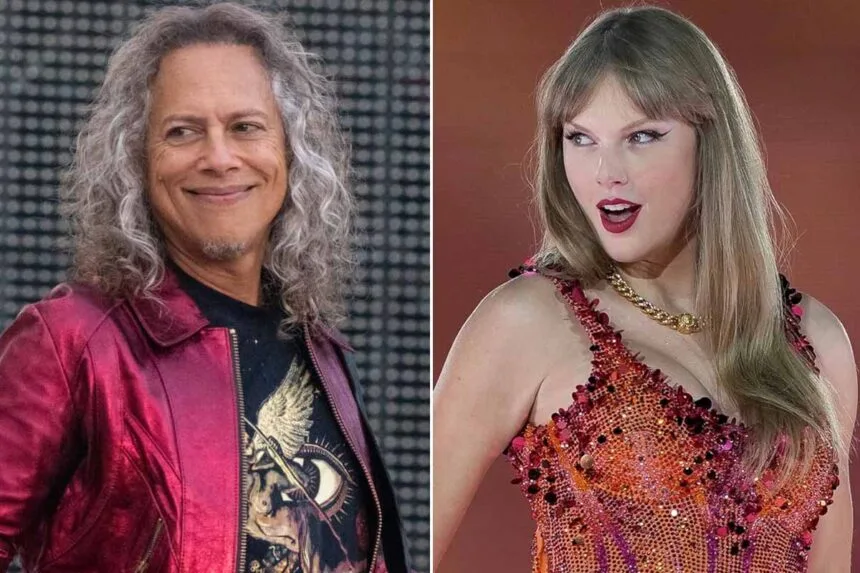
Metallica guitarist Kirk Hammett has shared a new controversial statement on pop music. The comments came days after he received backlash for wearing a shirt declaring that pop’s reigning queen, Taylor Swift, is a ‘CIA Psyop.’ Hammett made the remarks at a public interview in Dublin.

“I started off learning off records, just trying to develop my ear and learning songs and guitar solos from playing records over and over again,” Hammett said. “It’s a monotonous, tedious process, especially with the records. But I learned so much. And all my friends were doing the same thing.”
“We didn’t have tablature, we didn’t have music books. All we had was our ears and the albums. And it was a real challenge because if you got three different guitar players together and said, okay, play ‘I’m The One’ on Van Halen’s first album, all three guitar players would play it differently. There was some charm to that.”
Hammett went on to explain why he believes the struggle of learning music the old-fashioned way was essential to developing a unique artistic voice.
“I kind of lament those days when people had to really struggle to learn, because it’s all in the struggle,” he continued. “And it’s all in the determination and being inspired at the same time that forces you to come up with your own stuff and eventually your own sound and style. I just worry about how things are so perfect these days, the musicianship. It’s great that all these guitar players have all this vast knowledge of technique at their fingertips. I wonder where it’s leading to.”
He then turned his attention directly to the state of contemporary pop music, making no effort to soften his criticism.
“I hope it leads to a better quality of pop music, popular music, and just a better quality of songwriting,” Hammett said. “Because right now, songwriting and pop music is crap. I’m hoping that all these great musicians who can teach themselves through the internet step up and put all that great learning and all that great inspiration into creating new stuff, new songs, the future of music, and at a higher standard than what it is now. Because I’ll say it again, K-R-A-P. Crap. Sorry for all you pop fans out there.”
The remarks come just days after Hammett drew widespread attention for wearing a shirt with an anti-Taylor Swift message. The incident added further fuel to an already ongoing controversy surrounding the guitarist’s views on mainstream pop culture.
Hammett’s Dublin comments reflect a long-standing tension between the rock and metal communities and the dominance of pop music in mainstream culture. For a guitarist who came of age during the golden era of hard rock and heavy metal in the 1980s, the shift toward algorithmically driven, production-heavy pop represents a fundamental departure from the values he built his career on.
Hammett has been a central figure in Metallica since joining the band in 1983, replacing Dave Mustaine just weeks before the recording of their debut album, Kill ‘Em All. Over four decades, he has helped shape some of the most technically demanding and culturally significant guitar work in rock history. This makes his concerns about the direction of modern music carry considerable weight within the industry.
The Taylor Swift shirt incident sparked immediate backlash online, with fans of the pop superstar flooding social media with criticism. Swift has become one of the most commercially successful and culturally influential artists of her generation. Any public slight against her tends to generate significant reaction — something Hammett appeared fully aware of when he addressed pop music again so shortly afterward.
Hammett’s comments also touch on a broader debate within the music world about the role of technology and accessibility in shaping artistic development. While platforms like YouTube and TikTok have democratized music education in unprecedented ways, many veteran musicians argue that the ease of access has come at the cost of the raw, self-driven creativity that defined earlier generations of artists.
Despite the controversy, Hammett framed his criticism not as an attack on pop fans, but as a challenge to the next generation of musicians. His call for higher standards in songwriting suggests that, beneath the provocative language, his concern is ultimately about the future of music itself — and whether today’s technically gifted players will use their skills to push the art form forward.
Source: Irish Times


