
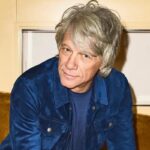


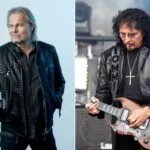



Guitarist Joe Satriani recently opened up about what makes Sammy Hagar stand out as a guitar player.

Satriani is a member of Sammy Hagar’s Best of All Worlds band. He explained that Hagar’s greatest strength as a guitarist stems from his instincts as a lead vocalist — a quality Satriani personally admires and says he has never been able to replicate.
“I’ll play too many notes, but he won’t,” Satriani said. “I always ask him, ‘Well, what is that?’ And of course, he doesn’t think about it. It’s totally natural to him. But he somehow plays the right notes with the right kind of vibrato. And that still fascinates me, as it did when I was a young kid growing up.”
Satriani went on to explain the connection he sees between Hagar’s vocal background and his approach to the guitar.
“I always thought that one of the coolest things about his guitar playing was that he somehow took the knowledge of being a really good lead vocalist and applied it to the way he played guitar,” he continued. “He’s kind of a crazy shred guitar player on the one hand. But on the other hand, he’s got this editorial process that I personally recognize as being a lead singer.”
Satriani also placed Hagar’s restrained style in a broader context, comparing him to iconic British guitarists known for their precision.
“There aren’t many American guitar players who are well known for restraint,” he said. “I always saw that as something that would come from the U.K. or Ireland. You have these players like Eric Clapton or Brian May who just play the perfect notes. They don’t turn the amp up to eleven.”
He concluded by highlighting the discipline he hears in Hagar’s playing.
“I think [Hagar] would take that one step back from the edge of the cliff and make sure that he could pull it off,” Satriani added. “I hear it over and over again as a thing that really good lead vocalists have. And they apply it to their guitar playing.”
The comments reflect a longstanding admiration Satriani has held for Hagar’s musical instincts, dating back to his early years as a guitarist.
The relationship between Satriani and Hagar runs deep, rooted in decades of mutual respect within the rock world. Their collaboration in the Best of All Worlds band brought together two of rock’s most accomplished figures, each with a distinct but complementary approach to the instrument.
Hagar first rose to prominence as the frontman of Montrose in the early 1970s before launching a successful solo career. He later replaced David Lee Roth as the lead vocalist of Van Halen in 1985. That tenure produced some of the band’s most commercially successful albums, including 5150 and OU812. Throughout that period, his guitar playing remained a secondary but consistent part of his musical identity.
Satriani, by contrast, built his entire reputation on technical guitar mastery. He is widely regarded as one of the greatest instrumentalists in rock history. His solo career began with Not of This Earth in 1986 and produced a string of acclaimed albums. His playing is defined by speed, precision, and an encyclopedic command of technique — qualities that make his admiration for Hagar’s restraint all the more telling.
The dynamic Satriani describes — where a vocalist’s sense of phrasing informs their guitar playing — is a concept long discussed among musicians. Singers naturally think in terms of breath, space, and melodic economy. These qualities translate directly into a more selective and emotionally resonant approach to the guitar. It is a discipline that purely technical players often struggle to develop organically.
The comparison to Eric Clapton and Brian May is particularly significant. Both guitarists are celebrated not for the volume of notes they play, but for the weight and intention behind each one. Clapton’s blues-rooted phrasing and May’s orchestral melodicism represent a school of playing where less consistently delivers more — a philosophy Satriani clearly believes Hagar has internalized in his own way.
Source: Thinking About Guitar


