

Former Rainbow frontman Joe Lynn Turner is opening up about his former bandmate Ritchie Blackmore’s recent one-off reunion with Deep Purple, sharing his thoughts on the event and the reception of Blackmore’s performance in a conversation with Cassius Morris Official.
Turner reflected on the significance of the reunion between Blackmore and Deep Purple’s Ian Gillan, expressing hope that any past tension between the two had been resolved. When asked directly about the reunion and what he thought of it, Turner offered a heartfelt response.
“Did you happen to see the reunion that happened with Deep Purple and Ritchie Blackmore? What do you think about it?” Turner was asked.
“Oh, yeah. Of course,” Turner said. “Well, what I think is that I really honestly sincerely hope that healing has happened. I honestly don’t hope it was not a dog and pony show, as we say, that it was just for uh publicity or notoriety. I really hope that Richie and Ian have sort of buried the hatchet as we say, you know, the healing that there’s no animosity.”
Turner went on to emphasize the importance of setting aside old grievances, noting the age and history shared by the two musicians.
“I mean, everybody’s so much older and time and life is short and I hope they all realize that the nonsense that everybody went through back then doesn’t mean anything compared to what they really did together as a unit,” Turner continued. “And I really hope that’s the sincere part of it.”
Addressing the criticism surrounding Blackmore’s performance during the reunion, Turner made clear that he did not view it as the central issue.
“You know, I’m not going to get into the fact of whether Ritchie played brilliantly or not or whether it was this or he look, he’s 80 years old,” Turner said. “He’s slowing down. He’s got certain ailments and all that. That’s not the important part. The important part is in his heart and hopefully in Ian’s heart, especially because it was those two guys who were at friction with each other, that there’s healing. So, I think it’s good.”
Turner closed his remarks by reflecting on the broader lesson the reunion offers and the impact Blackmore and Deep Purple’s music had on his own career.
“I think it shows people that you’ve got to let things go. You cannot carry anger or hate. It’s absolutely destructive in our lives. None of that matters, you know. None of it. You have to look always at the positive side of things,” Turner said. “These guys created just incredible music. I mean, these, you know, they were my heroes. I sat with my guitar and learned every Blackmore lick possible and uh was honored and blessed to play with them and at the same and to be part of that family and to see families or individuals in a family at odds is always heartbreaking. So, I hope that repaired it. That’s what I think. I hope it repaired all of those problems.”
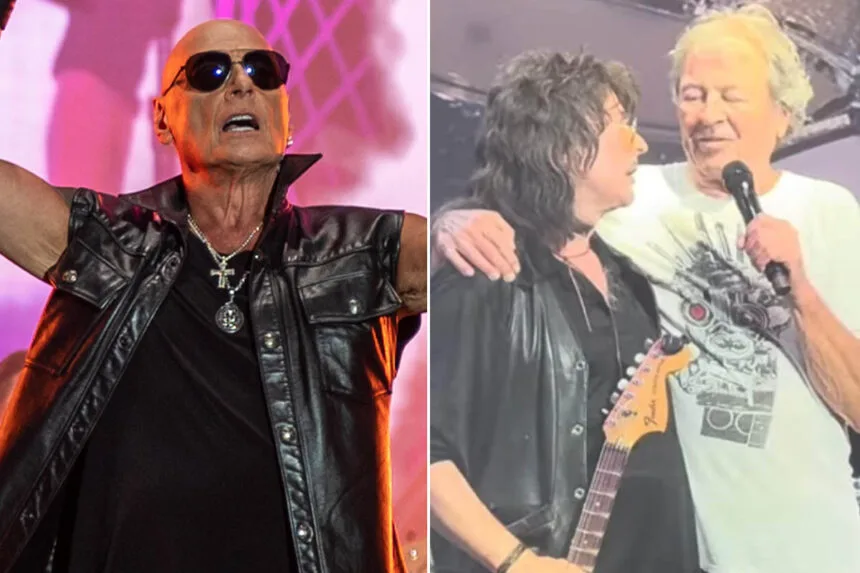
The reunion Turner is referring to took place on August 12, 2026, at the Northwell at Jones Beach Theater in Wantagh, New York, during Deep Purple’s headlining show. It marked Blackmore’s first appearance with the band in 33 years.
Blackmore joined Deep Purple for a single song, “Smoke on the Water,” performed as an encore, marking the only track he played with the band that night. Gillan personally welcomed Blackmore onstage in front of the crowd. The two traded warm words afterward, following decades of public friction between them.
Fan reaction to the moment was overwhelmingly emotional, with Blackmore greeted by a huge ovation as he walked out. The reunion was widely regarded as a long-awaited resolution to one of rock’s most enduring estrangements. This gave weight to Turner’s hope that the two had genuinely made peace rather than staged the moment for publicity.
As for the playing itself, Blackmore kept his performance simple and non-technical by design. He let current Deep Purple guitarist Simon McBride carry the main riff while adding fills and a mid-song solo that blended his classic style with new touches. That approach lines up closely with Turner’s own take, that Blackmore’s technical execution at 81 years old mattered far less than the emotional significance of the two men sharing a stage again.
Gillan himself later called the reunion “a big moment in rock history.” That sentiment echoes Turner’s own reflection on the healing power of letting go of old resentments after a lifetime of music and friendship.


