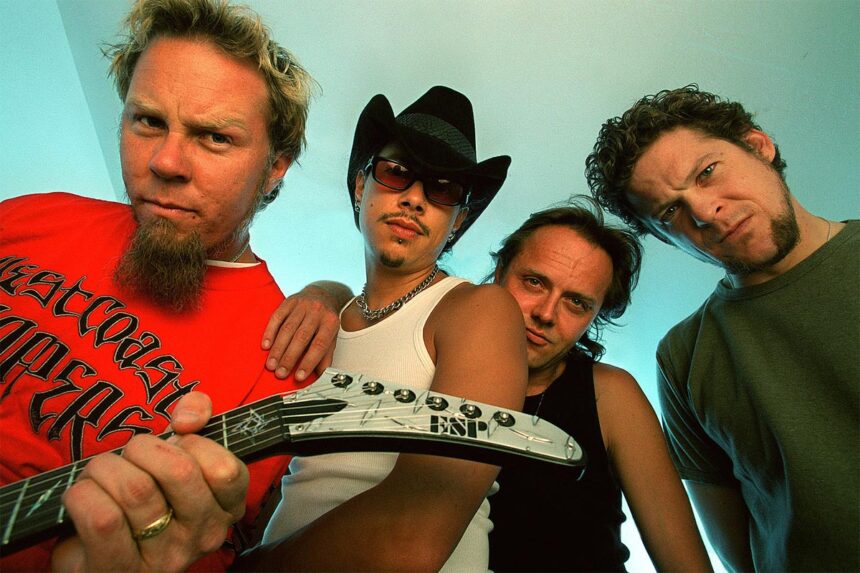
Former Metallica bassist Jason Newsted recently opened up about the challenging period following Cliff Burton’s death. He discussed how his enthusiasm clashed with the band’s grief, in an interview shared on Loudwire.

Newsted reflected on the stark contrast between his excitement about joining the band and the profound sadness that consumed the remaining members after losing their bassist and creative leader.
“I was the happiest person, happiest camper, most elated individual, reaching the pinnacle of the world that I found myself in, the world I wanted to be in, the microcosm we live in, the metal world,” Newsted said. “And I joined this thing of three of the saddest, collectively depressed, filled with anger and anguish people. And their crew — but the kings? It was so sad. They couldn’t comprehend what had happened. Nobody could, but especially they couldn’t.”
The bassist emphasized how quickly he was thrust into Burton’s role. The band had little time to process their loss.
“And they were never given any time to feel it or process it,” he continued. “One month after the event [of Cliff Burton’s death], maybe 20 days after the ashes spread, I was playing on Cliff’s amp. I mean, 20 days. We’re 23 years old. The consequence hadn’t even formed yet.”
Newsted described how the band members struggled with their grief during those early weeks.
“You know, I know my boys in those weeks tried some shit they never tried before inebriation wise to try to numb themselves hoping it wasn’t going to be true when they woke up,” he explained. “If they woke up, I know they tried that shit. I don’t think they did after, but those weeks they did. You know, that’s where they were.”
He highlighted Burton’s central role in the band’s dynamic and decision-making process.
“This their leader had been taken,” Newsted said. “You know, people like nowadays, nothing happens unless James says so. Back then, nothing happened unless Cliff said so. They move their whole lives in every goddamn thing just to be with that guy. That’s how much he meant. He was their teacher. He was their leader and he was just snatched from them just as they’re about mid-trajectory like that.”
The contrast between his excitement and their devastation created an impossible situation from the start. Newsted concluded: “So to have that happen and have them all feel that same way and I come in, I’m like, ‘Hey dude, how are you?’ They were like, ‘No.'”
Newsted’s recollections shed light on one of the most difficult transitions in metal history. A grieving band was forced to continue without their creative cornerstone.
The timeline of events reveals just how rushed this transition was. Wikipedia reported that Cliff Burton died on September 27, 1986, in a tour bus accident in Sweden during Metallica’s European Damage, Inc. Tour. The band auditioned over 50 bassists before recruiting Newsted from Flotsam and Jetsam in October 1986, just one month after Burton’s death. This compressed timeline left virtually no space for the band to properly grieve their loss.
Burton’s death represented more than just the loss of a band member. Metallica Wiki documented that Burton was a core creative force whose classical music influences and innovative style, particularly evident on Master of Puppets, had elevated the band’s sound significantly. His passing caused such profound fracturing and grief within Metallica that the band nearly quit altogether. They felt like their momentum had come to an abrupt end.
The challenge Newsted faced was stepping into this environment of raw grief and trauma. Shapes, Inc noted that Newsted joined Metallica as bassist following Burton’s death, stepping into a high-pressure role amid the band’s grief. Despite the hostile reception and emotional difficulties from the mourning members, Newsted endured as what he later described as the “first one in, last one out.” He provided 15 years of stabilization to the band.
Newsted later reflected on his role during this period. He described himself as the “new engine” needed to stabilize the “entity” amid the trauma. Metal Injection revealed that he positioned himself as the stabilizing force that helped the band navigate through their grief and anger following Burton’s passing. However, this came at a personal cost. Newsted ultimately left the band in January 2001 due to physical damage from touring and conflicts over his side project Echobrain.