






Jack White recently issued a clarifying statement regarding his controversial comments about Taylor Swift. He addressed misconceptions about his remarks in a post shared on Instagram.

The statement focused on clarifying that he never called Taylor Swift’s music “boring.” He explained his actual perspective on personal versus fictional songwriting approaches.
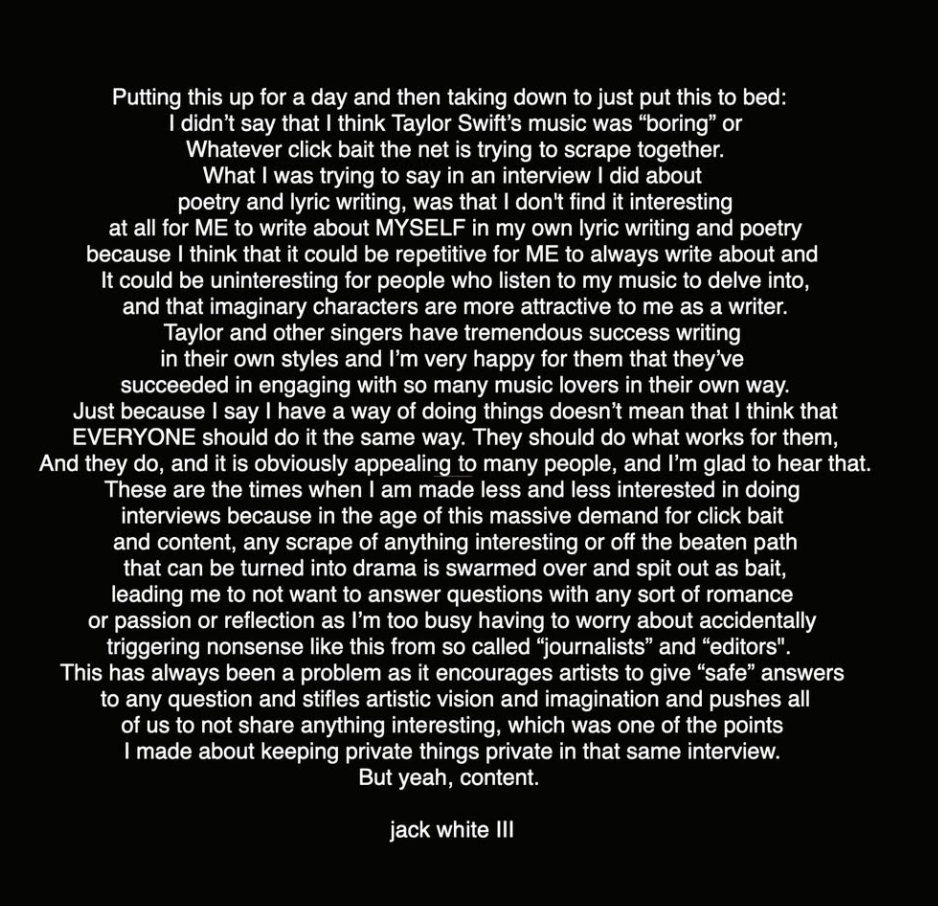
“I didn’t say that I think Taylor Swift’s music was ‘boring’ or whatever click bait the net is trying to scrape together,” White said. “What I was trying to say in an interview I did about poetry and lyric writing was that I don’t find it interesting at all for ME to write about MYSELF in my own lyric writing and poetry because I think that it could be repetitive for ME to always write about. It could be uninteresting for people who listen to my music to delve into, and imaginary characters are more attractive to me as a writer.”
White emphasized his respect for Swift and other artists who write in different styles.
“Taylor and other singers have tremendous success writing in their own styles and I’m very happy for them that they’ve succeeded in engaging with so many music lovers in their own way,” he continued. “Just because I say I have a way of doing things doesn’t mean that I think that EVERYONE should do it the same way. They should do what works for them, and they do, and it is obviously appealing to many people, and I’m glad to hear that.”
The musician also expressed frustration with how his comments were interpreted and the current media landscape.
“These are the times when I am made less and less interested in doing interviews because in the age of this massive demand for click bait and content, any scrape of anything interesting or off the beaten path that can be turned into drama is swarmed over and spit out as bait,” White stated. “This leads me to not want to answer questions with any sort of romance or passion or reflection as I’m too busy having to worry about accidentally triggering nonsense like this from so called ‘journalists’ and ‘editors.'”
“This has always been a problem as it encourages artists to give ‘safe’ answers to any question and stifles artistic vision and imagination. It pushes all of us to not share anything interesting, which was one of the points I made about keeping private things private in that same interview. But yeah, content.”
The controversy stems from White’s recent interview with The Guardian. In that interview, he discussed his songwriting philosophy and preference for fictional narratives over autobiographical content.
KOMO News reported that in the original Guardian interview, White explained his preference for fictional characters in lyrics over autobiographical writing. He stated: “Now it’s become very popular in the Taylor Swift way of pop singers writing about all of their publicly aired break-ups, which I don’t find interesting at all. I think it’s a little bit boring for me to write about myself.” He added that he avoids exposing personal pain to online critics.
The remarks quickly gained traction across social media and music publications. Many outlets framed White’s comments as a direct criticism of Swift’s artistic approach. Tone Deaf noted that outlets like Rolling Stone reported the remarks, leading to social media backlash and headlines that portrayed White as directly calling Swift’s music “boring.” This prompted his clarifying Instagram response.
This incident reflects White’s history of making bold public statements that often generate controversy. The White Stripes frontman has frequently voiced strong opinions on various cultural and political topics throughout his career. This demonstrates a pattern of outspoken commentary that extends beyond his musical work.
White’s clarification highlights the ongoing challenges artists face in the digital age. Comments can be quickly taken out of context and amplified across social media platforms. His frustration with the media’s tendency to create “clickbait” content from artist interviews reflects broader concerns within the music industry about how creative discussions are interpreted and presented to the public.