





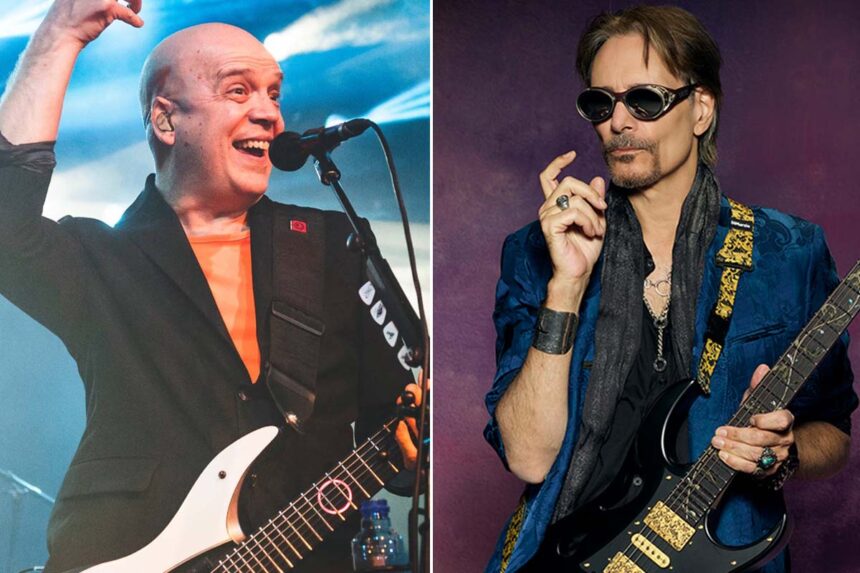
Devin Townsend has opened up about one of the more unusual stories from his early career — defecating in Steve Vai’s guitar case — in a candid conversation on the Heavy Stories podcast.

Townsend explained that the incident stemmed from a deep creative frustration he experienced as a teenager singing for Vai. He was unable at the time to express that frustration in any constructive way.
“With Steve, I was only 19 or 20 when I met him, so that petulant part of my personality was in full bloom, right?” he said. “When I got there, he was like, ‘I want you to sing these lyrics: sing this song, which is about my wife giving birth, and this song, which is about my experience with this.'”
“And I remember, at the time, just being like, ‘Man, I can’t!’ He’s like, ‘No, really give it on that line! This is the line where you really gotta reach for the heavens!’, and I’m just like, ‘But it doesn’t mean anything to me.'”
Townsend reflected on how fundamentally at odds Vai’s songwriting approach was with his own instincts. He described the experience as a turning point that shaped his creative identity.
“I remember reflecting on that experience as being so fundamentally in opposition to how I learned how to write that it wasn’t that I considered it to be wrong, necessarily – and it isn’t wrong, necessarily – but I reacted to it in such a way as a kid that everything in my nature was just like, ‘No!'”
“When you can’t articulate your discontent in a way that is able to be understood in a sitdown environment, I guess you’re left with only the shitting option.”
He went on to contextualize the act within a broader period of personal turmoil, ultimately framing it as a catalyst for his own artistic direction.
“I was too young to articulate it in any way that was rational. At that point, it was a culmination of a lot of circumstances, like arrogance, fame and confusion and relationships. All that stuff. I can forgive myself in hindsight for the ways I reacted at the time because I didn’t know what to do. I didn’t know how to respond. I was lost, right? And I responded to it by creating Strapping,” he continued.
The story carries more weight when placed against the full backdrop of what that collaboration actually was for Townsend — not a side appearance, but his first major professional moment in music.
Sex & Religion was released in July 1993. It marked Townsend’s debut on the world stage, with him singing the entire album. He stepped into a high-profile role at an age when most musicians are still finding their footing. The pressure of performing deeply personal material written by someone else, for a global audience, was immense for a young artist who had not yet developed the tools to navigate it.
The disconnect never fully healed. Townsend has stated that he still cannot listen to Sex & Religion to this day. What should have been a proud milestone in his career remains something he keeps at arm’s length, decades later.
That rupture, however, proved generative. The frustration Townsend could not articulate in words became the raw material for Strapping Young Lad, the industrial metal outfit he formed in the aftermath. Where Vai’s world was melodic, technical, and emotionally precise, Strapping Young Lad was abrasive, chaotic, and cathartic. It was a direct sonic response to everything Townsend had suppressed during the Sex & Religion sessions.
The contrast between the two projects tells the story more clearly than any explanation could. Townsend arrived in Vai’s world as a teenager with no framework for the experience. He left with the blueprint for one of the most uncompromising bands of the 1990s. The guitar case incident, as strange as it is, sits at the center of that transformation.


