






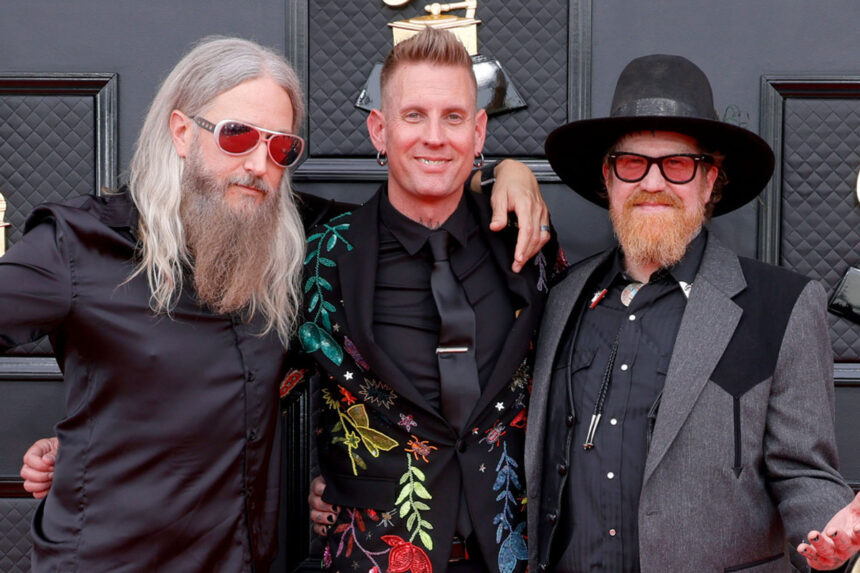
Mastodon drummer Brann Dailor has addressed criticism that the band threw the late Brent Hinds “under the bus” with their new mini documentary, “The Mastodon In The Room.” He discussed the matter in an interview with The Break Down With Nath & Johnny.

Dailor explained that he initially had reservations about releasing the documentary, given its personal nature and the fact that Hinds was no longer able to offer his own perspective.
“I had huge question marks about putting out ‘The Mastodon In The Room’,” Dailor said. “I was, like, ‘That’s pretty personal.’ And Brent’s not here to defend himself. And so I didn’t like that part of it either, and I talked about that with everybody. I was just, like, sort of on the fence about it.”
He went on to explain why the band ultimately felt they needed to address the situation publicly, given comments Hinds had made about them in the press.
“But we left our fans with all these questions because Brent obviously attacked us in the press,” Dailor continued. “And I knew that that was coming, and I address that in the video as well. And I knew that he didn’t mean that. I don’t know how many times I had heard him late at night, with a few, say some ridiculous shit, and I’d just be, like, ‘You don’t feel that way at all, but whatever. Okay.’ But we couldn’t come out and be, like, ‘Oh, R.I.P., Brent. We love you. And here’s our new record,’ and that’s it.”
Dailor pushed back directly on the idea that the documentary was unfair to his former bandmate. He acknowledged the complexity of their history together.
“I don’t think we threw him under the bus at all,” he said. “And we didn’t even touch the tip of the iceberg with that whole very complex relationship.”
He also reflected on the toll of the band’s repeated attempts to work through their issues with Hinds over the years. He addressed the decision to eventually step back.
“I know he was having a hard time [after we parted ways], but trying over and over again for 10 years plus, it does a number on yourself,” Dailor said. “And I’m, like, ‘I’m a person, too.’ What am I supposed to do? What are we supposed to do? It’s kind of, like, forcing our hand, and then at some point you need to protect yourself and your own mental health.”
Dailor closed by expressing hope that the rift with Hinds would eventually have been resolved. He voiced regret that this is no longer possible.
“Obviously we just need a break [from him] or something,” he said. “And I really honestly thought that — I don’t know if it would be a year, I don’t know if it would be two years or whatever happened, but that we would eventually squash it and just be, like, ‘Dude, what was all that bullshit?’ Hugs and kisses. And I don’t know if we would’ve jammed again, but we probably would’ve, I would imagine. But it just sucks that we won’t have that opportunity.”
The documentary and Dailor’s comments arrive at a pivotal moment for Mastodon, one shaped by loss, reflection, and a new chapter for the band.
Hinds died in a motorcycle crash in August 2025, roughly a year before “The Mastodon In The Room” surfaced. The film leans on old clips and home movies to trace the band’s history with the guitarist. It offers a largely unfiltered look at their years together and, in many ways, doubles as an attempt at reconciliation after his death.
Mastodon has since pressed forward with new music. The band released “Marrow Deep,” their ninth studio album, on August 28, 2026. It marks the first Mastodon record made entirely without Hinds, whose unpredictable lead guitar work had been a defining piece of the band’s sound for a quarter century. Guitarist Nick Johnston stepped in to handle lead guitar duties for the new material.
Hinds’ presence has continued to surface elsewhere in the months following his death. In August 2026, the band CKY released a song featuring Hinds, marking one of his first posthumous recordings. It followed closely behind another posthumous appearance on a Marcus King track.
Dailor’s remarks, set against that backdrop, read less like damage control and more like an attempt to explain a decision the band clearly wrestled with. It was a relationship too complicated to sum up in a single tribute, let alone a short film.


