






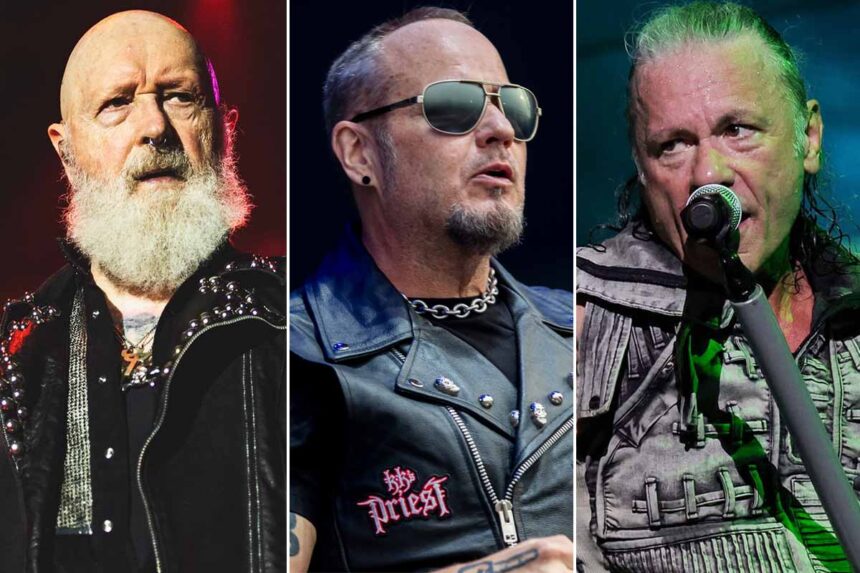
Former Judas Priest vocalist Tim ‘Ripper’ Owens has weighed in on a long-standing comparison between two heavy metal giants. He offered his candid take on why Iron Maiden outpaces Judas Priest in terms of live draw and overall management.

Owens fronted Judas Priest during the late 1990s and early 2000s. He addressed the contrast between how Iron Maiden handles its legacy — including performing songs recorded with former singer Blaze Bayley — versus how Priest treats material from his own era. He also touched on how Rob Halford might sound on some of the songs he originally recorded.
“You just said Rob Halford ‘rarely performs’ it. Rob Halford’s never performed [Priest songs from my era of the band]. But no, [I] absolutely [think there are songs he would sound great on],” Owens said. “Could you imagine how great Rob Halford would sound singing ‘Burn In Hell’? It would be better than my version. He would sound… It’s so great for him, he would sound fantastic. Now, I’d like to see him try ‘Jugulator’, but I don’t think that would happen. But, yeah, they would sound fantastic.”
Owens then shifted his focus to the broader question of why Iron Maiden operates at a higher level than Judas Priest when it comes to their live draw and business decisions.
“But there’s a difference of bands you’re talking about. You’re talking about Iron Maiden, who has great management. They do great business moves. They’re up here [at a higher level than Priest when it comes to their live draw]. Judas Priest, yeah… This is a band that announced they were going to one guitar player [for their live shows] years ago [only to quickly change their minds],” he said. “I mean, how the f*ck does Judas Priest go to one guitar player?”
Owens also pointed to the Rock And Roll Hall Of Fame inductions as a telling example of the difference in how each band treats its former members.
“So you’re talking about Iron Maiden with great management, great marketing, a great team. They go into the Rock And Roll Hall Of Fame. They demand that Blaze Bayley goes into Rock And Roll Hall Of Fame [with the other current and former members of the band]. Judas Priest goes into the Rock And Hall Of Fame, and Judas Priest is pretty much, ‘Absolutely not, Ripper’s not going in,'” he continued.
He concluded by tying the management differences directly to each band’s commercial success on the road.
“So [Iron Maiden] have great management, and there’s a reason why they play in front of 20,000 people and the other one [Judas Priest] plays in front of five. That’s the difference. So there’s your answer of why Iron Maiden, which is a little more class act, plays Blaze Bayley’s songs, ’cause they wrote ’em, they did it. Why would they not?”
Owens’ remarks offer a rare and direct insider perspective on the internal culture and business decisions that, in his view, have separated the two iconic bands over the years.
The comments carry particular weight given Owens’ unique position in heavy metal history. He was recruited by Judas Priest in 1996 to replace Rob Halford, having been discovered while fronting a Judas Priest tribute band called British Steel. That story served as the loose inspiration for the 2001 film Rock Star. During his tenure, he recorded two studio albums with the band: Jugulator in 1997 and Demolition in 2001. Both records remain unavailable on major streaming platforms to this day.
The streaming absence of those records is itself a point of ongoing frustration for Owens. It underscores the broader pattern of neglect he describes. Iron Maiden has actively embraced its full catalog and all of its former members. Judas Priest’s handling of the Owens era, by contrast, has been marked by erasure rather than acknowledgment. The band’s 2022 Rock And Roll Hall Of Fame induction excluded Owens entirely, standing as the most visible example of that divide.
The contrast with Iron Maiden’s approach is stark. When Maiden was inducted into the Rock And Roll Hall Of Fame in 2025, the band pushed for Blaze Bayley — who fronted the group from 1994 to 1996 — to be included alongside the other current and former members. That decision reflected a philosophy of institutional respect for every chapter of the band’s history, regardless of commercial performance or fan preference.
Owens has not stepped away from the metal world. He currently performs with KK’s Priest, a band formed by former Judas Priest guitarist KK Downing, as well as with Spirits of Fire and the Three Tremors. His continued activity in the genre makes his criticisms all the more pointed. These are not the grievances of someone who has moved on, but of a working musician who remains deeply embedded in the world Judas Priest helped build.
The broader takeaway from Owens’ comments is less about personal bitterness and more about institutional culture. Iron Maiden’s willingness to honor every era of its history — on stage, in award ceremonies, and in how it treats former members — has translated directly into a larger, more loyal fanbase. Judas Priest, by contrast, has repeatedly stumbled over decisions that signal internal disorganization and a reluctance to fully reckon with its own legacy.
Source: Whiplash


