
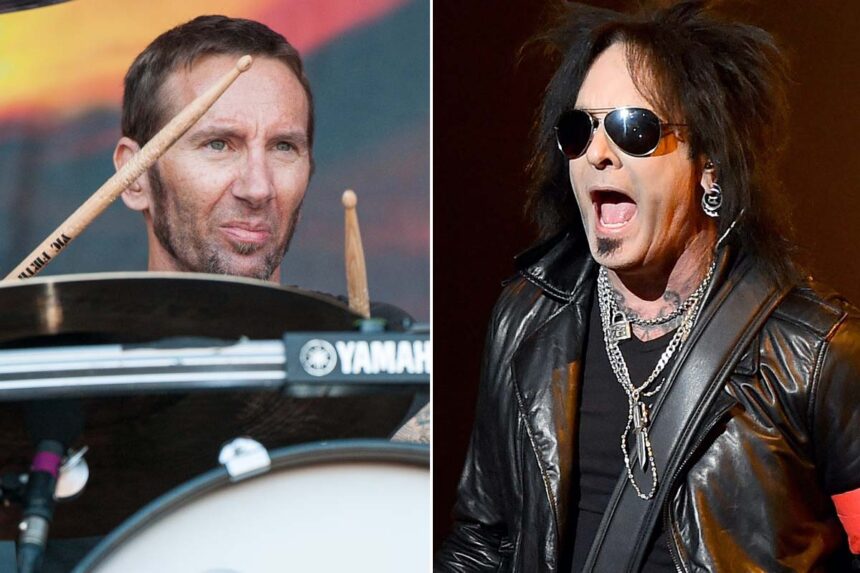
Former Godsmack drummer Shannon Larkin recently spoke out about backing tracks in live performances. He addressed the topic in a statement shared on his Inside Skinny Productions YouTube channel.

Larkin’s comments came in the context of defending the band’s former drummer Wade Murff, who was recently fired. He also weighed in on the broader debate over the use of click tracks and backing tracks in rock concerts, specifically calling out Mötley Crüe bassist Nikki Sixx.
“The only thing I could see in any kind of criticism towards Wade Murff, as I watched videos back through the shows — every show’s online — was the interaction of tempo push and pull wasn’t as smooth perhaps, but Sully and I have been on the same page for over two decades playing live shows and making records together,” Larkin said. “And so what I try to explain to people about tempo and when you’re not a band that’s a click-track, backing-track kind of band.”
Larkin went on to draw a clear distinction between Godsmack’s approach and what he described as an increasingly common practice across the industry.
“So Godsmack uses no click tracks, no backing tracks. It’s a thing that a lot of other musicians talk about too, I notice now. I’m really noticing it. We’ve been saying it for years as we watched the advent of everybody started adding some, the rhythm guitar or something being played, but there isn’t a guy behind the amps playing it. It’s on a track. Oh, it’s a new thing, kinda,” he continued.
He then directly pointed to Nikki Sixx as an example of a musician he believes relies on backing tracks during live shows.
“And backups, you see Nikki Sixx up there [with Mötley Crüe]. He’s not really singing, he looks away, but you still hear his voice. Well, it’s a track playing. But in order for those things to happen, the band has to be on a click track — and the band doesn’t have to. It’s just us, the drummer. We’re on a click, so it’s always the same every night. So it’s a homogenization of what used to be the dangerous feeling of a rock show — dangerous from the band’s aspect on stage too. You don’t know what’s gonna go on,” Larkin said.
Neither Nikki Sixx nor Mötley Crüe have publicly responded to Larkin’s remarks at this time.
Larkin’s candid remarks place him at the center of a debate that has quietly simmered in the rock world for years. It is now increasingly spilling into public view as fans and musicians alike grow more vocal about the authenticity of live performances.
Larkin served as Godsmack’s drummer for over two decades, becoming one of the most recognizable figures in the band’s lineup alongside frontman Sully Erna. His tenure with the band was defined by a commitment to raw, unfiltered live performance — a philosophy he has consistently championed throughout his career. His departure from the band made his continued commentary on Godsmack’s internal affairs and artistic standards all the more notable.
Wade Murff stepped in as Godsmack’s drummer following Larkin’s exit and was fired after a relatively brief stint with the band. While the official reasons behind his dismissal were not fully detailed by the band, Larkin’s remarks suggest that tempo inconsistencies during live shows were a point of contention. He was careful to frame those issues as a natural byproduct of playing without the safety net of a click track, rather than a fundamental failing on Murff’s part.
The backing track debate is not new to the rock world. As production technology advanced over the past two decades, an increasing number of touring acts began supplementing their live sound with pre-recorded elements — ranging from vocal harmonies and rhythm guitar layers to full orchestral arrangements. Critics argue that the practice undermines the spontaneity and authenticity that define live rock music. Proponents maintain it is a practical tool for delivering a consistent, polished show night after night.
Mötley Crüe has faced persistent scrutiny over the authenticity of their live performances since reuniting for their The Stadium Tour in 2022. Questions about the band’s use of backing tracks and pre-recorded elements have followed them throughout their recent touring activity. Fans and fellow musicians have pointed to visual cues — such as instruments appearing to be played while the corresponding sound continues uninterrupted — as evidence of supplemental audio. Larkin’s comments add a prominent new voice to those long-standing suspicions.
The broader conversation Larkin is tapping into reflects a growing tension in the live music industry between spectacle and authenticity. As rock’s elder statesmen continue to tour well into their fifties and sixties, the physical demands of performing at the level audiences expect have led many acts to lean more heavily on technological assistance. This is a reality that younger and more purist-minded musicians are increasingly unwilling to let pass without comment.