



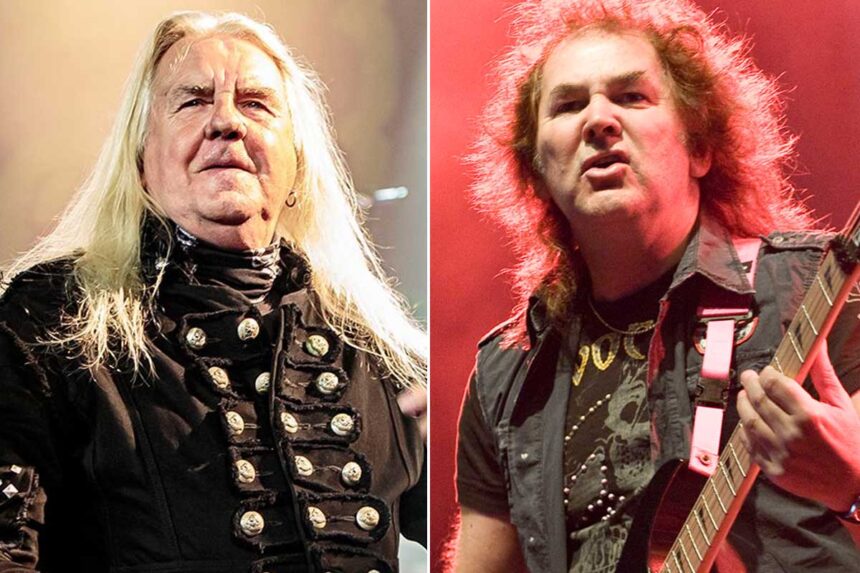
Saxon frontman Biff Byford addressed the topic of former band members Paul Quinn and Graham Oliver in a recent interview. He sent an unexpected message about the years of bad blood between them.

Byford was asked about Quinn and Oliver’s occasional Saxon-themed shows together and whether he had any thoughts on the matter — particularly given the history surrounding Oliver’s departure from the band.
“Why shouldn’t they do it?” Byford said when asked whether Quinn and Oliver should be performing Saxon-themed shows together.
When it was pointed out that there had been bad blood toward Graham since he was sacked in 1996, Byford offered a notably reconciliatory response.
“I don’t really have any problem with Graham any more,” he said. “He used to do stupid things that smashed the reputation of the band. That’s all over now.”
Byford also revealed that the two had crossed paths in person. “I met Graham not too long ago in an airport and we had a chat,” he added. “I don’t think Paul wanted to retire from music, just the bigger gigs.”
Oliver’s history with Saxon had been a contentious one. He and ex-bassist Steve ‘Dobby’ Dawson had previously run a rival outfit under the Oliver-Dawson Saxon name following his dismissal. Byford’s comments suggest that chapter may now be firmly in the past.
The fallout between Oliver and the band had deep roots. The consequences stretched well beyond a simple lineup change. What followed Oliver’s exit was one of the most drawn-out and damaging disputes in British heavy metal history.
After his departure, Oliver and Dawson launched a legal battle over the rights to the Saxon name. The court ultimately ruled that the pair could only operate under the name Oliver-Dawson Saxon, with specific conditions attached. They were prevented from using the “Saxon” name on its own. The ruling drew a clear legal line between the two camps, though the rivalry continued to simmer for years.
Oliver had spent over two decades with Saxon and was a central figure during the band’s most commercially successful era. His contributions spanned landmark albums including Wheels of Steel and Strong Arm of the Law. Those records helped define the New Wave of British Heavy Metal movement and cement Saxon’s place in rock history.
Paul Quinn stood alongside Byford throughout the legal battles and lineup turbulence. He had been a constant presence in the band for decades before stepping back from larger commitments. His occasional performances with Oliver in recent years marked a notable shift — two figures from different sides of a long-standing divide sharing a stage under the Saxon banner once more.
Byford’s airport encounter with Oliver, and his willingness to speak openly about moving on, signals a broader thawing of tensions that once defined the band’s public narrative. With the legal disputes settled and the rival outfit no longer active, the story of Saxon’s fractured past appears to be giving way to something closer to acceptance.