

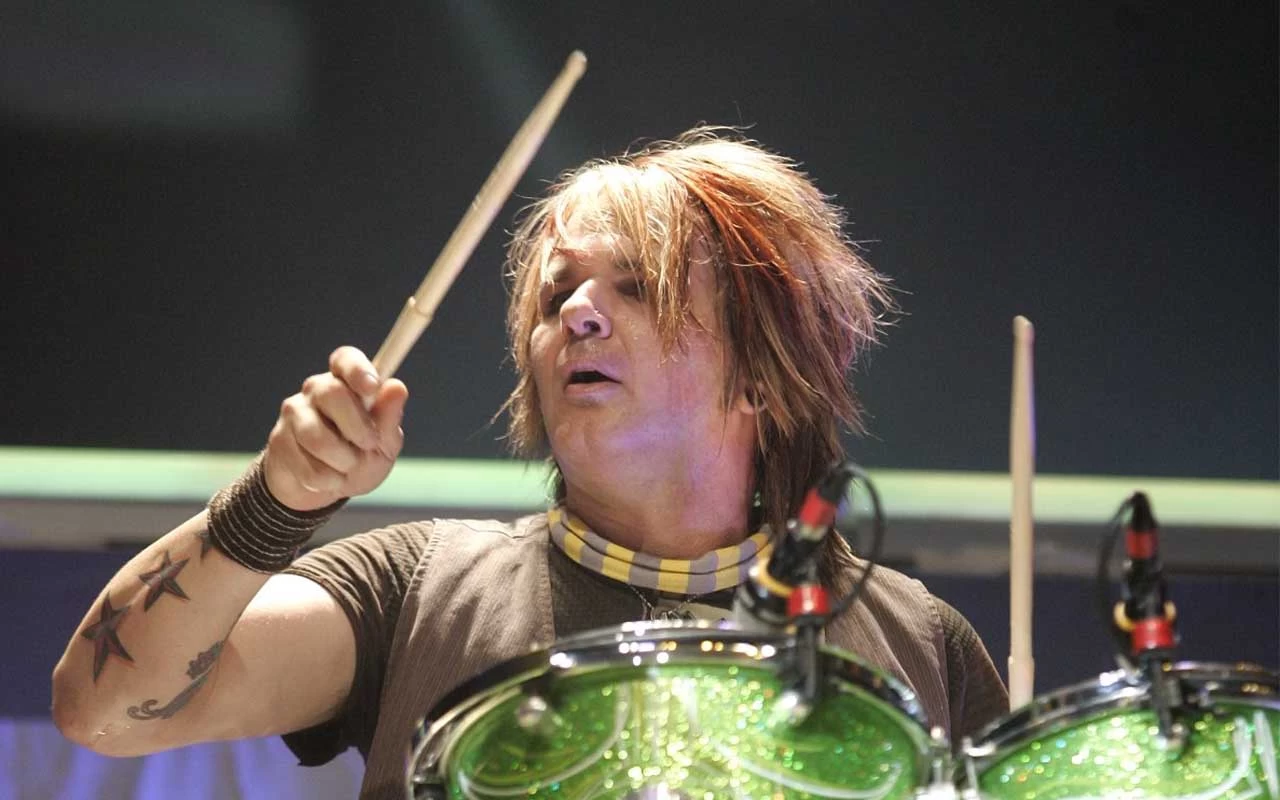
Poison drummer Rikki Rockett shared a detailed personal statement about his cancer journey on Facebook. He revealed that he is now ten years cancer free — a milestone he described as bigger than anything he accomplished with his band.

In the statement, Rockett recounted his initial diagnosis, the grueling treatment process, and the experimental immunotherapy trial that ultimately saved his life.
“In 2015 I went to my ENT because I was on my second round of antibiotics to cure a sore throat,” Rockett said. “I got scoped that day and not long after I was diagnosed with Stage 3 Head and Neck Cancer (Throat Cancer). Squamous Cell Carcinoma.”
He went on to describe the intensity of the treatment that followed.
“I began a three month, intensive treatment plan that included radiation (5 days a week) and Chemo (weekly),” he continued. “Then you have to wait another three months to see if it worked. The side effects were insane. I lost 30% of my body weight. I could not eat solid food. My throat hurt 24/7, I was tired, my throat swelled, I had radiation burns. I kept my hair, except that I had a radiation burn around the back so I had to cut my back off. My beard had a radiation line, so I shaved it off. After three months, I had gone from stage 3 to stage 4. The treatment didn’t work. I was offered a surgery to remove my tongue.”
Rather than accepting that outcome, Rockett sought an alternative path through a clinical trial.
“Me being the bullheaded thing that I am, I refused and I was able to find a clinical trial using a new approach called, Immunotherapy,” he said. “The trial was headed up by Dr. Ezra Cohen and Dr. Sandip Patel at Moores Cancer Center / UCSD in San Diego. These men became my life lines along with Tony Le who was my trial co-ordinator. It was an intense first week of tests. The plan was this: Infusion every three weeks, two pills a day and every nine weeks, MRI, PET and CT Scans. I was told not to freak out if the first scans showed tumors to be larger.”
He described the frightening first night of treatment and the reassurance he received from his doctor.
“Day one was seven hours in the hospital on infusions,” Rockett said. “Night one was scary. I stayed in San Diego. My tongue swelled and I thought I might choke. I called Dr. Cohen, he said, ‘This means it’s working!'”
Nine weeks later, Rockett received news that stunned even his medical team.
“Nine weeks later I had my first clinical visit for scans. I was more nervous than ever in my life,” he said. “If this modality didn’t work, it would be more chemo, more radiation eventually, probably surgery. TC was by my side that day. She was ALWAYS by my side. The assistant looked at the scans and I asked slowly, ‘How do they look?’ She said, ‘Pretty good, actually!’ Dr. Cohen walked in just then and said, ‘This is near miraculous. Your tumors are 90% gone!'”
“Two weeks later I pulled my car over to spit,” he continued. “Spitting had become routine. Something not much different than an effect in Evil Dead landed on the ground. I called my Dr… ‘Dr. Cohen, I think I just spit out my tumor!'”
The trial, originally scheduled for two years, ended early — but not without a new challenge emerging.
“My trial was scheduled as a two year trial. It lasted nine months and I was declared cancer free just 18 weeks after I started,” Rockett said. “We stopped the trial because during the trial I developed another cancer, Chronic Myeloid Leukemia (CML). I was pulled off of immunotherapy and put on a medication called Gleevac. In two months my numbers dropped to almost zero cancer and finally after two years to zero cancer. From a pill! Dr. Jameison is still my anchor and she is a brilliant Dr. Thank God CML is one of the more mild things that you can get and I still take a daily pill to keep it away. It too is in remission.”
Reflecting on the broader significance of his experience, Rockett expressed deep gratitude and a sense of purpose.
“Folks, I beat two forms of cancer!” he said. “I would walk through the infusion room and see people on a drug that was experimental for me, but now has become routine. I felt like I was part of something much, much bigger than I had ever been a part of. This very thing was an accomplishment, not just for the Dr.s, for me and my family, but honestly, for the world! I was one of the few that gifted that opportunity. I am not taking a bow, I am gracious for the chance. I was able to speak before crowds of Dr.s, scientists and people who wanted a new answer. This was bigger than anything I had ever done with Poison. I was part of something miraculous!”
Rockett also marked the personal significance of the anniversary and issued a public health warning.
“Today marks exactly 10 years cancer free. One day before my son’s birthday. We will celebrate together,” he said. “All of this story is in my book coming out. It was tough to write. Everyone, be careful. My cancer was caused by HPV and is the #1 cause of this in people my age and younger. Same for women and cervical cancer.”
He closed with a message of encouragement for anyone facing a similar battle.
“If you ever get this or anything like this, take care of yourself, keep working out, get up and take a shower and look your best,” Rockett said. “Go to a shrink. Treat yourself and make yourself first and then you can come back and help others. Have a blessed day. Thank you to all my Doctors and forever to TC.”
Rockett’s full story is set to be detailed further in his upcoming book.
Rockett’s warning about HPV carries real weight in the broader medical landscape. The virus has become one of the most significant drivers of head and neck cancer globally.
HPV-related head and neck cancers have been rising steadily in recent decades, even as tobacco-related cases have declined. Incidence rates for HPV-associated subtypes have increased across all age groups and genders worldwide. In the United States alone, HPV is responsible for approximately 39,300 cancer cases each year.
The type of cancer Rockett developed — oropharyngeal squamous cell carcinoma — is now the most common HPV-related head and neck malignancy. HPV accounts for 72% of all such cases in developed countries. HPV16, a specific strain of the virus, is responsible for more than 90% of HPV-driven head and neck cancers. Despite the alarming rise in diagnoses, patients with HPV-positive tumors tend to fare significantly better than those with HPV-negative cases. Five-year survival rates reach 80% or higher for HPV-positive patients, compared to 40–60% for HPV-negative patients.
The immunotherapy approach that Rockett credits with saving his life has also proven to be particularly effective in HPV-positive cases. Clinical data shows that immunotherapy response rates for HPV-positive head and neck tumors can reach as high as 84%, compared to 57% for HPV-negative tumors. That gap underscores why Rockett’s participation in the early trial was not only personally transformative but scientifically meaningful. The drug he helped test has since become a routine treatment option for patients facing the same diagnosis.
Rockett has been Poison’s drummer since the band’s formation in 1983. He co-wrote many of their biggest hits across a career that spanned decades of arena rock success. That context makes his reflection all the more striking. For a musician who helped define a generation of rock music, it is the quiet work done in a San Diego infusion room — not the stages or the stadiums — that he considers his greatest contribution.


