


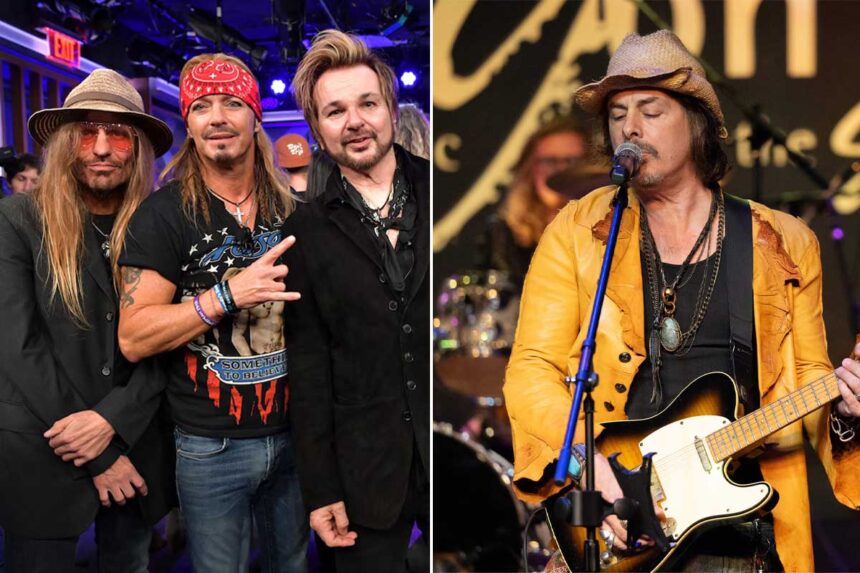
Rikki Rockett opened up about the band’s decision to replace C.C. DeVille with Richie Kotzen. He also discussed the making of their fourth album, Native Tongue.

Rockett spoke about the challenges the band faced following DeVille’s departure in late 1991. He explained why the album turned out to be a relative commercial disappointment. It remains the only Poison LP to feature Kotzen on lead guitar.
“The thing is that during the early part of the whole grunge thing, we were so consumed with trying to kind of reinvent Poison and fill C.C.’s shoes in some way, shape or form, and we realized we’re not gonna be able to do that, so we made a little bit of a left turn,” Rockett said.
The drummer reflected on the album years later. He admitted he still holds the record in high regard.
“And it’s funny ’cause I just listened to that record, ‘Native Tongue’, yesterday. And I haven’t listened to it for a while, except for one song that I do in my drum clinic. But I love the way I played on that record. I think it’s a great record. Richie was great to work with, and I’m very, very proud of that record. I feel like we went, ‘We’re not gonna try to be grunge ’cause that’s not our jam. We’re not gonna try to be what we were with C.C. We’re going to turn the page and do a new chapter, and we’re gonna do it really well,'” he continued.
Rockett acknowledged that the album did not match the commercial heights of earlier Poison records. It still found a respectable audience.
“And I think we did all those things. Was it as successful as [1988’s] ‘Open Up And Say… Ahh!’, and stuff like that? No, it wasn’t. People had grown to understand Poison a certain way, and then there were other types of music that were, obviously out there. And so there was a lot of ingredients for why [it wasn’t as successful],” he explained.
“But it still quietly sold a million records in the first few months. And we were still on MTV, and we did get treated differently than some of the other acts that followed us. And it was well-received by a lot of people. A lot of critics liked it. To this day, I think a lot of people like that record. And, again, I do too. I’m sitting there listening, I go, ‘I really like what I played on that. That’s cool.’ I go back to [1986’s] ‘Look What The Cat Dragged In’, and I go, ‘Oh my God, why did I play that?’ But it’s 40 years later. What do you want?”
Rockett also praised the production and the band’s performance during that era.
“Sometimes it’s just perception and timing and all that kind of stuff. But we had a great producer. Richie Zito was fantastic to work with. And I think everybody was playing, and Bret was singing — we were at our prime, I feel like. And [we made a] great video. The ‘Stand’ video’s incredible. I look back at that and I go, ‘Wow.’ We shot it on film. It looked fricking like a movie. It was so good. But it just didn’t resonate with core Poison fans — most of them anyway. We went out, we did a tour, we did fine and all that stuff. We did Europe. Again, it was fine. It was good. But it wasn’t phenomenal.”
Native Tongue was released in 1993. It marked a deliberate stylistic departure for Poison. The band moved away from the party-anthem glam-metal sound that had defined their earlier work with DeVille. They embraced a more serious, blues-rock-oriented approach. The album debuted at No. 16 on the Billboard 200. It was a respectable showing that nonetheless fell short of the multiplatinum heights of albums like Open Up and Say… Ahh!.
The record produced two notable singles: “Stand” and “Until You Suffer Some (Fire and Ice).” The music video for “Stand” was shot on film. It was a point of particular pride for Rockett. He described it as looking “like a movie.”
Native Tongue represented a creative milestone for Rockett. It was the album where he finally felt he could play the way he wanted to play. He contrasted it with the band’s earlier records. This sense of artistic fulfillment remains a key reason why he looks back on the album so fondly.
The Kotzen era proved to be a brief chapter in Poison’s history. The band ultimately reunited with C.C. DeVille in 1999. They returned to the lineup that had defined their biggest hits. But Native Tongue stands as a testament to a moment when Poison refused to repeat itself. The band chose to take a risk instead.


