



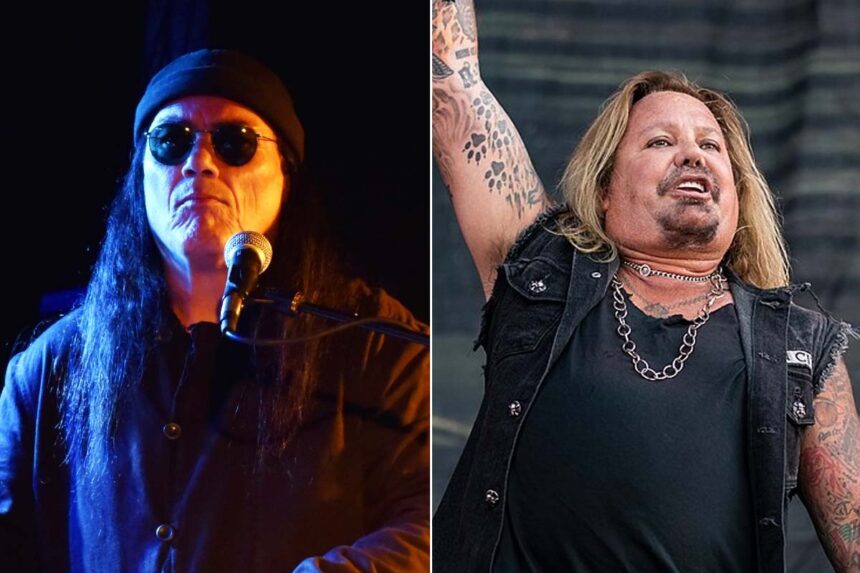
Former Rainbow keyboardist Tony Carey has made new claims about Mötley Crüe using backing vocals at their live shows. He shared his thoughts in an interview published on Classic Album Review.

Carey was asked about the growing prevalence of click tracks and backing tapes in live rock performances, and whether such practices are healthy for rock and roll. His response touched on Mötley Crüe specifically, as well as the broader shift toward highly choreographed, production-heavy live shows.
“It’s not rock and roll anymore,” Carey said. “And I’m not sure that there is rock and roll anymore because when you get to the point where you’re charging 200 bucks for a ticket, like big shows like I mean even Foo Fighters or more the pop shows, Robbie Williams or Adele. Take it take us to four or five hundred bucks. It’s got to be right.”
Carey then turned his attention directly to Mötley Crüe, alleging that the band relies on pre-recorded material during their performances.
“And it’s not just flying in vocals, which is what Mötley Crüe does and sometimes the whole band,” he continued. “I mean, I’ve seen Tommy Lee caught on film where he didn’t make his symbol crash that that you could clearly hear.”
He went on to describe how modern large-scale concerts are tightly synchronized systems, with safety implications for everyone involved.
“It’s everything is synced to this click track including lighting cues and explosions and it can be really dangerous to be on in one of these worked out shows to be on the stage in the wrong place at the wrong time when an explosion goes off,” Carey said. “It’s not just up to chance. And in the 70s and 80s that was rock and roll that I mean we just went out and played you know and if the drummers really excited we play the songs too fast. Who cares?”
Carey contrasted the spontaneity of earlier rock performances with today’s rigidly planned productions.
“But these days it’s much more of a business and it’s more like putting on a Broadway show,” he said. “It has to be choreographed down to where they don’t change the set. In the old days we could change the set list. We were like, ‘No, I don’t want to play that tonight. Let’s play this, you know. Okay. 1 2 3 4 we play that.'”
“Today it’s all programmed into computers and things have to work,” he continued. “There are like elevators in the stage, you know, where like Billy Eilish comes up and the thing throws her up. Imagine she missed her queue. You know, it could kill her. And if you’re underneath that stage where these elevators go up and down, it can kill you.”
“And so it’s a very professional, let’s put that professional way to present your music,” Carey concluded. “Whereas rock and roll is the least professional thing.”
Carey made these remarks during a broader conversation about his time with Rainbow and the state of the modern rock music industry. No response from Mötley Crüe has been issued at this time.
Carey’s comments arrive amid a long-running and very public debate over Mötley Crüe’s live performance practices. The controversy has only intensified following the departure of founding guitarist Mick Mars from the band.
As Ultimate Classic Rock reported, Mars alleged that Mötley Crüe used backing tracks during their 2022 tour. He claimed that bassist Nikki Sixx “did not play a single note on bass during the entire U.S. tour.” The accusations formed part of a broader legal and public dispute between Mars and his former bandmates following his exit from the group.
Sixx pushed back against the claims, acknowledging that the band has used “audio enhancements” since 1985. He insisted that “anything we enhance the shows with, we actually played.” The band’s attorney also weighed in, stating that “the fact of the matter is that Motley always plays live,” as Ultimate Classic Rock noted.
The broader conversation around backing tracks in live rock performances is not unique to Mötley Crüe. Jamzone highlighted how backing tracks, when paired with click tracks and in-ear monitoring, have become a widespread tool across the industry. They help artists keep everyone synchronized — from timing guitar solos to cueing backing vocals — particularly in large-scale productions where precision is non-negotiable.
The practice has roots that go back further than many fans may realize. Karaoke Version noted that Mötley Crüe themselves changed rock in 1987 by openly admitting the truth about their use of backing tracks. That history makes the band’s current denials all the more striking to critics and longtime observers of the industry.
Whether Carey’s latest remarks will prompt a fresh response from the Mötley Crüe camp remains to be seen. What is clear is that the debate over authenticity in live rock performance shows no signs of fading. Veterans like Carey continue to draw a sharp line between the raw spontaneity of classic rock and the polished, production-driven spectacles that dominate arenas today.


