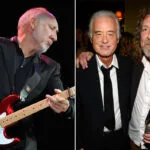




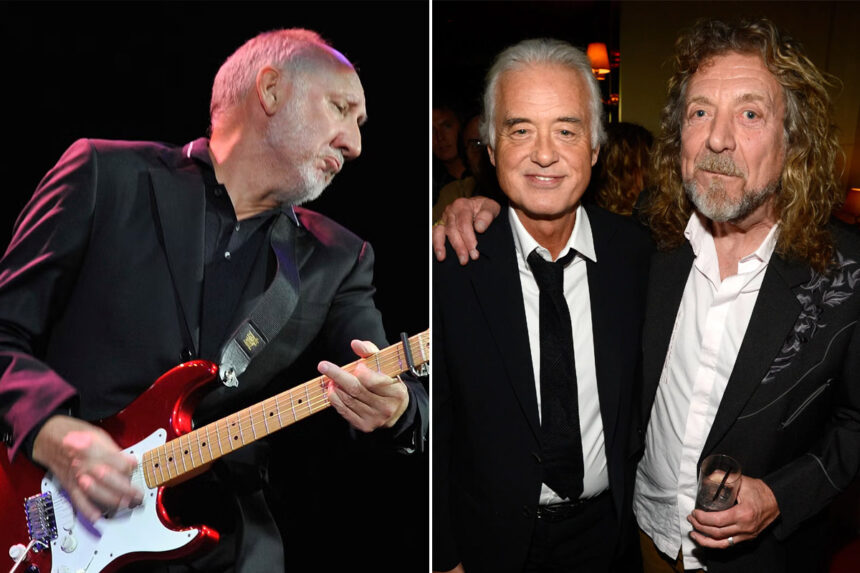
Pete Townshend has confessed that he deliberately avoided Led Zeppelin’s music when the band was at its peak because he felt they were taking The Who’s audience, he told Classic Album Review.

Townshend was asked about his relationship with Led Zeppelin’s work during their rise in the late 1960s and early 1970s. He explained that his resistance to the band stemmed from a sense of rivalry rather than any musical objection, and he compared the situation to earlier tensions he had felt with other guitar-playing contemporaries.
“I never really got into Led Zeppelin, which is strange because today I’ve recently been trying to get Jimmy Page to have lunch with me,” Townshend said. “I sent him a note recently just saying, ‘I’ve been listening to all of Led Zeppelin albums again,’ and I thought I should. And there’s some fucking great stuff there. It’s just that at the time I didn’t like it that they were, in a sense, trying to pinch our audience.”
He went on to reflect on similar feelings he had experienced with other influential guitarists who had emerged on the scene. “[Laughs] I’d been through it before with Jimi Hendrix coming over with his big amplifiers and his distortion and his wah-wah pedal and everything else, and having to admit, ‘Wow, here is a guitar genius,'” Townshend continued. “Eric Clapton was my friend. Jeff Beck was my friend. Jimi was somebody that I knew really well. I knew he was a great shredder if he wanted to be. And so I was kind of surprised, really, when I started to listen to Led Zeppelin at the variations.”
Townshend’s comments came as he reflected on his listening habits and his appreciation for the band’s catalogue in recent years. The remarks show how competitive pressures in rock music during that era affected even established artists.
Townshend’s frustration with Led Zeppelin’s commercial success reflected a broader shift in rock music during the 1970s. Led Zeppelin formed in 1968 under guitarist Jimmy Page and quickly became one of the world’s most popular live acts, earning four times their initial American tour fee by their spring 1969 North American tour. The band remained a major draw from September 1968 until the summer of 1980, performing hundreds of sold-out concerts worldwide.
The Who had established themselves as one of the most creatively ambitious bands of their era through albums released between 1967 and 1973, including Who’s Next in 1971 and Quadrophenia in 1973. Townshend has claimed that The Who “sort of invented heavy metal” with their 1970 live album Live at Leeds and that they “were copied by so many bands, principally by Led Zeppelin, you know, heavy drums, heavy bass, heavy lead guitar.”
The mid-to-late 1970s brought personal and commercial challenges to The Who. Drummer Keith Moon died in September 1978 just weeks after the release of Who Are You, and The Who by Numbers in 1975 had been a deliberately smaller record. Townshend has acknowledged that Led Zeppelin became much more successful than The Who in many ways, which may have created resistance to appreciating their music.
Townshend’s earlier experiences with other guitarists shaped his approach to musical rivalry. When Jimi Hendrix arrived in London, Townshend was stunned by how Hendrix took what he and Eric Clapton had done and made it better. After seeing Hendrix perform, Townshend felt that some of his trademark guitar tricks had been copied, but he responded by committing to improve as a player. These competitive tensions were part of a broader pattern in which Townshend encountered gifted musicians who pushed him to develop his own craft.