

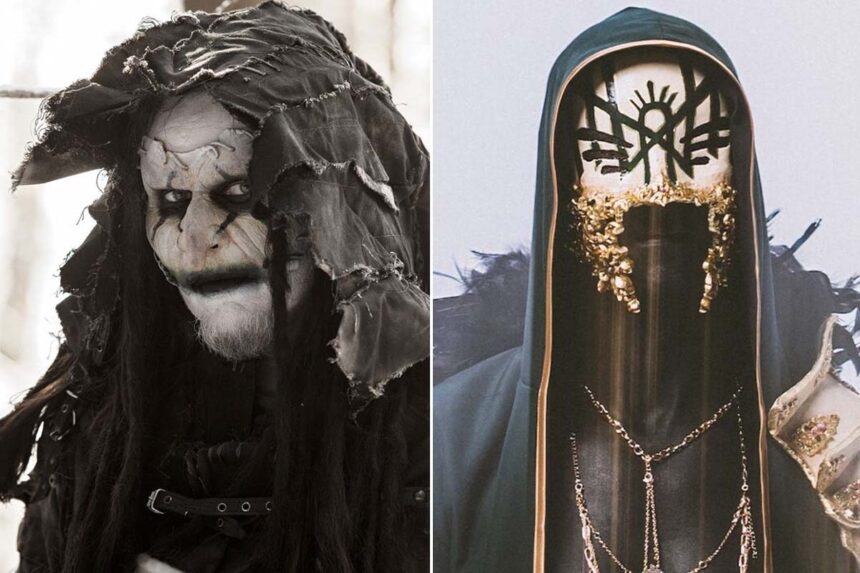
Mortiis frontman Håvard Ellefsen, also known as the dungeon synth maestro and ex-Emperor bassist, recently shared his thoughts on the growing trend of masked bands in rock and metal. The interview was published by Louder Sound.

When asked about the influx of popular masked acts like Ghost and Sleep Token quickly reaching the mainstream of heavy metal, Ellefsen offered a candid and measured perspective on the phenomenon.
“I don’t pay a lot of attention to it,” he said. “I think Tobias [Forge] has done some really cool stuff with Ghost. I like some of his music and I’ve only met him once. He was quiet, seemed very nice.”
On Sleep Token specifically, Ellefsen noted his limited familiarity with the band while pointing to a broader saturation of the masked aesthetic.
“Sleep Token, I’m only aware of them because people talk about them, so I don’t have a whole lot of opinions on them,” he continued. “I’ve seen a couple of photos of them, and it looks alright, but a lot of people look that way, though, right? I feel like I’m seeing a shitload fly by in my algorithm: masked band, masked band, masked band! The weird thing is, I feel like I’m the only guy who wears a mask and still a face.”
Ellefsen went on to explain how his own approach to the mask has always differed from the anonymity-driven tradition associated with acts like KISS.
“The Mortiis mask is still a face. It’s so natural for me to do interviews as this. I don’t feel the need to hide my face,” he said. “I did try that in the 90s for a little while: it was sort of half-hearted, to do that KISS thing, where you’re not supposed to be seen without your makeup. I copied off the originators for a short while, and I was like, ‘This is boring! This is f*cking exhausting!’ Trying not to be seen and, when people ask you, you pretend you’re not Mortiis? F*ck this! Maybe I’m lazy.”
He concluded by reflecting on the authenticity behind his long-standing persona.
“Excluding those 15 minutes in the 90s where I tried to hide it, I’ve just always been myself,” he said. “It’s the most natural thing for me to do, and this is just the most natural way for me to interact with people. When it’s time to become Mortiis, I become Mortiis.”
The comments position Ellefsen as one of the original proponents of the masked identity in heavy music. They offer a unique insider perspective on a trend that continues to grow in the genre.
Ellefsen’s remarks come at a time when Mortiis remains very much an active force in the heavy music world. As Time for Metal reported, Mortiis is set to co-headline the North American “The Witches of Dystopia Tour MMXXVI” alongside black metal outfit Uada in 2026. The announcement underscores that the project continues to command a dedicated following decades after its inception.
Ellefsen’s career stretches back to the early 1990s, when he served as the original bassist for Norwegian black metal pioneers Emperor before departing to pursue Mortiis as a solo project. The Mortiis persona is characterized by its elaborate prosthetic goblin mask and dark, atmospheric soundscapes. It became one of the most distinctive and recognizable images in the underground metal and dungeon synth scenes, predating the current wave of masked acts by well over two decades.
The dungeon synth genre that Ellefsen helped pioneer with early Mortiis releases has itself seen a significant resurgence in recent years. A new generation of artists has been drawing directly from the atmospheric, lo-fi aesthetic he helped establish in the mid-1990s. This context makes his observations about the modern masked band trend particularly pointed — he is not speaking as an outsider looking in, but as someone who helped lay the groundwork for the visual and sonic language that many newer acts now draw upon.
Ghost and Sleep Token, the two bands Ellefsen specifically referenced, represent perhaps the most commercially successful examples of the masked band phenomenon in contemporary rock and metal. Ghost, fronted by Tobias Forge, has built a multi-platinum career on theatrical, occult-tinged hard rock. Sleep Token’s anonymous, mask-wearing lineup has rapidly ascended from cult status to arena-level popularity in recent years, driven in large part by viral social media exposure — the very “algorithm” Ellefsen described being flooded with.
What sets Ellefsen’s perspective apart from the broader conversation is his insistence that the Mortiis mask was never about concealment. While many modern masked acts lean into the mystique of anonymity as a core part of their branding, Ellefsen has consistently presented his mask as an extension of his identity rather than a barrier to it. This is a distinction he has maintained throughout his career and one that continues to define how Mortiis engages with the public today.