


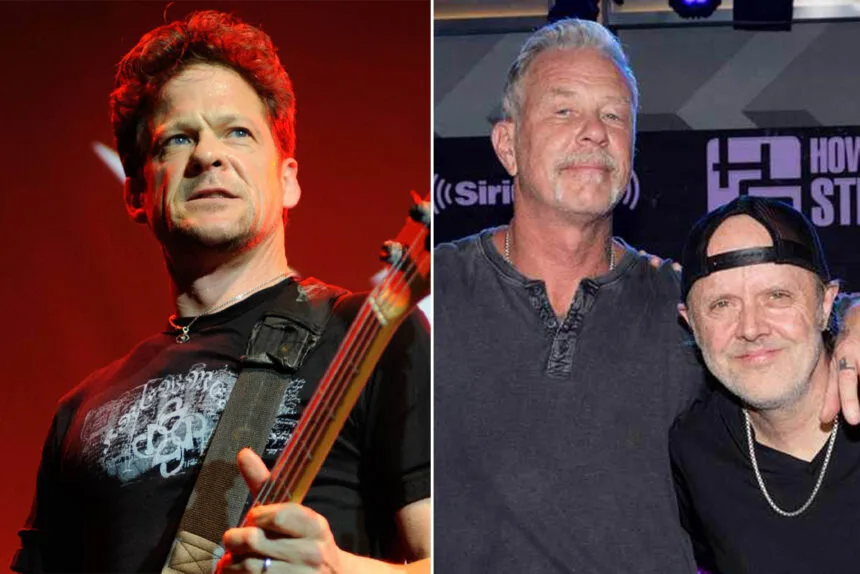
Former Metallica bassist Jason Newsted recently opened up about his relationship with his former bandmates and the lasting impact of Cliff Burton’s death on the band.

When asked about his positive relationship with Metallica and his recognition of the pain they were in from the very beginning, Newsted offered a candid reflection on how the band was never given the space to grieve — and how that shaped everything that followed.
“They never got to process. Everybody was 23 years old. Male consequence ain’t even formed yet. Absolutely gutted, but then not being able to comprehend. To drink it away, do whatever you have to do to chase it away,” Newsted said. “They didn’t let themselves grieve, but other people didn’t let them grieve either. We got this ball rolling, this motherf*cker’s going downhill in the snow, and we can’t stop. We got to keep the momentum. They want to have this dream come true and this monster you want to create, then you got to jump right back on the horse.”
Newsted went on to describe how the mental well-being of the individuals behind the band was never truly considered amid the pressure of expectations — both internal and external.
“There was never any thought about the mental stability of the persons involved — not the personas. What they actually were, this brotherhood, us against the world thing, also being a spearhead or leaders and everybody expecting them to do so much,” he continued. “It has a lot to do with the expectations of others, expectations of themselves for themselves, what they had planned for it, and they had to blindly blow through it and almost pretend it didn’t happen in certain ways.”
Reflecting on the weight of what the band witnessed firsthand, Newsted emphasized that forgetting was never truly an option — but that healing, decades later, has finally become possible.
“There was no way they could ever forget it. It happened right in front of them. They were in it. They were amongst it. They just happened to walk away,” he said. “The chemistry that we had, being able to finally process 25 f*cking years later, that’s what’s real. They are finally able to go, ‘Yeah, it’s our boy,’ and I go, ‘That’s my boys.’ We did our thing, and it’s pretty f*cking awesome.”
Newsted’s comments shed light on the emotional toll Cliff Burton’s sudden passing took on James Hetfield, Lars Ulrich, and the band as a whole — a wound that, by his account, took a quarter century to begin to heal.
To understand the depth of that wound, it helps to revisit the night everything changed — and the brutal speed at which the band was pushed forward in its wake.
Cliff Burton died on September 27, 1986, near Dörarp, Sweden. The band’s tour bus skidded on a patch of ice and overturned while the members were sleeping. Burton had won the window bunk by drawing the Ace of Spades. He was thrown through the side window and crushed when the bus landed on top of him. The death was immediate. James Hetfield and Kirk Hammett were among those who witnessed the aftermath firsthand. Hammett later recalled Hetfield screaming Burton’s name in a hysterical, grief-stricken state before collapsing into tears — a moment that captures just how devastating the loss was in real time.
Despite that trauma, the band returned to the stage just 43 days after the crash. On November 9, 1986, Metallica performed a secret slot for Metal Church in Reseda, California, with newly hired bassist Jason Newsted making his live debut. Within two months of the accident, the band was already on tour in Japan. There was no extended period of mourning, no pause to process what had happened — only the relentless forward motion that Newsted would later describe so vividly.
The rationale offered at the time was that returning to work was what Cliff would have wanted. Lars Ulrich made that case explicitly in the immediate aftermath. He framed the band’s decision to push forward as a form of tribute rather than avoidance. It was a justification that allowed the machinery to keep moving — but one that came at a significant psychological cost to everyone involved.
James Hetfield has since spoken about the permanence of that loss in quieter terms. “I still miss Cliff, no doubt. I’d love to see him again,” he has said, adding that old photographs remain one of the few ways to feel reconnected to his former bandmate. Those words, measured and restrained, reflect a grief that was never fully expressed in the years that mattered most — years when the band was too busy surviving to stop and feel what had happened.
What Newsted’s interview ultimately reveals is not just a story about one band’s loss, but about the broader culture of the music industry in that era — one that treated momentum as sacred and mental health as an afterthought. For Metallica, the cost of keeping that machine rolling was a grief deferred for 25 years. It finally surfaced in the kind of honest, unguarded conversations that Newsted is only now able to have with the men he once stood beside on stage.
Source: Spin Magazine