





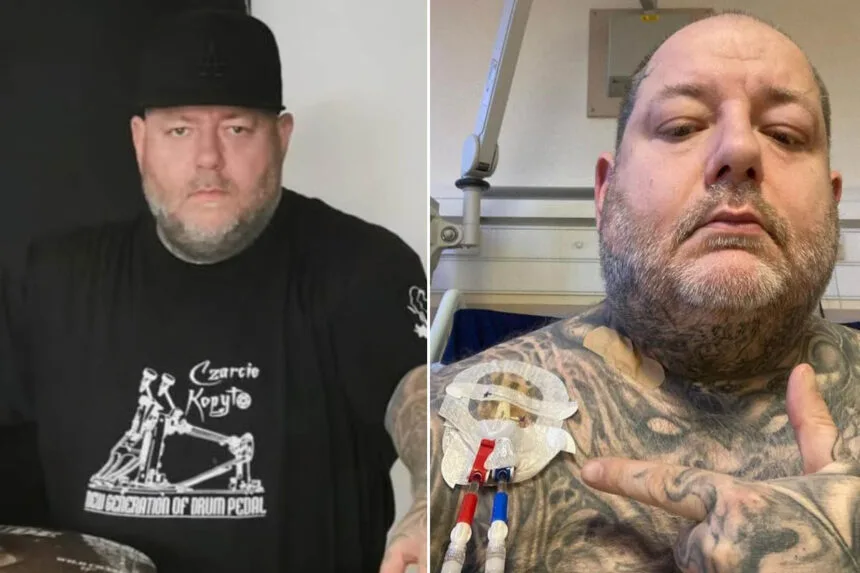
Former Cradle of Filth drummer Nick Barker has opened up about a serious and life-threatening health ordeal. He shared details of his condition in an appearance on The False Face podcast. This comes three years after Barker first announced he was battling kidney failure.

Barker described in detail the condition he developed, the extreme pain he endured, and the very real possibility of amputation he faced during his recovery.
“The health is improving day by day. I’m in a really positive head space ’cause I developed a life-threatening condition called calciphylaxis,” Barker said. “Let me tell you a little bit about it. It’s got a 50/50 chance of survival rate. That’s how serious it is.”
He went on to explain how the condition was triggered by medication he had been prescribed.
“Basically, I was prescribed a drug called warfarin, which is a blood thinner. And it made the blood vessels in my calves calcify. So I had these big fucking bruised lesions. It looks like a shark has just come and taken chunks out of my calf muscles. I’ve got some really bad scarring. And it was because of this drug,” he said. “And so we caught it in time because what it started off as, it started off like a pea-sized blood blister with a little bit of bruising around it. I didn’t think anything of it at the time. It was a bit painful. And I thought, ‘Oh, I probably f*cking done it in my sleep or caught something while I wasn’t paying attention.’ Bro, it was a 50/50 survival rate. And at the height of it, these lesions were so bad on my legs, my wife’s grandmother described it best. She said, ‘It just looked like raw meat.'”
Barker described the level of pain he experienced as unbearable, requiring multiple strong medications that still offered little relief.
“But you imagine all of your nerve endings — bro, it was f*cking excruciating. The pain was unbearable. I couldn’t even sleep. They had me on morphine, on methadone and then this other drug nabilone, which is a derivative of THC. Basically, I was off my fucking tits, but it didn’t do anything to kill the pain. All it did was took the edge off a little bit. But bro, it felt like my legs were in a fire constantly,” he continued. “We stopped that medication immediately. And then to try and flush it out of my system, the docs put me on dialysis five times a week. And I was given all these intravenous drugs while I was dialyzing to help try and push it out. And all my wounds got infected. I almost got sepsis. [This was], like, last month.”
He also spoke about the emotional toll the ordeal took on his wife, and how close he came to losing his life.
“But yeah, it was f*cking life-threatening. And even my wife, she was in tears. When we looked at the wounds and the doctor said, ‘Oh, you’re healing. This is good,’ my wife burst into tears. She said, ‘I honestly thought I was gonna lose you’ because it’s only a 50% survival rate,” Barker said. “Because the wounds are that intense and deep, and they’re prone to infection. And anyway, so they got infected. I got f*cking cellulitis. And bro, my lower legs, from the knee down, they were so fucking — you couldn’t even touch them.”
“Even trying to put socks on, it was, like, ‘Ah!’ It was just crazy, the pain. Because it, that’s what a lot of people die from, is the infection. They get sepsis. It’s kind of like meningitis. Once it kicks in, if you don’t catch it early enough, you’re done. But anyway. I’m here. And I’m on the mend,” he added. “And it was a 24/7 ordeal. I couldn’t even sleep. I really couldn’t, mate. The pain was that bad. And then we’re in bed, and if I did get to sleep, if my wife just happened to touch my leg, in your sleep how you do, I’d wake up [in pain], ‘What’s wrong? What’s wrong?’ ‘My f*cking legs. Ah.’ Yeah. And at one point I thought they were gonna amputate…”
Barker also addressed the prospect of amputation directly, making clear how he felt about that possibility as a drummer.
“See, I’ve got a thing with my wife. I said, ‘Look, if anything ever happens and they say they’ve got to amputate, I don’t wanna be here. I’d rather die with my legs than f*cking live without them,'” he said. “Because I’m a drummer. What am I gonna do? Fucking walk around in one of those mobility fucking things with no legs. It’s, like, nah. No. I ain’t going out like that, mate. No, I ain’t going out like that. I’d rather fucking jump off a cliff.”
Barker confirmed he is currently recovering and in a positive mindset, with his health improving day by day.
Barker’s health struggles carry particular weight given the stature he built over more than a decade at the heart of one of extreme metal’s most iconic bands. He joined Cradle of Filth in 1994 and remained with the group until 2006. During that time, he recorded eight albums and played a central role in shaping the band’s sound and identity. His departure marked the end of an era for the group, and he has remained a respected figure in the extreme metal world ever since.
The condition that nearly claimed his life is closely tied to his pre-existing kidney problems. Calciphylaxis is most commonly found in patients with end-stage renal disease who have developed secondary hyperparathyroidism. This complication fits directly with Barker’s history of kidney failure. The disease causes calcium to deposit within blood vessels, triggering endothelial dysfunction, thrombosis, and tissue ischemia, which explains the severity and depth of the wounds he described.
The link between his kidney failure and this latest crisis underscores how interconnected his health challenges have been. His weekly treatment schedule has already made touring impossible, placing his career on hold.
Calciphylaxis remains one of the most difficult conditions to treat. Sodium thiosulfate is considered a viable first-line treatment. It is often introduced early in the course of the disease to support wound healing. Barker’s treatment has centered on intensive dialysis and intravenous medications, reflecting the aggressive approach required when the condition reaches an advanced stage.
Despite the severity of what he has been through, Barker’s outlook remains forward-facing. His willingness to speak openly about the experience — including the emotional strain on his family and the very real prospect of losing his legs — reflects both the gravity of the ordeal and his determination to come out the other side of it intact.


