





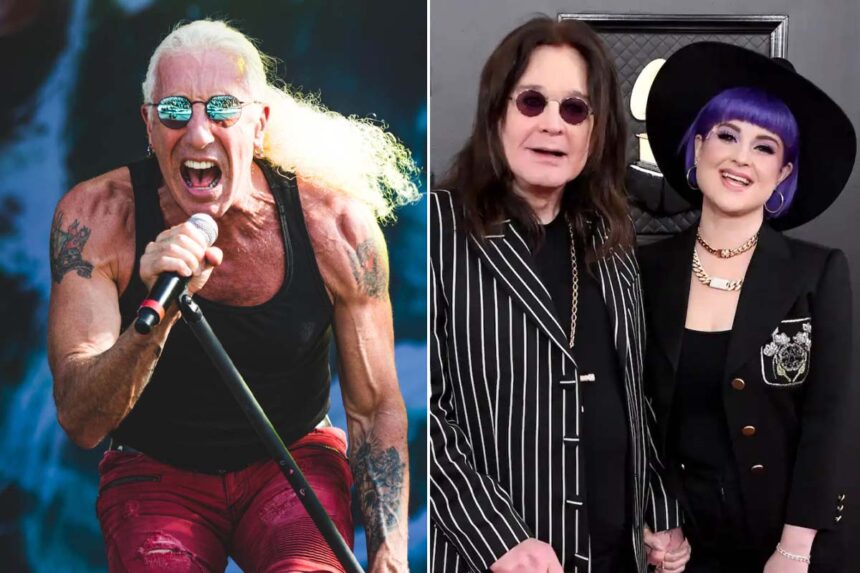
A public dispute has broken out between Twisted Sister frontman Dee Snider and Kelly Osbourne after Snider questioned the extent of Ozzy Osbourne’s songwriting contributions. The exchange began on social media and quickly escalated into a back-and-forth between the two.

Snider first commented on the topic by pointing to bass players who he says wrote lyrics credited to Ozzy Osbourne and Black Sabbath. He also referenced Sharon Osbourne’s role in shaping the narrative around the band’s history.
“I know too much about the truth behind the scenes,” Dee Snider said. “Let’s just say that Sharon [Osbourne] doesn’t like to share.”
Snider went further, naming specific songwriters he claims contributed lyrics without full credit.
“(Bob Daisley wrote) a load of lyrics? How about ALL the lyrics?” Snider said. “Ozzy always had bass players write his lyrics. Geezer Butler wrote ALL of BLACK SABBATH lyrics. Daisley wrote lyrics for the first two solo albums (I’m pretty sure he was paid to write on other records but not credited) and Lemmy wrote lyrics.”
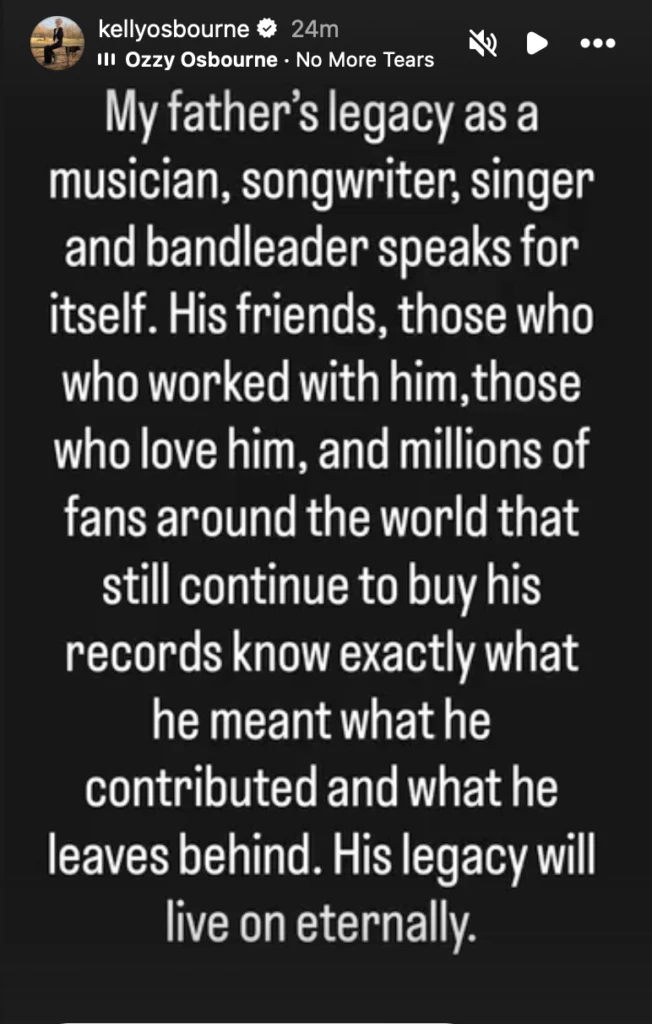
Kelly Osbourne responded on her Instagram story, defending her father’s legacy and career achievements.
“My father’s legacy as a musician, songwriter, singer and bandleader speaks for itself,” Kelly Osbourne wrote. “His friends, those who worked with him, those who loved him and millions of fans around the world that still continue to buy his records know exactly what he meant, what he contributed and what he leaves behind. His legacy will live on eternally.”
She also took aim directly at Snider’s own career timeline.
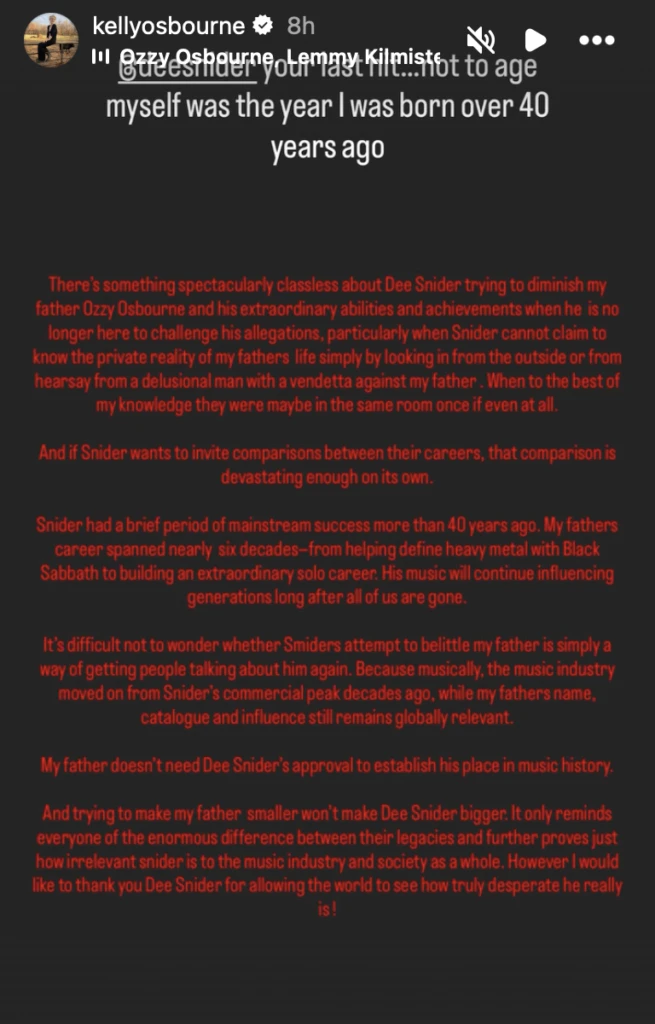
“Dee Snider your last hit … not to age myself was the year I was born over 40 years ago,” she wrote.
Kelly Osbourne continued by criticizing the timing and basis of Snider’s comments, noting that her father is no longer able to respond.
“There’s something spectacularly classless about Dee Snider trying to diminish my father Ozzy Osbourne and his extraordinary abilities and achievements when he’s no longer here to challenge his allegations, particularly when Snider cannot claim to know the private reality of my father’s life simply by looking in from the outside or from hearsay from a delusional man with a vendetta against my father, when to the best of my knowledge they were maybe in the same room once if even at all,” she wrote.
She then drew a direct comparison between the two musicians’ careers.
“And if Snider wants to invite comparisons between their careers, that comparison is devastating enough on its own,” she wrote. “Snider had a brief period of mainstream success 40 years ago. My father’s career spanned nearly six decades – from helping define heavy metal with Black Sabbath to building an extraordinary solo career. His music will continue to influence generations long after all of us are gone.”
Kelly Osbourne suggested Snider’s remarks may have been motivated by a desire for attention.
“It’s difficult not to wonder whether Snider’s attempt to belittle my father is simply a way of getting people talking about him again,” she wrote. “Because musically, the music industry moved on from Snider’s commercial peak decades ago, while my father’s name, catalogue and influence still remains globally relevant.”
She closed her statement with a pointed remark aimed at Snider.
“My father doesn’t need Dee Snider’s approval to establish his place in music history,” she wrote. “And trying to make my father smaller won’t make Dee Snider bigger. It only reminds everyone of the enormous difference between their legacies and further proves just how irrelevant Snider is to the music industry and society as a whole. However, I would like to thank Dee Snider for allowing the world to see how truly desperate he really is!”
Snider later addressed the controversy in a statement posted on his X account, clarifying his stance toward Ozzy Osbourne.
“To be clear, I HAVE NOTHING BUT LOVE FOR OZZY,” Snider said. “He was always lovely to me. Black Sabbath changed my life! As a songwriter I can be a little touchy about credit and royalties.”
The dispute did not emerge in isolation. It taps into a songwriting credit debate that has followed Ozzy Osbourne and Black Sabbath for decades. The details behind those claims help explain why the exchange struck such a nerve.
Bob Daisley has long maintained that he wrote most of the lyrics on Ozzy Osbourne’s earliest solo albums, a claim that predates this current feud by years. Snider’s comments essentially revived that long-standing dispute rather than introducing a new one. His remarks framed Daisley’s contributions as more extensive than what fans typically credit to Osbourne himself.
Geezer Butler, meanwhile, has widely been regarded within the industry and among fans as Black Sabbath’s primary lyricist throughout the band’s run. That reputation predates Snider’s remarks. It lines up with what Snider said about Butler writing all of the band’s lyrics, making that particular claim less controversial than the assertions about Osbourne’s solo work.
Snider later clarified that his belief centers specifically on Daisley writing all of the lyrics on Osbourne’s first two solo records. This sharpened the scope of his original comments after the backlash from Kelly Osbourne. That clarification did little to cool the exchange. It did narrow the specific claim at the center of the controversy to those early solo albums rather than Osbourne’s entire catalogue.
The feud has since spread across social media platforms. Fans and fellow musicians have weighed in on both sides of the songwriting credit debate, and on where the line falls between collaborative songwriting and full authorship in rock history.