

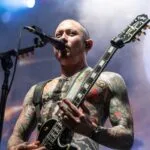




Dave Mustaine recently shared an unusual story about how Megadeth found their second lead guitarist, Jeff Young, after a bizarre guitar solo request, in an interview with Guitar World.

The Megadeth frontman explained the strange circumstances that led to Jeff Young joining the band during the recording of their third album.
“I saw something in Jeff [Young] when we hired him. It was a strange occurrence. We had tried to find a guitar player, and I went with David Ellefson to the country club in Reseda, where we watched this band called Malice,” Mustaine said. “Malice had this big, tall, good-looking guitar player [Jay Reynolds] who had a Gibson Flying V and was heavily influenced, to me, by Michael Schenker.”
The story took an unexpected turn when it came time to record guitar solos for the album.
“I said I wanted him to be in Megadeth. He was excited about joining the band. Then we were in the studio recording [third album] So Far, So Good… So What? and I was like, ‘Okay, it’s time to do your solos, man,'” Mustaine continued. “He goes, ‘Okay, I’m gonna call up my guitar teacher, have him do [the] solos and then have him teach me.’ I thought, ‘Get out – you’re pulling my leg.’ But no, that was true. That’s what he wanted to do.”
Despite the unusual request, Mustaine decided to go along with the plan. This ultimately led to Jeff Young’s involvement with the band.
“I went along with it and Jeff [Young, his teacher] showed up, and as I said, Jeff was a really superb guitar player. He really had his own unique style, as Chris did, and we started working on the record,” he said.
This bizarre recruitment story reflects the turbulent period Megadeth experienced during the late 1980s. The band struggled with lineup instability that would continue to plague them for years.
Young’s time with Megadeth proved to be remarkably brief, lasting only through the recording and touring cycle of “So Far, So Good… So What!” 80s Metal Man reported that Mustaine later fired Young and drummer Chuck Behler before recording “Rust in Peace.” This forced the band to pull out of the European Monsters of Rock tour due to lineup changes.
The departure of Young ultimately paved the way for one of Megadeth’s most celebrated periods. Riffology noted that Marty Friedman joined the band as lead guitarist, bringing his precise and technical solo work that would define the sound of “Rust in Peace.” The album is widely regarded as one of thrash metal’s greatest albums.
The recording of “Rust in Peace” took place at Rumbo Studios in Canoga Park, California. The studio was owned by the pop duo Captain and Tennille. Louder Sound revealed that this unlikely setting became the birthplace of some of thrash metal’s most influential compositions. Dave Mustaine wrote the majority of the material while David Ellefson contributed to tracks like “Hangar 18” and “Lucretia.”
The contrast between Young’s unconventional approach to guitar solos and Friedman’s technical mastery highlights how crucial the right personnel decisions were for Megadeth’s artistic evolution. While Young’s teacher-assisted recording method may have seemed unprofessional, it inadvertently led the band to discover one of metal’s most respected guitarists in Friedman. His contributions would help cement Megadeth’s legacy in the thrash metal pantheon.