

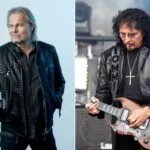



The Kinks’ Dave Davies addressed longstanding claims that Jimmy Page played the electric guitar solos on early Kinks recordings. He spoke candidly about the controversy in an interview published on Guitar Player.

Davies pushed back on Page’s account of his involvement with the band, attributing the claims to ego and a tendency toward myth-making.
“You see, Jimmy Page was a friend of [producer] Shel Talmy’s, and was a session player who used to hang around and hope that he could get in on sessions. And we locked him out,” Davies said. “But he learned a lot, you know, like the many other people who wouldn’t admit borrowing from the Kinks. And I suppose when he became successful himself, all credit due to him, his ego was so inflated he probably thought he invented the bloody instrument anyway, being carried along on that crystal and glamour.”
Davies went on to reflect on the broader nature of fame and ego, drawing a sharp conclusion about what he saw as Page’s trajectory.
“It’s all an illusion, building your ego up, and eventually something’s going to pop it like a balloon and you’re back flat down on your ass again,” he continued. “Which is what happened, didn’t it?”
He also made clear that he felt personally wronged by Page’s statements, closing with a pointed remark about the guitar work in question.
“And I suppose it was a bit unfortunate of him; I thought he did me a great injustice by saying that,” Davies said. “Besides, I can’t see anybody crazy enough to play a solo like the one on ‘You Really Got Me’ anyway.”
The comments add a new chapter to a long-running dispute over the origins of one of rock’s most iconic guitar moments.
To understand why Davies takes the claim so personally, it helps to look at what he actually created on that record — and how he created it.
As Thalia Capos reported, Davies achieved the now-legendary distorted guitar tone on “You Really Got Me” not through pedals or studio trickery, but by physically damaging the speaker cone of his amplifier. Born out of frustration and experimentation, the technique produced a raw, aggressive sound that had rarely been heard on a rock record before. That sonic breakthrough became the backbone of the song and, by extension, a defining moment in the history of electric guitar.
Guitar World documented Davies demonstrating the method firsthand, showing how slashing an amp speaker can replicate the band’s landmark distortion without any effects units. The approach was unconventional and entirely his own. That makes the suggestion that someone else played those parts all the more galling to him.
The Page dispute is also rooted in a broader truth about the London music scene of the early 1960s. Page was already an active session musician in the city well before Led Zeppelin, which is why his name kept resurfacing in stories about early Kinks recordings. As noted on the Les Paul Forum, Page’s connection to producer Shel Talmy placed him in proximity to the sessions, lending a degree of plausibility to the claims even if Davies firmly denies them.
Davies’ position has always been that Page’s later fame as the architect of Led Zeppelin’s sound may have encouraged a revisionist myth. In that myth, Page’s presence near the sessions was quietly upgraded into active participation. For Davies, the record speaks for itself. The distorted, slashing guitar on “You Really Got Me” was the product of his own hands, his own amp, and his own willingness to break things in pursuit of a sound nobody else had found yet.
“I can’t see anybody crazy enough to play a solo like the one on ‘You Really Got Me’ anyway,” Davies said — a line that reads less like a boast and more like a statement of fact from someone who knows exactly what it took to make it.


